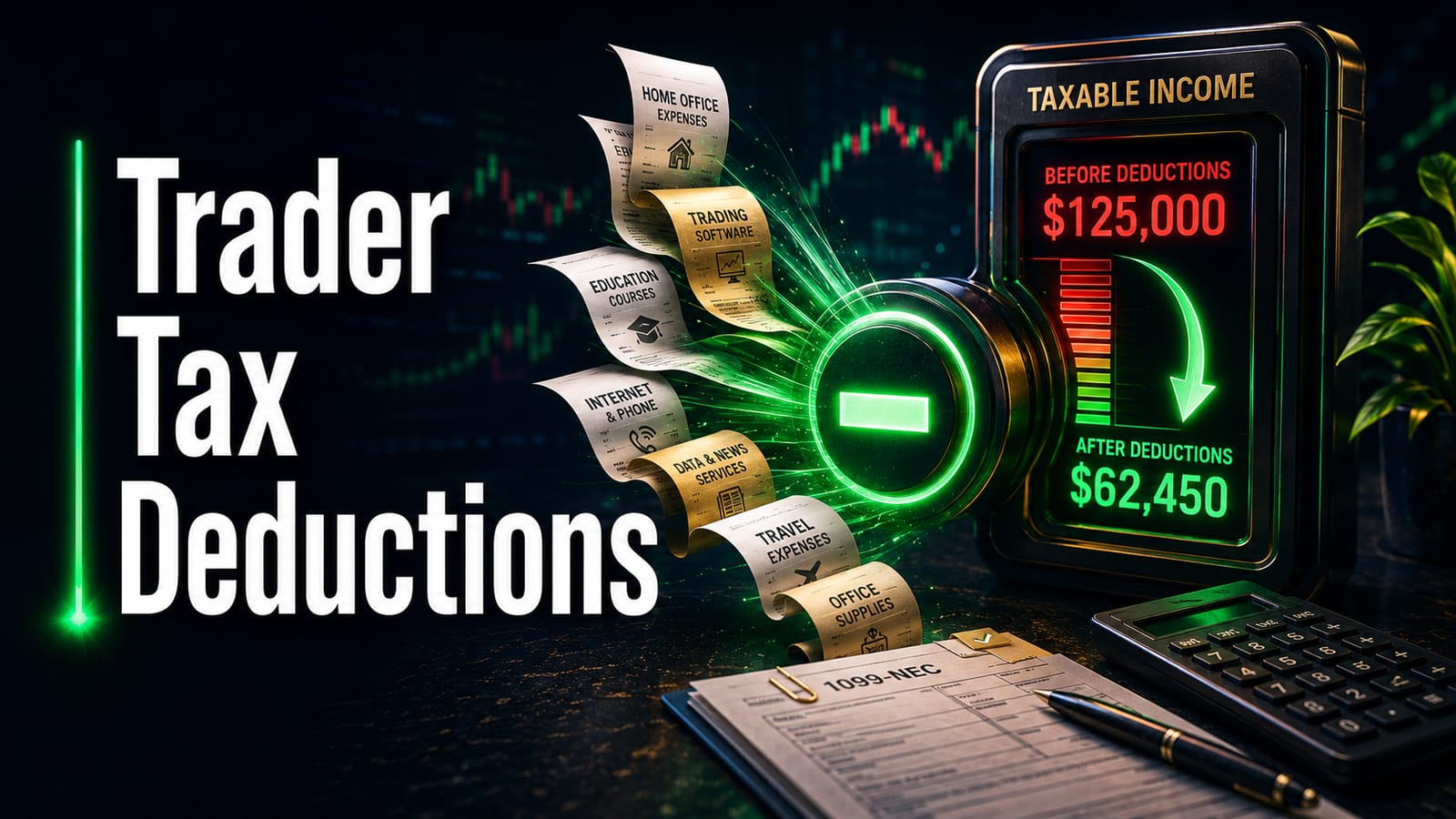
- Many active traders miss deductions they're entitled to — eval fees, data, education, equipment, home office. What those are worth varies with income, entity structure, and state.
- Trader Tax Status (TTS) typically unlocks Schedule C business deductions — software, data, education, home office, equipment depreciation, and a portion of internet/phone.
- Equipment (monitors, computers, peripherals) typically qualifies for Section 179 expensing or bonus depreciation, allowing immediate full deduction in many cases.
- Home office typically requires exclusive and regular use for trading. The simplified method ($5/sq ft up to 300 sq ft) is the easier path; the actual-expense method can be larger but requires documentation.
- Every situation varies — qualification, recordkeeping standards, and Section 179 limits depend on the trader's full picture. A CPA who specializes in trader taxation confirms what applies.
Most traders dramatically underestimate what they can deduct. A general CPA will tell you to deduct software and call it done. A CPA who specializes in trader taxation will find deductions that easily add up to $10,000–$30,000 or more per year — deductions hiding in plain sight.
This guide covers every legitimate deduction available to active traders who qualify for Trader Tax Status (TTS).
Everything below rests on one IRS test: a business expense is deductible when it is both ordinary and necessary. The agency defines those two words, and the substantiation it expects behind them, on its Deducting Business Expenses page. Whether a given item clears that bar depends on how a particular trader actually operates, so the borderline ones are typically worth reviewing with a CPA.
Most of these deductions require Trader Tax Status (TTS). Without TTS, you're limited to investment-related deductions which are far more restricted. See our guide on qualifying for TTS before claiming these deductions.
Technology & Software Deductions
| Expense | Examples | Deductible |
|---|---|---|
| Charting Software | TradingView, Sierra Chart, ThinkOrSwim | 100% |
| Execution Platform | NinjaTrader, TradeStation, Bookmap | 100% |
| Market Data | CME data, Bloomberg Terminal, Reuters | 100% |
| News & Research | Benzinga Pro, Fly on the Wall, Seeking Alpha | 100% |
| Trading Journal Software | TraderSync, Tradervue, Edgewonk | 100% |
| Screening Tools | Trade Ideas, Finviz Elite | 100% |
| Options Analysis | OptionStrat, Market Chameleon | 100% |
Equipment & Hardware Deductions
Trading equipment qualifies for either Section 179 expensing (full deduction in year of purchase) or standard depreciation. Section 179 is almost always better — you deduct the full cost immediately.
| Equipment | Deductible | Method |
|---|---|---|
| Monitors (all of them) | 100% business use | Section 179 |
| Computer / Laptop | Business use % | Section 179 or depreciation |
| Keyboard, Mouse, Headset | 100% | Section 179 |
| Trading Desk / Chair | Business use % | Section 179 |
| UPS / Power Backup | 100% | Section 179 |
| Webcam / Ring Light (for trading calls) | 100% if business use | Section 179 |
Home Office Deduction
If you have a dedicated space in your home used regularly and exclusively for trading, you can deduct a portion of your housing costs.
Two methods:
- Simplified method: $5 per square foot, up to 300 square feet = max $1,500/year. Easy, but limited.
- Regular method: Calculate the percentage of your home used for trading (e.g., 200 sq ft office / 2,000 sq ft home = 10%). Deduct 10% of rent/mortgage interest, utilities, insurance, repairs, and depreciation. Often much larger than the simplified method.
The space must be used REGULARLY and EXCLUSIVELY for trading. A desk in your bedroom doesn't qualify. A dedicated room you only use for trading does. Document this with photos if you're ever audited.
Education & Learning Deductions
- Trading courses and programs — generally deductible if related to your current trading business
- Books, audiobooks, and publications on trading, markets, and finance
- Trading mentorship and coaching fees
- Trading conference and seminar attendance fees
- Podcast and YouTube premium subscriptions for trading content
This limit is stricter than most people expect, and it has a specific source. Treas. Reg. §1.162-5 allows an education deduction only where the education maintains or improves skills required in an existing trade or business — and it expressly denies the deduction where the education qualifies you for a new trade or business, even if it also improves your skills. The "new trade or business" disqualifier wins. So a course taken to learn to trade before trading was your business generally is not deductible, and no amount of trading-related content changes that — the same structural question as prop firm evaluation fees, arriving from a different direction.
Internet & Communication Deductions
- Internet service — deduct the business-use percentage (most full-time traders can justify 80–90%+)
- Dedicated business phone line or second line
- VPN service for secure trading connections
- Fiber or dedicated high-speed upgrade necessitated by trading
Prop Firm Fee Deductions
If you trade funded accounts, the fees you pay the firm are generally deductible once your trading business is underway:
- Evaluation and challenge fees — even if you fail the evaluation
- Monthly subscription / platform fees charged by the firm
- Reset fees
- Any administrative fees charged by the firm
A trader who spent $4,000 on Apex evaluations over the year and received $6,000 in payouts has net income of only $2,000 — not $6,000. The deductions are legitimate whether or not you were profitable.
The one case that differs is a trader who has never been funded and has no payout history. §162 deducts the expenses of carrying on a business; before that, the same fees can be start-up expenditures under §195 instead — $5,000 in the year the business becomes active and the rest over 180 months — or not deductible at all if the activity is not engaged in for profit under §183. The four fee types, broken out →
For the long-form version of this list organised by category, see 50 active trader tax deductions for 2026.
Professional Fees & Business Expenses
- CPA and tax preparation fees — your TraderTax fees are themselves deductible
- Attorney fees related to your trading business
- Business bank account and brokerage fees
- LLC or corporate formation and maintenance fees
- State filing fees for your business entity
- Business cards, website, and marketing if you have a trading business presence
Retirement Account Contributions
This is the most powerful deduction most traders overlook. As a self-employed person with trading income, you can contribute to:
- SEP-IRA: Up to 25% of net self-employment income, max $69,000 for 2026
- Solo 401(k): Up to $23,000 in employee contributions + 25% employer match, max $69,000 total
- Traditional IRA: Up to $7,000 ($8,000 if 50+), deductibility depends on income
A trader earning $120,000 net who maximizes a Solo 401(k) could reduce taxable income by $45,000+. That's potentially $12,000–$18,000 in actual tax savings — every single year.
Health Insurance Deduction
Self-employed traders who pay for their own health insurance can deduct 100% of premiums — for themselves, their spouse, and dependents — as an adjustment to income (above-the-line deduction). This reduces your adjusted gross income dollar-for-dollar.
Travel and Meals
- Travel to trading conferences or seminars — flights, hotel, transportation
- 50% of meals during business travel
- Travel to meet with a licensed tax professional or attorney about your trading business
A full-time trader who properly claims all available deductions could easily reduce taxable income by $20,000–$50,000+ per year compared to an investor filing without TTS. At a 30% effective tax rate, that's $6,000–$15,000 in real money back in your account — annually.
Frequently Asked Questions
What can active traders deduct on their taxes?
Active traders with Trader Tax Status can deduct trading platform subscriptions, market data feeds, education and courses, home office, all trading equipment, internet costs, prop firm fees, professional fees, health insurance premiums, and retirement contributions.
Can traders deduct a home office?
Yes. Traders with a dedicated trading space used exclusively for trading can deduct home office expenses including a proportional share of rent or mortgage interest, utilities, and internet.
How much can traders contribute to a Solo 401k?
Self-employed traders can contribute up to $69,000 to a Solo 401k in 2025, including both employee and employer contributions, significantly reducing taxable income.
Not Sure Where You Stand on Taxes?
Answer 8 quick questions. Get a personalized AI summary of your tax exposure, missed deductions, and what you should do next — reviewed by a real CPA.
Get My Free Tax Snapshot →Dig deeper into the adjacent topics most relevant for active traders: