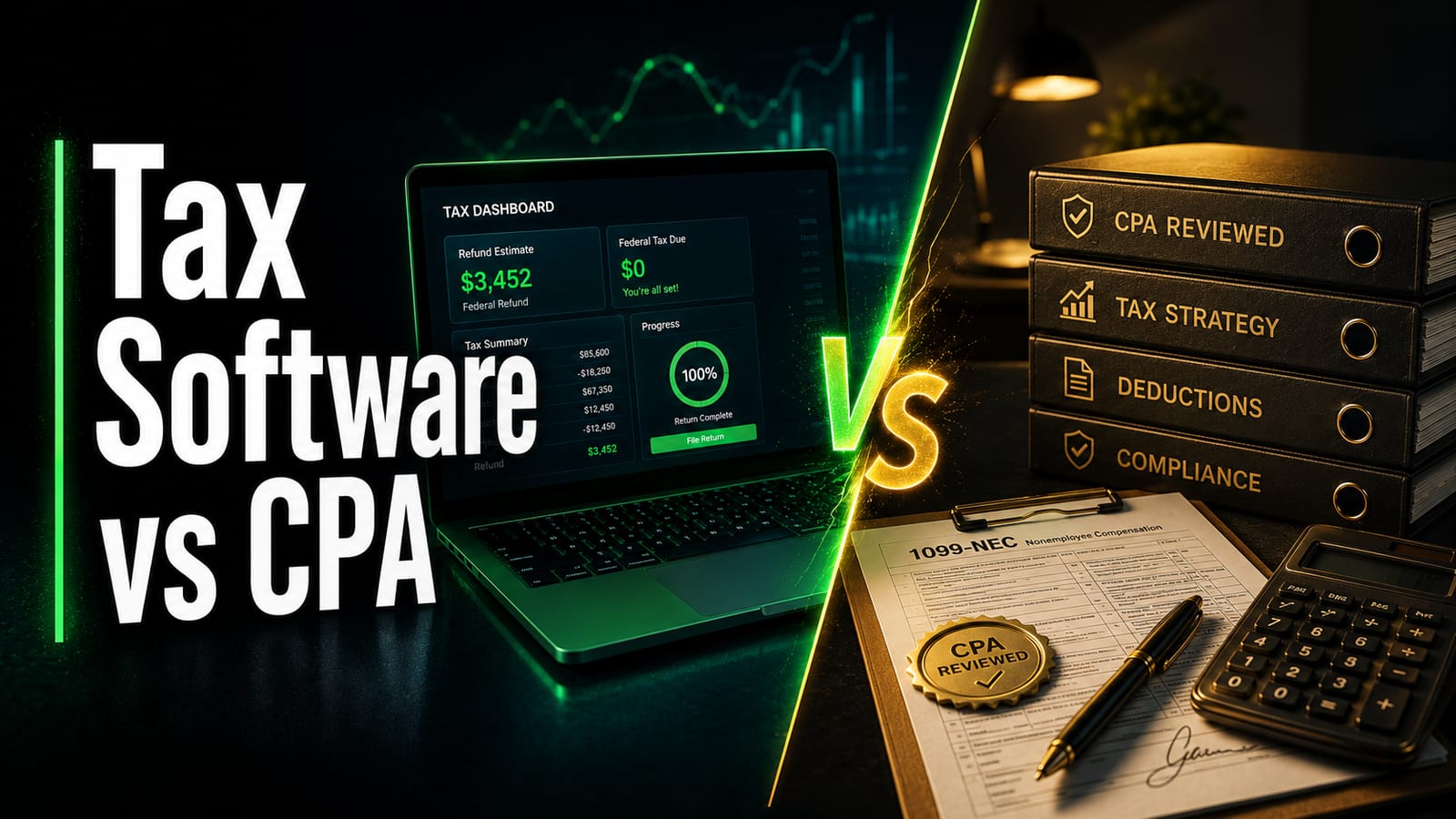
Every year plenty of active traders file with TurboTax, H&R Block, or a crypto tax tool and get a correct return out of it. Plenty of others have a return where the software was never going to make the judgment calls for them. Here's an honest comparison of when software is typically sufficient and when a trader-specialist preparer is worth the fee.
If you have already decided you want a professional and are comparing firms rather than categories, the companion page to this one is how to choose among the trader tax services — it covers the named preparers, what each publishes about its pricing, and why TraderTax is not the cheapest of them.
Tax Software Options for Traders
| Product | What it is | What to know for trader situations | Cost |
|---|---|---|---|
| TurboTax | DIY filing software | Supports Form 6781 for §1256 contracts. A trader-tax-status interview, a §475 election workflow and cross-broker wash-sale aggregation are not publicly documented — we could not confirm either way | Varies by tier |
| TaxAct | DIY filing software | Its own support page states §1256 transactions cannot be imported and must be entered by hand. It does compute the 60/40 split correctly onto Schedule D | Varies by tier |
| H&R Block | DIY software, with in-person options | Trader-specific workflows not publicly documented | Varies by tier |
| FreeTaxUSA | Low-cost DIY filing | Form 6781 is available. Trader-specific guidance not publicly documented | Low-cost |
| TradeLog | Reporting software, not a filing service | Produces Form 8949 with wash-sale adjustments using taxpayer rules rather than broker 1099-B rules, and carries deferred wash sales forward. §475 MTM reporting on Form 4797 is reported to sit only in the top tier. It generates the forms; filing remains a separate step | Reported $89–$329/yr |
| Koinly · CoinLedger · CoinTracker | Crypto tax-reporting tools | Built for digital-asset cost basis. Coverage of futures, options or trader tax status is outside their stated focus rather than something we have confirmed they lack | Varies by tier |
Pricing and feature notes above were gathered from each vendor's own site in October 2026 and are not first-party confirmed — we surfaced them through search rather than loading each page. Vendors change tiers and features without notice, so check the vendor directly before relying on a figure. Where a capability is marked not publicly documented, that means we could not find documentation either way — it is not a claim the product lacks it.
When Tax Software Is Probably Enough
Software may be sufficient if all of the following are true:
- You made fewer than 200 trades in the year
- You only traded stocks or ETFs in a single taxable brokerage account
- You have no prop firm income
- You have no crypto activity beyond simple buy/sell in one exchange
- Your net trading gains or losses are under $15,000
- You have no interest in MTM elections or TTS optimization
- You don't have multiple accounts (IRA + brokerage) trading the same securities
When You Need a Trader-Specialist CPA
In any of these situations the return typically turns on choices the software will not make for you, and most traders find a specialist earns the fee:
- You have prop firm payouts from any firm
- You trade futures — §1256 contracts carry the 60/40 split and an automatic year-end mark, and at least one DIY product's own documentation says those transactions must be entered by hand rather than imported
- You have crypto activity beyond simple buy/sell — especially DeFi, staking, or NFTs
- You have wash sales across multiple accounts — each broker reports only its own activity, so cross-broker wash sales generally need aggregating outside whatever imported the 1099-Bs
- Your trading income is over $50,000 — at that level MTM and TTS are usually worth evaluating rather than assuming either way
- You want to set up an LLC or S-Corp for your trading
- You have losses you want to carry back (especially Section 1256 futures losses)
- You've been trading for multiple years and haven't reviewed your strategy
On a prop firm return, the items most often handled differently by a trader-specialist preparer are the same every year: whether trader tax status applies at all, whether any §1256 contracts were reported under the 60/40 split, whether wash sales were aggregated across accounts rather than per broker, which trading expenses survive §162, and whether an entity or retirement-plan structure is worth its administrative cost at that income level. How much any of that is worth on a given return depends entirely on the actual numbers. We do not publish an estimate, because an honest one cannot be produced without seeing the return.
📖 Trader tax status criteria: IRS Topic 429, Traders in Securities.
What Does a Trader-Specialist CPA Actually Do?
A genuine trader tax specialist does far more than just file your return:
- Reviews your trading activity and confirms whether you qualify for TTS
- Identifies all deductible expenses — not just the obvious ones
- Recommends and implements the right election (MTM or not) for your situation
- Analyzes your entity structure and recommends changes if needed
- Sets up and maintains proper bookkeeping systems
- Manages quarterly estimated tax payments
- Plans for next year — not just files for last year
- Provides audit protection and representation if the IRS comes calling
Red Flags When Choosing a CPA for Trading Taxes
- They've never heard of mark-to-market accounting
- They don't know what Section 1256 is
- They've never worked with a prop firm trader
- They want to file your prop firm income as capital gains
- They can't explain Trader Tax Status
- They've never set up an S-Corp for a self-employed client
If several of these describe your situation, the return involves judgment calls that filing software is not designed to make on your behalf. That is not a claim about any particular preparer — it is about how much of an active trader's return is discretionary rather than transcribed from a 1099.
What TraderTax Does Differently
TraderTax works exclusively with active traders — prop firm traders, futures traders, options traders, crypto traders, and day traders. Returns are prepared by licensed CPAs and EAs in our partner network who work on trader returns throughout the season, so §1256 contracts, wash sales across multiple accounts, prop firm 1099-NEC income, and the §475(f) election are routine rather than one-off research.
Not sure whether you need a specialist or if software will work for your situation? Message the TraderTax team and tell us where you're at. We'll review your situation and tell you honestly whether you need us — or whether software is sufficient. Get a free consultation →
Frequently Asked Questions
Can I use TurboTax for trader taxes?
TurboTax handles basic trading 1099s, and supports Form 6781 for §1256 contracts. What is not publicly documented is a guided workflow for trader tax status, the §475 election, prop firm income structuring, or complex crypto reconciliation — so on those the filer generally supplies the judgment themselves. Many active traders decide that is the point at which a trader-specialist preparer earns their fee.
What does a trader CPA cost?
TraderTax's own pricing is flat-rate and published: File It $597, Optimize It $1,197, and Strategize It $2,497. Standardized add-ons — LLC formation, the S-Corp election, and a tax extension — are priced separately and shown upfront. We do not publish a comparison figure for what other preparers charge, because independent CPA fees vary by firm, state, and return complexity and we have no sourced basis for a range.
What does crypto tax software like Koinly do?
Crypto tax software like Koinly, CoinTracker, and TaxBit imports blockchain transaction data and calculates digital-asset gains and losses. Their stated product focus is digital-asset cost basis; we could not find public documentation of trader tax status analysis, prop firm 1099-NEC structuring, or tax planning in their materials, so treat those as outside their stated scope rather than as capabilities we have confirmed they lack.
When should I hire a CPA instead of using tax software?
Most traders find professional preparation worth considering if they have prop firm income, may qualify for Trader Tax Status, are weighing the mark-to-market election, earned over $50K from trading, have crypto with complex DeFi activity, or are considering an LLC or S-Corp. Every situation varies — a tax professional can tell you which of these actually applies to your return.
Not Sure Where You Stand on Taxes?
Answer 8 quick questions. Get a personalized AI summary of your tax exposure, missed deductions, and what you should do next — reviewed by a real CPA.
Get My Free Tax Snapshot →