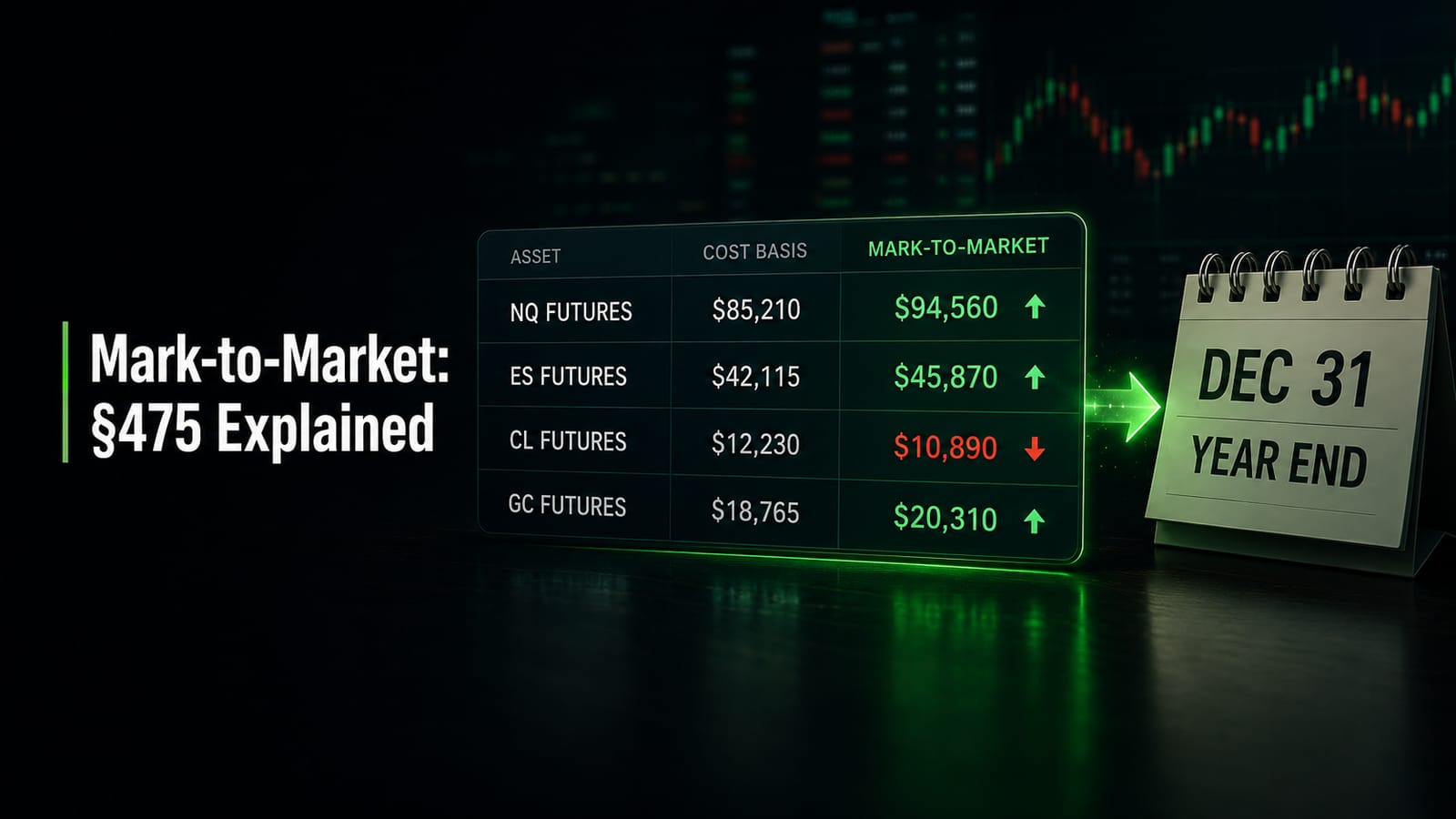
- Mark-to-Market (MTM) under IRC §475(f) is an election that lets qualifying active traders treat all gains and losses as ordinary income, not capital gains.
- For qualifying traders, MTM typically eliminates the $3,000 capital loss limit and eliminates wash sale rules on the elected positions — turning losing years into fully deductible ordinary losses.
- Eligibility typically requires Trader Tax Status (TTS) — substantial and continuous trading activity with profit intent. Investors and casual traders generally do not qualify.
- The election is typically irrevocable and has a strict timing requirement — for most filers the election must be made by the April 15 deadline of the year you want it to apply. Missing the window typically means waiting until the following tax year.
- MTM is high-stakes — beneficial for some traders, costly for others (e.g. traders sitting on large unrealized gains at year-end). A CPA who specializes in trader taxation should model the math before electing.
The §475 election's two biggest advantages are sometimes credited to the One Big Beautiful Bill Act (OBBBA, signed July 2025) — but both predate it by years:
- §475 ordinary losses have been exempt from wash-sale and capital-loss limits since 1997 (the Taxpayer Relief Act, which extended mark-to-market accounting to traders). Traders who elect MTM can typically deduct full trading losses against ordinary income without the $3,000 cap — this is long-standing law, not a 2026 change.
- §475 ordinary income has been QBI-eligible under §199A since the IRS finalized its regulations in January 2019. What OBBBA actually did: it made the §199A 20% QBI deduction itself permanent, removing a scheduled 2025 expiration — so this QBI treatment stays in place going forward rather than sunsetting.
Every situation varies — a CPA who specializes in trader taxation models whether MTM makes sense for a particular trader's mix of trading instruments, entity structure, and unrealized year-end positions.
Mark-to-market (MTM) is the single most powerful tax election available to active traders. Most traders have never heard of it. Those who use it — and qualify correctly — can eliminate the $3,000 capital loss limit, avoid wash sale rules, and convert trading losses into full ordinary deductions.
This is not a loophole. It's a legitimate IRS-sanctioned election under Internal Revenue Code Section 475(f), and it's been available to qualifying traders for decades. The IRS describes the election, and the trader-status test that gates it, in its own words on Topic No. 429, Traders in Securities — the primary source for everything on this page.
Under MTM, you treat all open trading positions as if they were sold on December 31 at fair market value. All gains and losses become ordinary income/loss — not capital. This eliminates the $3,000 annual cap on capital loss deductions and removes the wash sale rule entirely.
How Mark-to-Market Works
Under standard capital gains rules, you recognize a gain or loss when you close a position. Under MTM, you recognize gains and losses on December 31 of each year — whether you've closed the position or not.
The practical effect:
- All gains are ordinary income (taxed at your marginal rate — can be higher than long-term capital gains rate)
- All losses are ordinary losses — fully deductible with no $3,000 cap
- Wash sale rules no longer apply — you can trade the same securities without worrying about disallowed losses
- Open positions are "marked" to their December 31 value as if sold
Who Benefits from the MTM Election?
| Trader Type | MTM Benefit | Worth Electing? |
|---|---|---|
| Trader with large losses | Full deduction vs $3K cap | Almost always yes |
| Trader with wash sale issues | Wash sales eliminated | Yes |
| Consistently profitable trader | Loses long-term cap gains rate | Usually no — short-term only anyway |
| Mixed long/short term portfolio | Loses LTCG rate on longs | Likely not — analyze carefully |
| High-frequency day trader | Simplifies — all short-term anyway | Often yes |
| Futures trader (§1256) | §1256 is already advantaged | Can still help with losses |
MTM converts all gains to ordinary income. If you hold any long-term positions that would otherwise qualify for the 0%, 15%, or 20% long-term capital gains rate, electing MTM means those gains are taxed at ordinary income rates instead. Analyze your full trading portfolio before electing.
Who Qualifies for the MTM Election?
Qualification is typically required for Trader Tax Status (TTS) before you can make the MTM election. The IRS requires you to trade as a business — with regularity, frequency, and continuity throughout the year.
Generally, this means:
- Substantial trading volume — courts have generally looked for 720+ trades per year
- Holding periods of days, hours, or minutes — not months or years
- Consistent trading throughout the year, not just in a few weeks
- Trading as your primary activity or a significant business activity
- Profit motive from short-term price movements, not dividends
The MTM Election Deadline — The Most Critical Rule
This is where most traders miss out, and it is also where most guides get it wrong. The election statement is due by the due date of the prior year's return without regard to extensions — April 15 for a calendar-year individual.
Rev. Proc. 99-17 fixes the deadline at the unextended due date and then lets you attach the statement to either the return or a request for an extension of time to file it. Both documents are due on the same April date. So filing Form 4868 buys six more months to file the return — it buys zero extra days to make the election. A trader who files an extension in April intending to decide about §475 in September has already missed it.
For the 2026 tax year that date was April 15, 2026, attached to the 2025 return or to the 2025 extension request. That window has closed, and there is no October fallback. The next ordinary opportunity is electing for the 2027 tax year, due April 15, 2027 with the 2026 return.
And the deadline is real. The IRS has repeatedly refused §9100 relief for late §475(f) elections, and has held that missing the Rev. Proc. 99-17 deadline forecloses the substantial-compliance doctrine — so "I clearly intended to elect" is not an argument that has been working. The one legitimate route left in-year is the new-taxpayer rule, covered below.
The MTM election is not made on your current year return. It's made on your prior year return (or extension). Many traders discover MTM in December after a bad year and learn they've already missed the deadline for that tax year. For most traders planning ahead, talking to a CPA well before the following April — not in the final weeks — is what makes the election possible at all.
The six §475 procedures, kept separate
Almost every error we have seen on this topic — including four we had to correct on our own pages — comes from collapsing distinct procedures into "the §475 deadline". There are six, they have different due dates, and two of them differ on the single question of whether an extension counts.
| Procedure | When | Do extensions help? |
|---|---|---|
| 1. Election deadline Rev. Proc. 99-17 §5.03 | Due date of the return for the year immediately preceding the election year | No — "without regard to extensions" |
| 2. The election statement itself content per Rev. Proc. 99-17 §5.04 | Attached to that return or to the request for an extension to file it — whichever you file by the date in row 1 | No — the extension request is itself due on that same date |
| 3. Form 3115 automatic change, DCN 64 | With the return for the year of change — the first year the election is effective, so roughly a year after the statement. A signed duplicate also goes to the IRS service centre handling these filings. | Yes — filed with the timely return including extensions |
| 4. New-taxpayer route Rev. Proc. 99-17 §5.03 | Statement placed in the taxpayer's own books and records within 2 months and 15 days of the first day of the election year; copy attached to the first return | N/A — nothing is filed with the IRS up front |
| 5. Revocation automatic change, DCN 218 | Notification statement by the due date of the return for the year before the revocation takes effect, plus a Form 3115 changing the method back to realization | No, for the statement — this deadline is also "without regard to extensions" |
| 6. Late-election relief | — | Repeatedly denied for §475(f) — see below |
Look at rows 1 and 3. The Form 3115 genuinely is filed with the return including extensions. The election statement genuinely is not. Both are part of "making the §475 election", they are a year apart, and only one of them tolerates an extension. Collapse the two and you get the exact wrong answer that is repeated all over the internet — and that was on this page until we corrected it. If a source gives you one §475 deadline, it is describing at most one of six things.
Where the procedures live
The method change for adopting §475 mark-to-market is an automatic change, designated change number 64, sitting at Rev. Proc. 2025-23 §24.01 and operating through the general automatic-change procedures of Rev. Proc. 2015-13. Because it is automatic there is no user fee. §24.01 covers, expressly, a dealer in securities, a trader in securities and a trader in commodities changing to the mark-to-market method. Adopting the method under §24.01 is conditioned on having filed the Rev. Proc. 99-17 statement by its own deadline — the statement is not optional paperwork, it is what makes the method change available.
The change back has its own number. Going the other way — from mark-to-market to the realization method — is §24.02 of the same list, and it is also an automatic change, with its own designated change number 218. §24.02 reaches elections made under §475(e), §475(f)(1) and §475(f)(2), so commodities and securities elections both have a route back. That matters practically: a trader told that revocation requires a private letter ruling is being told something that stopped being true when this automatic path appeared.
One caution about the numbers. The annual list is renumbered and reissued most years — Rev. Proc. 2025-23 replaced 2024-23, and later procedures have already modified parts of it for unrelated subjects — so the section number quoted in any article, including this one, should be checked against the current year's list before it is relied on. The designated change numbers 64 and 218 and the structure (statement first, Form 3115 later, §481(a) adjustment on the form) are the stable parts.
What if you missed the election deadline?
For an existing trader the deadline is generally unforgiving — the §475(f) election ordinarily has to be in place by the due date of the prior year's return, without regard to extensions, which means the decision is made looking forward into a year that has already started.
The route commonly discussed after that window closes is a new trading entity. A newly formed entity is generally able to make the election within a short window of beginning business rather than waiting for the following tax year, which is why traders who miss the personal deadline sometimes form an entity mid-year instead. Whether that is worth doing depends on the cost of the entity, the size of the expected benefit, and whether the trading activity genuinely rises to trader tax status — this is firmly a model-it-with-a-CPA decision, not a default.
How to File the MTM Election
- Confirm you qualify for Trader Tax Status — document your trading frequency and volume
- Prepare a written statement. Rev. Proc. 99-17 asks it to identify the election being made, the first tax year it is effective for, and the trade or business it covers. Name the subsection: a statement electing under §475(f)(1) covers securities; covering commodities and §1256 contracts takes a separate statement under §475(f)(2). One statement does not do both.
- Attach it to the prior year's return, or to the request for an extension of time to file that return — whichever you are filing by the unextended April due date. An amended return does not work. The late-election rulings turn on exactly this: the election is not something you can add after the fact, and the IRS has declined to treat a late attempt as substantial compliance.
- Keep a copy for your records — the IRS may challenge TTS status in an audit
The new-taxpayer window — the one legitimate in-year route
If no federal return was required for the year immediately before the election year, you are a new taxpayer under Rev. Proc. 99-17, and you elect differently: by placing the statement in your own books and records within 2 months and 15 days after the first day of the election year, then attaching a copy to your first return. Nothing goes to the IRS on the front end.
This is why a trader who misses the April deadline is sometimes advised to form a new trading entity: a genuinely new taxpayer gets its own 2-month-15-day window from the date its first tax year begins, which can fall mid-year. It is a real route, not a loophole in the deadline — but it only works if the entity is actually a new taxpayer with a real business purpose, and the §481(a) and entity-cost consequences are a separate conversation. This is not a do-it-yourself manoeuvre.
What is Form 3115, and why does the election take two steps?
Electing §475 is generally a two-part exercise, and missing the second part is a common and expensive error. The first part is the election statement itself, attached to a timely-filed return (or extension) by the deadline. The second is Form 3115, Application for Change in Accounting Method — filed with the return for the first year the election is effective, because moving from realization accounting to mark-to-market is a change of method in the IRS's eyes.
Form 3115 is also where the §481(a) adjustment lands: the one-time catch-up that marks existing positions to market as the new method begins. That adjustment can be income or a deduction depending on whether the portfolio is carrying unrealized gains or losses on the changeover date, which is a large part of why the timing of the election matters as much as the decision itself.
And the two directions are not spread the same way. As a general rule, subject to exceptions in the procedures themselves, a negative §481(a) adjustment — the favourable one — is taken into account entirely in the year of change, while a positive adjustment is spread over four years: the year of change plus the next three. So a trader sitting on large unrealized gains when they elect does not get to pick when that income lands, and a trader sitting on unrealized losses generally gets the benefit immediately. The exceptions are not footnotes — there are de minimis and elective provisions that can change the spread, and short-year and terminated-business situations that accelerate it — so the four-year figure is the default, not a guarantee. Running the adjustment in both directions before electing is the part of the analysis most often skipped.
A trader who files the election statement on time but omits Form 3115 has typically not completed the change of method. Traders in this position generally work with a CPA on both filings together rather than treating the election as a single-form job — and a new entity formed specifically to trade has a different, shorter window, discussed below.
What Happens After You Elect MTM?
Once elected, MTM stays in effect for every future year until you affirmatively revoke it. It is a commitment to an accounting method, not a year-by-year choice, so the decision deserves the same care as the election itself.
Revoking the election — and why the five-year mark matters
Revocation no longer requires a private letter ruling. That was the position years ago and it is still repeated widely; the IRS added an automatic-consent path, and its own Topic no. 429 now walks through it. Two filings are generally involved:
- a notification statement revoking the election, due by the due date of the return for the year before the year the revocation is to take effect — without regard to extensions, the same hard deadline that applies to making the election — attached to that return or to the extension request for it; and
- a Form 3115 changing the method back from mark-to-market to realization (the automatic change at Rev. Proc. 2025-23 §24.02, DCN 218, where the automatic path is available).
The five-year timing trap. Revoking within five years of making the election leaves the notification statement unchanged, but pushes the Form 3115 into the non-automatic change procedures of Rev. Proc. 2015-13, which carry a user fee and are not a filing you complete by simply attaching a form. Outside five years the automatic path generally applies, with no fee and no advance consent. So a trader who elects §475 in a loss year intending to reverse it in the next profitable year has chosen the expensive route, not the easy one — which is the strongest practical argument for treating the election as a multi-year decision rather than a one-season tactic.
Both the making and the revoking of the election run on the same structural logic: a statement that fixes the intent by a hard deadline, and a Form 3115 that executes the method change. Missing either one leaves the change incomplete.
Accounting Under MTM
Each December 31, you "mark" all open positions to their fair market value. Any unrealized gain or loss is recognized as if the position was sold. When you close the position in the following year, only the difference from the December 31 value (not the original cost basis) is recognized.
This adds complexity to your bookkeeping. You'll need detailed records of all open positions at year-end and their market values. This is another reason a specialized CPA is essential for MTM traders.
Does the MTM election apply to futures as well as stocks?
Only if you elect it for them, and for most futures traders that is the wrong move. §475(f) contains two separate elections — one for securities under (f)(1) and one for commodities and derivatives under (f)(2) — and a trader can make either, both, or neither.
The reason this matters: electing MTM on commodities generally converts §1256 gains from the 60/40 blend into ordinary income, giving up the preferential blended rate that makes futures attractive in the first place. A futures trader who elects MTM across the board can therefore increase their tax bill while intending to reduce it.
| Situation | Election commonly considered | Why |
|---|---|---|
| Active stock / equity options trader with wash-sale problems | §475(f)(1) — securities only | Removes wash-sale tracking; losses become ordinary |
| Futures trader already receiving 60/40 | Typically neither | §1256 is usually better than ordinary treatment |
| Trades both, with large equity losses | Securities only, commodities left out | Keeps 60/40 on futures while fixing the equity side |
Which combination fits is fact-specific and depends on the mix of instruments, the size of unrealized positions, and whether the trader qualifies for trader tax status at all. The futures taxation page covers what the 60/40 treatment is worth before it is given up, and the Section 1256 calculator puts a number on it; the instrument-family pages for index futures, gold and crude and Treasury futures cover what is specific to each. Note that a prop firm payout is generally ordinary income regardless of any election, because §1256 and §475 both concern positions held in your own account.
MTM and Net Operating Losses (NOL)
One of the most powerful benefits of MTM: if your trading losses exceed your total income in a year, you have a Net Operating Loss (NOL). NOLs can be carried forward to offset income in future profitable years — potentially deferring taxes for years or even decades.
Example: MTM trader loses $80,000 in 2026. Total income from all sources is $60,000. The trader has a $20,000 NOL that carries forward. In 2027, the trader earns $100,000 in trading profit — but the $20,000 NOL reduces taxable income to $80,000.
Frequently Asked Questions
What is the mark-to-market election for traders?
The mark-to-market election under IRC Section 475 allows qualifying traders to treat all trading gains and losses as ordinary income rather than capital gains, eliminating the $3,000 capital loss cap and wash sale rules.
When must the mark-to-market election be filed?
The MTM election statement is due by the due date of your prior year return without regard to extensions — April 15 for a calendar-year individual. Filing an extension does not extend it: Rev. Proc. 99-17 lets you attach the statement to the return or to the extension request, and both are due on that same April date. To have had MTM in effect for 2026, the statement was due April 15, 2026. There is no October fallback.
Who qualifies for mark-to-market accounting?
Traders who qualify for Trader Tax Status — generally those making 720 or more trades per year with short holding periods and consistent trading activity throughout the year.
Not Sure Where You Stand on Taxes?
Answer 8 quick questions. Get a personalized AI summary of your tax exposure, missed deductions, and what you should do next — reviewed by a real CPA.
Get My Free Tax Snapshot →MTM only makes sense alongside Trader Tax Status, entity structure, and an honest read of your wash-sale exposure. These are the most relevant adjacent topics: