Capital gains taxes are the primary tax burden for most traders. Understanding exactly how they work — and how to legally minimize them — can be worth thousands of dollars a year. Here's a complete 2026 guide.
Capital Gains Tax Rates for 2026
Your capital gains rate depends on two things: your holding period and your total taxable income.
Short-Term Capital Gains (Held ≤ 1 Year)
Taxed as ordinary income. Same rate as your W-2 salary.
| Taxable Income (Single) | Short-Term Rate |
|---|---|
| $0 – $11,600 | 10% |
| $11,601 – $47,150 | 12% |
| $47,151 – $100,525 | 22% |
| $100,526 – $191,950 | 24% |
| $191,951 – $243,725 | 32% |
| $243,726 – $609,350 | 35% |
| Over $609,350 | 37% |
Long-Term Capital Gains (Held > 1 Year)
| Taxable Income (Single) | Long-Term Rate |
|---|---|
| $0 – $47,025 | 0% |
| $47,026 – $518,900 | 15% |
| Over $518,900 | 20% |
The Net Investment Income Tax (NIIT): The Hidden 3.8%
On top of regular capital gains rates, high-earning traders face an additional 3.8% Net Investment Income Tax under the Affordable Care Act. This applies to your capital gains, dividends, and other investment income if your MAGI exceeds:
- $200,000 — Single filers
- $250,000 — Married filing jointly
- $125,000 — Married filing separately
The NIIT applies to the lesser of your net investment income or the amount your MAGI exceeds the threshold. For a trader earning $300,000 in trading gains as a single filer, the NIIT applies to the full $300,000 — an extra $11,400 in tax.
Short-term gains: up to 40.8% (37% + 3.8%). Long-term gains: up to 23.8% (20% + 3.8%). State income taxes add on top of this — California traders can face effective rates over 50% on short-term gains.
How Capital Losses Work
Capital losses offset capital gains dollar-for-dollar. If you have more losses than gains:
- You can deduct up to $3,000 of net capital losses against ordinary income (W-2, etc.) per year
- Remaining unused losses carry forward to future years indefinitely
- Short-term losses first offset short-term gains; long-term losses first offset long-term gains
- Short-term losses can also offset long-term gains (after netting within each category)
The $3,000 cap and the netting order above are the IRS's, set out in Publication 550, Investment Income and Expenses — the authoritative source for capital gain and loss treatment. Pub 550 is revised annually, so most traders confirm current figures there or with a CPA.
Tax-Loss Harvesting for Traders
Tax-loss harvesting is the strategy of intentionally realizing losses to offset gains. For active traders, this isn't just a December activity — it's year-round:
- Sell losing positions to realize losses that offset profitable trades
- Wait 31 days before rebuying the same position (or buy a correlated but not substantially identical alternative immediately)
- Use losses to bring down your taxable gain for the year
- For traders with carryforward losses from prior years, those losses automatically offset current year gains
Retirement Accounts: The Most Powerful Tax Reduction Tool
Active traders with Trader Tax Status can establish a Solo 401(k) and contribute up to $69,000 per year (2024 limits, indexed for 2026). This is trading income that:
- Is completely excluded from your current year taxable income
- Grows tax-deferred (Traditional) or tax-free (Roth) inside the account
- Can be used to trade stocks, options, and some futures within the account itself
A trader in the 35% bracket contributing $50,000 to a Solo 401(k) saves $17,500 in federal income tax in a single year.
State Capital Gains Taxes
Many states tax capital gains as ordinary income at the state level. Notable examples:
- California: up to 13.3% on all capital gains (no distinction between short and long-term)
- New York: up to 10.9% state + New York City tax
- Texas, Florida, Nevada: 0% — no state income tax
- Washington state: 7% capital gains tax on long-term gains over $262,000
For high-income traders, state taxes can be as significant as federal. Entity structure and, in extreme cases, domicile planning can reduce state tax burden.
Strategies to Reduce Capital Gains Tax as a Trader
- Hold winners longer — converting a short-term gain to long-term saves 10–17% on federal taxes alone
- Offset with losses — match gains with strategic loss harvesting throughout the year
- Max out retirement contributions — Solo 401(k) or SEP-IRA shelters significant income
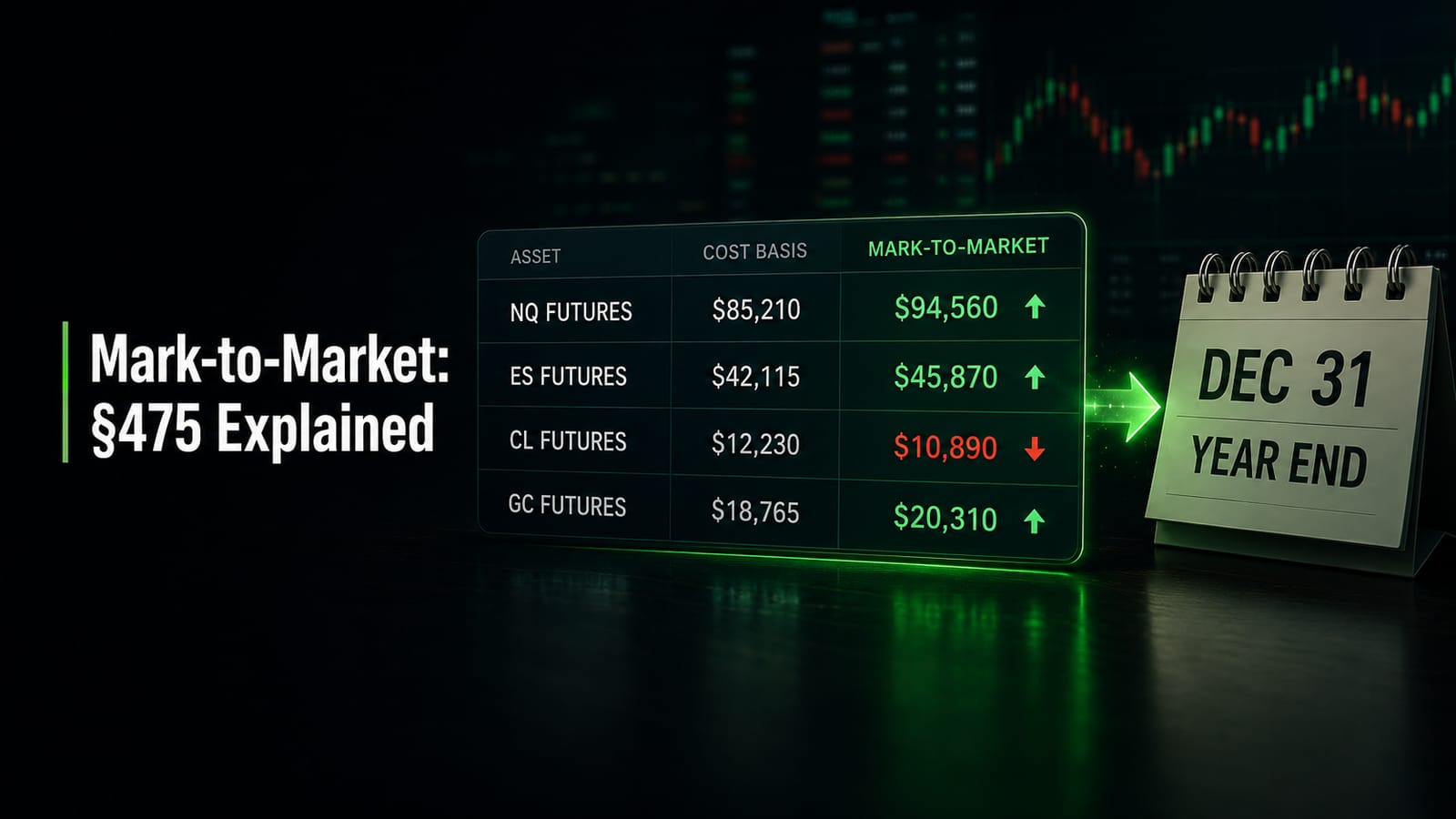
- Elect mark-to-market — if you have large losses, MTM converts them to ordinary losses with no $3K/year cap
- Use Section 1256 contracts — futures and cash-settled index options get automatic 60/40 treatment
- Set up an S-Corp — doesn't affect capital gains rates but reduces self-employment tax on prop firm / Schedule C income
- Installment sales for business interests — if selling a trading business, installment treatment can spread gain recognition
Capital Gains and Your Tax Return
Gains and losses are reported on Schedule D and Form 8949. High-volume traders file thousands of 8949 lines electronically. Key things a licensed tax professional will handle:
- Reconciling 1099-B data against your actual records
- Identifying and correctly reporting wash sale adjustments
- Separating Section 1256 contracts (Form 6781) from regular capital gains
- Calculating NIIT on Form 8960
- Carryforward tracking from prior years
Frequently Asked Questions
What is the capital gains tax rate for traders in 2026?
Short-term capital gains (positions held under one year) are taxed at ordinary income rates of 10%–37%. Long-term capital gains (held over one year) are taxed at 0%, 15%, or 20% depending on your income. The 3.8% NIIT may also apply on top of these rates.
What is the Net Investment Income Tax (NIIT)?
The 3.8% Net Investment Income Tax applies to capital gains, dividends, and other investment income if your modified adjusted gross income exceeds $200,000 (single) or $250,000 (married filing jointly). It stacks on top of your regular capital gains rate, bringing the effective max rate to 23.8% long-term or 40.8% short-term.
How does tax-loss harvesting work for traders?
Tax-loss harvesting is the practice of selling positions at a loss to offset capital gains realized elsewhere in your portfolio. The losses reduce your taxable gains dollar-for-dollar. Unused capital losses offset up to $3,000 of ordinary income per year and carry forward indefinitely.
Can traders reduce capital gains with a retirement account?
Yes. Traders with Trader Tax Status and Schedule C income can contribute to a Solo 401(k) or SEP-IRA, sheltering a significant portion of their trading income from both income tax and future capital gains tax. This is one of the most powerful tax reduction strategies available to active traders.
Not Sure Where You Stand on Taxes?
Answer 8 quick questions. Get a personalized AI summary of your tax exposure, missed deductions, and what you should do next — reviewed by a real CPA.
Get My Free Tax Snapshot →