- Holding period drives almost everything. Positions held a year or less are typically short-term and taxed at ordinary rates up to 37%; over a year they typically qualify for long-term rates of 0%, 15% or 20%.
- Stock traders do not get the 60/40 split. That belongs to §1256 contracts — futures and broad-based index options — which is why instrument choice has real tax consequences for an active trader.
- The wash sale rule applies to stocks and does not apply to §1256 contracts. For a high-frequency stock trader this is usually the single largest bookkeeping burden of the year.
- Capital losses generally offset capital gains, then up to $3,000 of ordinary income per year, with the remainder carried forward. There is no 3-year carryback for stock losses — that is a §1256 feature.
- Trader tax status is not a checkbox and not automatic at any particular trade count. Every situation varies — a CPA who specializes in trader taxation can confirm what applies.
Whether you're flipping stocks daily or holding for months, how you're taxed depends almost entirely on one thing: how long you held the position. Here's everything you need to know about stock trading taxes in 2026.
Short-Term vs. Long-Term Capital Gains
The IRS taxes stock gains differently based on your holding period. This is the main structural difference between trading stocks and trading futures, where §1256 applies a 60/40 blend regardless of how briefly a position was held:
- Short-term gains (held 1 year or less) — taxed as ordinary income at your marginal rate (10%–37%)
- Long-term gains (held more than 1 year) — taxed at preferential rates of 0%, 15%, or 20%
| Income Level (Single) | Short-Term Rate | Long-Term Rate | Savings |
|---|---|---|---|
| Up to $47,025 | 10–12% | 0% | Up to 12% |
| $47,025–$200,000 | 22–24% | 15% | 7–9% |
| $200,000–$518,900 | 32–35% | 15% | 17–20% |
| Over $518,900 | 37% | 20% | 17% |
For active traders who hold positions for days or weeks, nearly all gains will be short-term — meaning you pay your full marginal tax rate on every dollar of profit.
The 3.8% Net Investment Income Tax (NIIT) may also apply to capital gains if your modified adjusted gross income exceeds $200,000 (single) or $250,000 (married filing jointly). This effectively raises the top long-term rate to 23.8% and short-term to 40.8%.
What Is Trader Tax Status and Who Qualifies?
The IRS distinguishes between investors and traders. If you trade substantially and continuously — typically 500+ trades per year, holding positions for days rather than months — you may qualify for Trader Tax Status (TTS).
The agency states that test in its own words on Topic No. 429, Traders in Securities. Worth noting: the trade-count figure above is a practitioner benchmark drawn from case law, not an IRS threshold — the IRS itself sets no number, which is why TTS is typically assessed with a CPA rather than self-diagnosed.
TTS unlocks significant benefits:
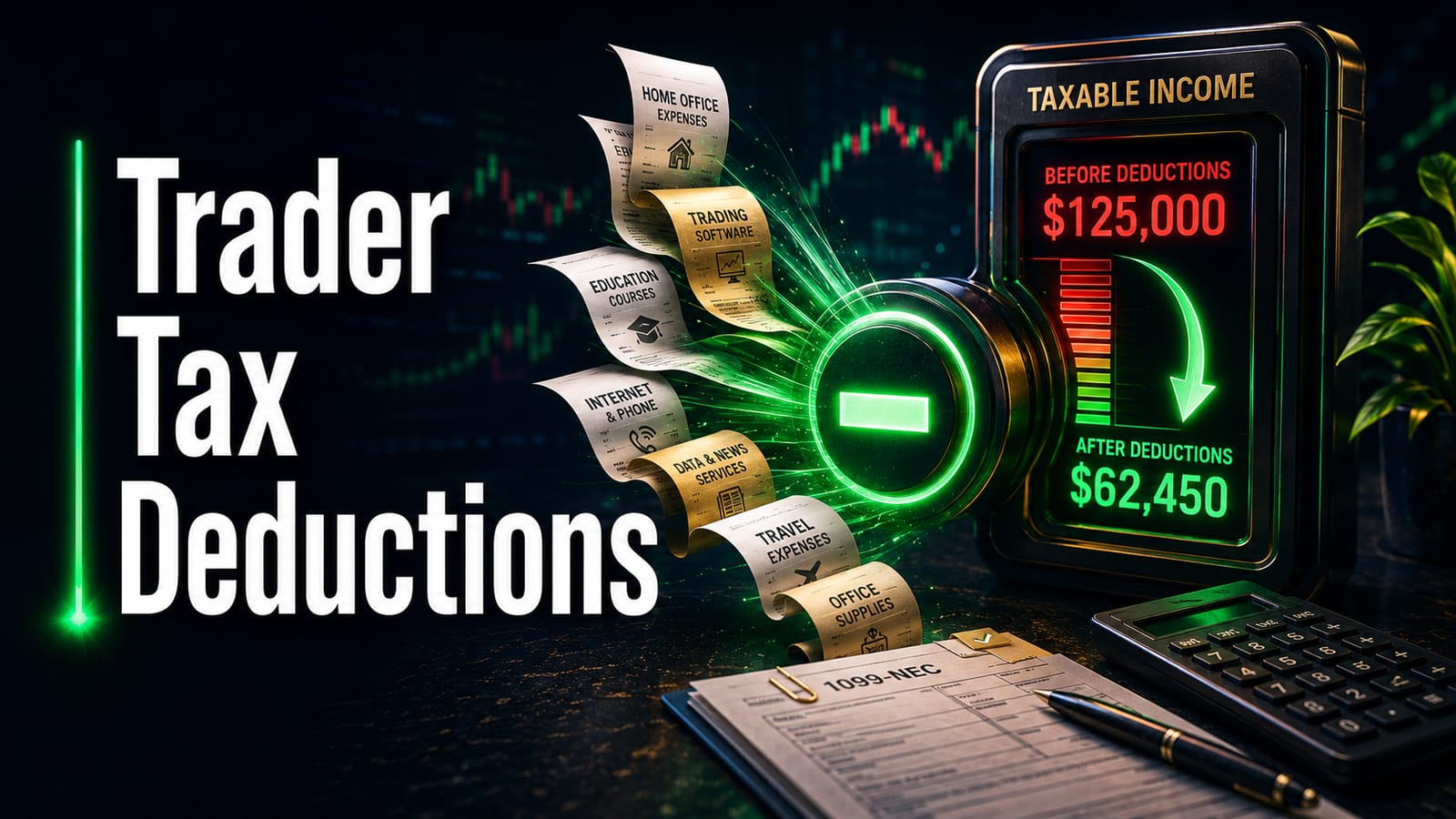
- Deduct all ordinary and necessary trading expenses on Schedule C
- Potentially elect mark-to-market accounting (eliminates wash sale rules)
- Treat trading losses as ordinary losses (not subject to the $3,000/year capital loss limit)
- Contribute to a Solo 401(k) or SEP-IRA based on Schedule C income
No hard threshold, but the IRS looks at: substantial daily volume, short holding periods (days to weeks), continuity throughout the year, time devoted to trading, and trading being your primary income source. A CPA can evaluate your specific situation.
Day Trader Taxes: What to Expect
If you're an active day trader, here's your typical tax reality — and the full treatment, including trader tax status, quarterly estimates and entity questions, is on day trading taxes:
- All gains taxed as ordinary income (short-term rates)
- Self-employment tax does NOT apply to trading gains — only to SE income from a trade or business (important: trading gains in a personal account are investment income, not SE income)
- Losses limited to $3,000/year against ordinary income (unless you have TTS and elect MTM)
- Wash sale rule applies to every position you trade repeatedly
Swing Trading Taxes
Swing traders holding positions for days to weeks face the same short-term capital gains rates as day traders. The key difference is position count — swing traders may make fewer trades, making TTS qualification harder but wash sale management easier.
Smart tax moves for swing traders:
- Hold winning positions past the one-year mark when possible for long-term rates
- Track wash sales carefully — selling and rebuying the same ticker within 30 days disallows your loss
- Consider tax-loss harvesting in December to offset gains realized throughout the year
The Wash Sale Rule
This trips up more active stock traders than almost anything else. The wash sale rule says: if you sell a stock at a loss and buy the same stock (or a substantially identical security) within 30 days before or after the sale, your loss is disallowed.
Common traps:
- Selling AAPL at a loss, then buying AAPL calls within 30 days — wash sale
- Selling in a taxable account at a loss, buying the same stock in your IRA — wash sale
- Your spouse sells at a loss while you buy the same stock — wash sale
- Selling at a loss on December 28 and rebuying January 5 — wash sale
Active traders who repeatedly trade the same tickers can accumulate thousands of dollars in disallowed wash sale losses without realizing it. Professional tax software and a CPA can identify and properly report these adjustments — which route fits depends on volume and instrument.
Form 8949 and Schedule D
Every stock sale goes on Form 8949, then summarized on Schedule D. Your broker provides a 1099-B at year end, but it may have errors — particularly in cost basis reporting and wash sale adjustments. A CPA reconciles the 1099-B against your actual trading records.
High-volume traders can have thousands of 8949 line items. We file these electronically in bulk — no one's typing 2,000 trades by hand.
Deductions Active Stock Traders Can Take
With Trader Tax Status, these are deductible on Schedule C:
- Trading platform and software subscriptions (ThinkorSwim, Webull, TC2000, etc.)
- Market data and news subscriptions (Bloomberg, Benzinga, etc.)
- Home office (dedicated trading space — square footage method)
- Computer and monitors purchased for trading
- CPA and professional fees related to trading
- Trading education, courses, and seminars
- Margin interest paid to your broker
- Internet service (pro-rated for trading use)
Estimated Tax Payments for Active Traders
If you expect to owe $1,000 or more in taxes, the IRS requires quarterly estimated payments. For profitable stock traders, missing these results in underpayment penalties on top of your tax bill.
2026 due dates: April 15 · June 16 · September 15 · January 15, 2027
A common rule: set aside 25–30% of every realized gain into a dedicated savings account. Adjust based on your total income and other deductions.
Frequently Asked Questions
How are stock trading gains taxed?
Stock gains held under one year are taxed as short-term capital gains at ordinary income rates (10%–37%). Gains on stocks held over one year qualify for long-term capital gains rates of 0%, 15%, or 20% depending on your income.
Do day traders pay more taxes than long-term investors?
Yes — day traders almost always pay short-term capital gains rates (ordinary income rates up to 37%) since they hold positions for less than one year. Long-term investors who hold over a year qualify for lower long-term capital gains rates.
What is the wash sale rule for stocks?
The wash sale rule disallows a tax loss if you repurchase the same or substantially identical stock within 30 days before or after the loss sale. The disallowed loss adds to your cost basis in the replacement shares.
Can active stock traders deduct business expenses?
Traders who qualify for Trader Tax Status (TTS) can deduct trading-related expenses on Schedule C — including data subscriptions, trading software, home office, and professional services. Casual investors cannot deduct these expenses.
Not Sure Where You Stand on Taxes?
Answer 8 quick questions. Get a personalized AI summary of your tax exposure, missed deductions, and what you should do next — reviewed by a real CPA.
Get My Free Tax Snapshot →