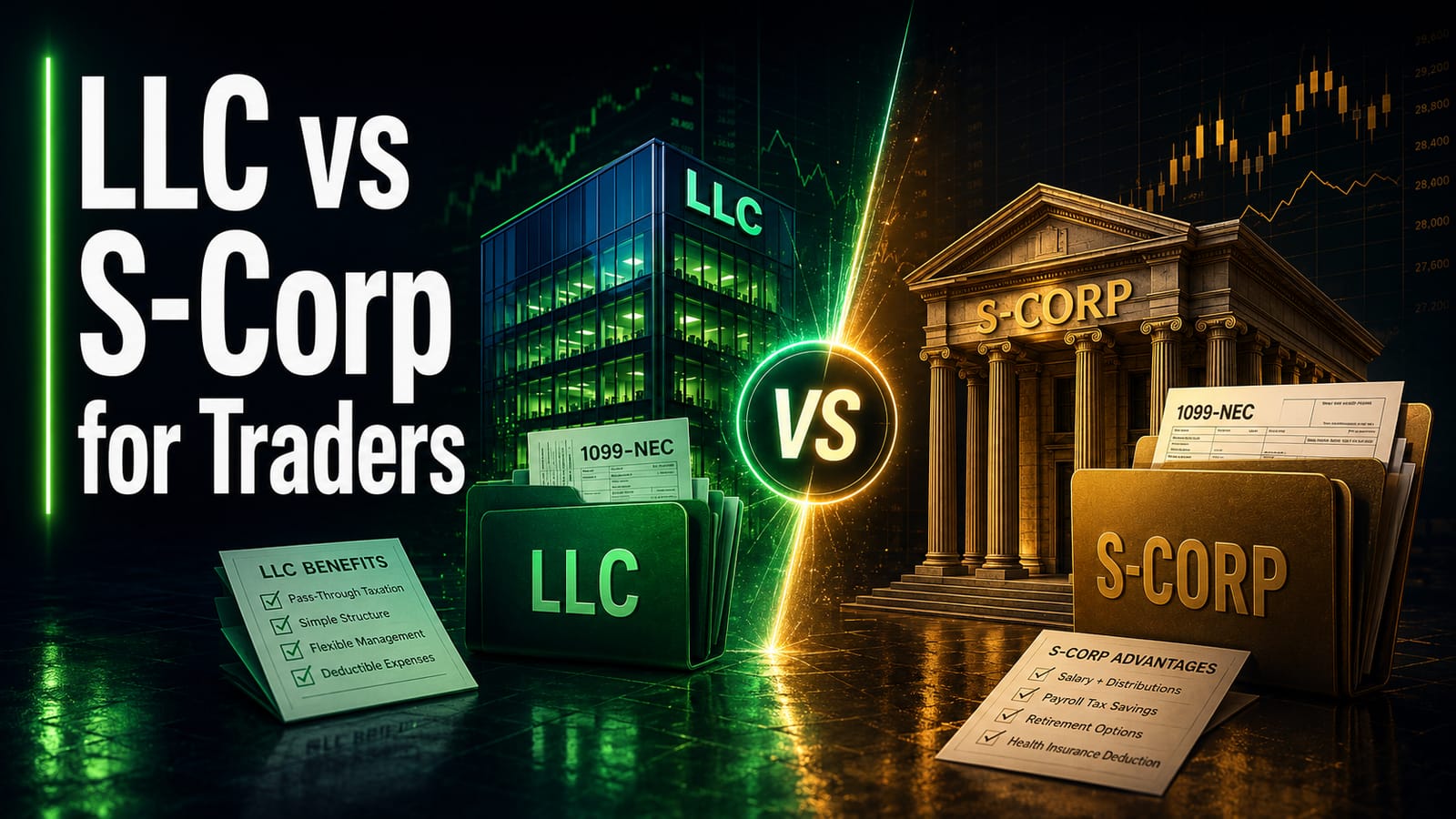
- An LLC on its own typically doesn't change federal tax treatment for an individual trader — by default it's a pass-through, taxed identically to a sole proprietorship. The benefits are usually legal liability + state-level positioning.
- An S-Corp election (filed on Form 2553) is what unlocks the self-employment tax savings — by splitting profit into reasonable salary (subject to payroll tax) and distributions (not subject to SE tax).
- For most traders, the S-Corp typically starts making sense at higher SE-income levels (commonly cited threshold around $80K+ in net trading income), where the SE-tax savings outweigh the added payroll, bookkeeping, and entity-return costs.
- An S-Corp election also brings ongoing obligations: reasonable compensation rules, quarterly payroll filings (Form 941), annual S-Corp return (Form 1120-S), and state-level filings. These add real overhead.
- Every situation varies — entity strategy depends on your state, your trading instruments (futures payouts vs prop firm 1099-NEC vs personal-account capital gains are all treated differently), and your long-term plans. A trader-specialist CPA models the math before electing.
One of the most common questions profitable traders ask is whether they need an LLC — and whether they should elect S-Corp status. The answer depends on your income level, trading type, and long-term goals.
Done right, the right entity structure can save a profitable trader $10,000–$40,000+ per year in taxes. Done wrong, it adds complexity and cost without benefit.
Why Entity Structure Matters for Traders
By default, a self-employed trader (including prop firm traders) is a sole proprietor. All net income is subject to both income tax AND self-employment tax (15.3%). The 15.3% applies to 92.35% of net profit, not the whole figure — so on $100,000 of net trading income the SE tax is roughly $14,130, on top of federal and state income taxes. Above the 2026 Social Security wage base of $184,500 the Social Security portion stops and only the 2.9% Medicare portion continues.
The right entity structure can dramatically reduce this burden — but only if it's set up correctly and at the right income level.
Option 1: Sole Proprietor (No Entity)
If you have no entity, you file all trading/prop firm income on Schedule C as a sole proprietor. Simple, cheap, but expensive at scale.
- No formation cost or annual fees
- No payroll requirements
- Full self-employment tax on all net income (15.3%)
- No liability protection
- Best for: traders earning under $40,000 net from trading
Option 2: Single-Member LLC
A single-member LLC (SMLLC) is a disregarded entity for tax purposes — meaning it's taxed exactly like a sole proprietor. The benefit is legal, not tax-related. This is the IRS's own default treatment, set out on its Limited Liability Company (LLC) page — which is why forming an LLC alone typically changes nothing on the tax return.
- Provides liability protection — separates trading business from personal assets
- Professional credibility with brokers and financial institutions
- Same tax treatment as sole proprietor (Schedule C, full SE tax)
- Formation cost: $50–$300 depending on state
- Annual fees: $0–$800 depending on state
- Best for: traders who want liability protection but don't yet earn enough to justify S-Corp complexity
Option 3: LLC with S-Corp Election
This is where the real tax savings happen. An LLC can elect to be taxed as an S-Corporation by filing Form 2553 with the IRS. When you do this, you split your income into two buckets:
- Reasonable salary — subject to payroll taxes (SE tax equivalent)
- Distributions — pass-through profit NOT subject to self-employment tax
Net trading income: $120,000. As a sole proprietor, SE tax applies to 92.35% of that ($110,820) at 15.3% — about $16,955. As an S-Corp paying a $50,000 reasonable salary plus a $70,000 distribution, payroll tax applies to the full $50,000 salary at 15.3% — $7,650 — and the distribution carries none. That is a gross difference of about $9,305. The S-Corp itself costs roughly $2,000–$3,000/year to maintain, so the realistic net saving here is closer to $6,300–$7,300. Whether a $50,000 salary is defensible on $120,000 of profit is a facts-and-circumstances question — reasonable compensation is the part the IRS actually scrutinizes, and a CPA sets it.
LLC vs S-Corp: Side-by-Side Comparison
| Factor | LLC (No S-Corp) | LLC + S-Corp Election |
|---|---|---|
| SE Tax on All Income | Yes — 15.3% | Only on salary portion |
| Payroll Required | No | Yes — quarterly payroll |
| Annual Cost | $50–$500 | Often around $2,000–$3,000 (payroll + CPA) |
| Liability Protection | Yes | Yes |
| Complexity | Low | Medium-High |
| Break-Even Point | — | ~$80,000 net income |
| Tax Savings Potential | None vs sole prop | $5,000–$40,000+/year |
When Should You Elect S-Corp Status?
The general rule: S-Corp election makes sense when your net self-employment income (after expenses) consistently exceeds $80,000–$100,000 per year. Below that threshold, the cost of running payroll and the additional accounting complexity often outweighs the tax savings.
Key considerations:
- You must pay yourself a "reasonable salary" — the IRS scrutinizes S-Corps that pay no salary or an unreasonably low one
- You'll need to run quarterly payroll and file quarterly payroll tax returns (Form 941)
- Your licensed tax professional fees will increase — S-Corp payroll, bookkeeping and the separate 1120-S return are often around $2,000–$3,000 annually depending on provider and complexity
- The S-Corp election typically must be filed by March 15 of the tax year (March 16, 2026, since the 15th falls on a Sunday); late or retroactive elections require IRS relief
The reasonable-salary requirement is not a rule of thumb — the IRS states its position, and the factors it weighs when testing whether compensation is reasonable, on its S Corporation Compensation and Medical Insurance Issues page. What counts as reasonable is facts-and-circumstances and varies by trader, so it is typically set with a CPA rather than picked from a table.
How to Set Up an LLC for Trading
- Choose your state — most traders form in their home state. Delaware and Wyoming offer benefits for larger operations.
- Choose a name — confirm it's available in your state's business registry
- File Articles of Organization with your state — typically $50–$300
- Get an EIN (Employer Identification Number) from the IRS — free at IRS.gov
- Open a dedicated business bank account — never mix personal and business funds
- If electing S-Corp: file Form 2553 with the IRS by March 15 (March 16, 2026, since the 15th falls on a Sunday)
TraderTax handles LLC formation, S-Corp elections, and ongoing accounting for active traders. We've set up hundreds of trading entities — we know exactly what's needed and what to avoid. Book a free consultation →
What About a C-Corp for Trading?
C-Corps are taxed at 21% on retained earnings — which sounds attractive. But trading gains distributed to shareholders are taxed again as dividends, resulting in double taxation. C-Corps are rarely the right structure for individual traders.
The exception: high-volume prop trading operations functioning more like a fund, where retaining capital inside the entity is part of the strategy. This is institutional-level planning and requires experienced counsel.
Frequently Asked Questions
Do traders need an LLC?
No, an LLC is not required to trade. However, an LLC provides liability protection and professional credibility. From a tax perspective, a single-member LLC is taxed identically to a sole proprietor.
How much can an S-Corp save a trader on taxes?
For most traders the modeled saving falls between roughly $5,000 and $20,000 a year, and it is bounded — once profit clears the Social Security wage base, the remaining saving is only the 2.9% Medicare portion. On $100,000 of net income with a $50,000 reasonable salary, the gross difference is about $6,500 ($14,130 of SE tax versus $7,650 of payroll tax), before the S-Corp's own $2,000–$3,000 of annual running costs. Every situation varies.
When does an S-Corp make sense for traders?
An S-Corp generally makes financial sense when a trader consistently earns $80,000 or more in net self-employment income annually, after accounting for S-Corp maintenance costs of approximately $2,000 to $3,000 per year.
Not Sure Where You Stand on Taxes?
Answer 8 quick questions. Get a personalized AI summary of your tax exposure, missed deductions, and what you should do next — reviewed by a real CPA.
Get My Free Tax Snapshot →If you're weighing LLC vs S-Corp, these are the adjacent topics most traders also need to think through: