- An LLC alone typically doesn't change federal tax treatment — a single-member LLC is disregarded for federal income tax and taxed identically to a sole proprietor. The benefit is usually liability protection, not tax savings.
- The S-Corp election (Form 2553) is what typically unlocks self-employment tax savings — by splitting profit into a reasonable salary (subject to payroll tax) and distributions (not subject to SE tax).
- For most active traders, the S-Corp election starts making financial sense around $80,000+ in net SE income per year, once you net out the added payroll, bookkeeping, and 1120-S filing costs.
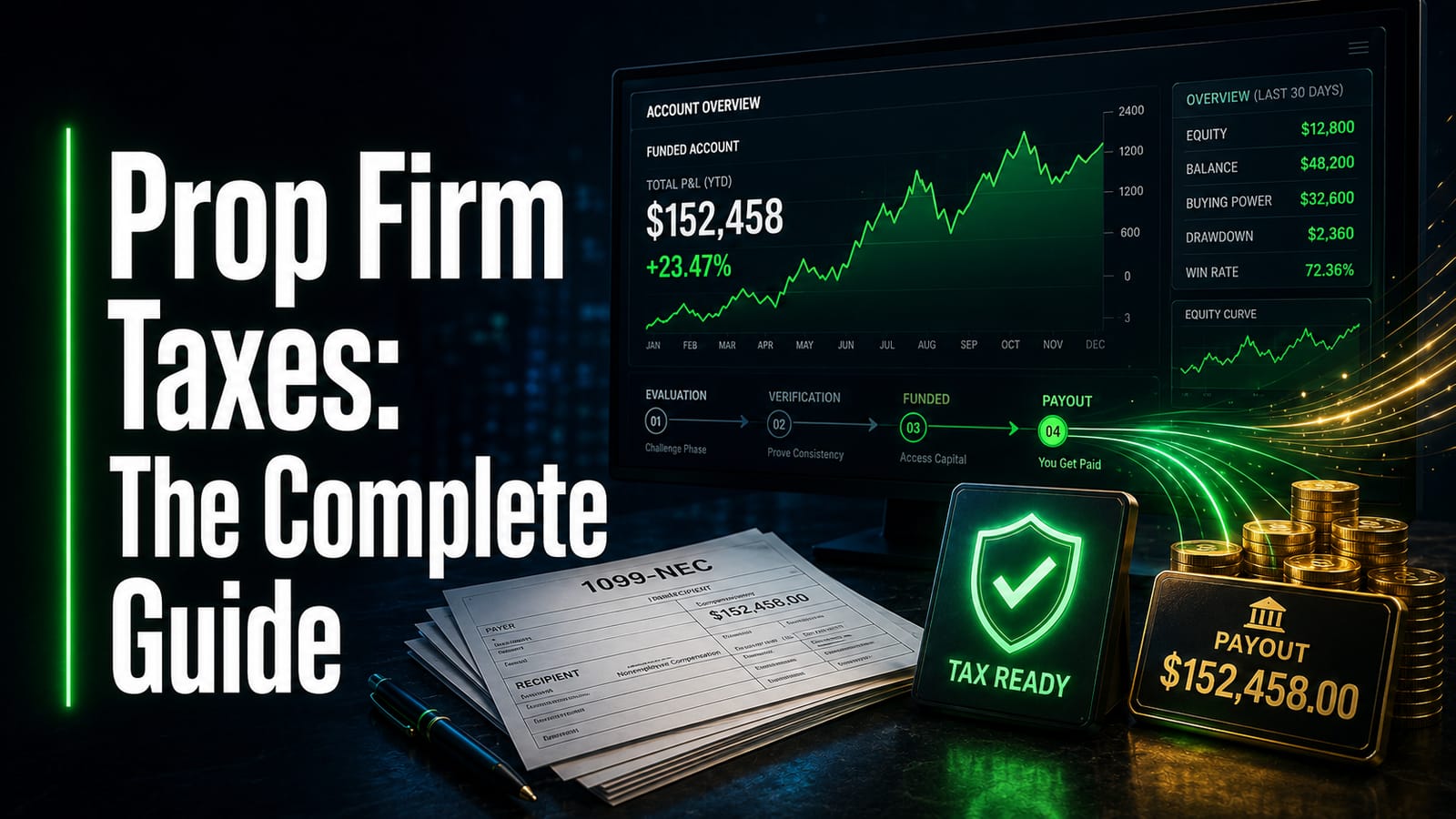
- Prop firm payouts arrive on a 1099-NEC, not a 1099-B — they're self-employment income, not capital gains. That's why the SE-tax conversation matters even more for prop firm traders than for personal-account stock traders.
- Every situation varies — the right answer depends on your state, instruments, trader tax status, and long-term plans. A trader-specialist CPA models the math before electing.
The $80K Example, Worked Out
Both columns are the same trader. Same year. Same payouts from Apex, TopStep, Tradeify, Lucid Trading, or Alpha Futures. The only difference is the entity structure and which CPA is filing the return.
| Line Item | LLC Only | LLC + S-Corp Election |
|---|---|---|
| Net trading profit | $80,000 | $80,000 |
| Reasonable salary | n/a | ~$40,000 |
| SE tax base | $80,000 | $40,000 (salary only) |
| SE / payroll tax (15.3%) | ~$12,240 | ~$6,120 |
| §199A QBI strategy applied | No | Yes (where eligible) |
| S-Corp maintenance cost | $0 | ~$2,000–$3,000 |
| Estimated SE-tax savings | — | ~$3,000–$5,000+ net |
These numbers are typical for an $80K prop firm trader, but actual savings depend on your reasonable-salary determination, state tax, payroll setup, §199A eligibility, and whether trader tax status is established. Higher income generally widens the savings gap; lower income can narrow it past the point where S-Corp costs are worth it. A CPA models YOUR numbers before any election is filed.
"Pays for Itself" — and Why That's Not Marketing Spin
Two reasons the math typically works out in your favor on day one:
- Annual SE-tax savings outpace the CPA fee at most income levels above $80K net. Even if the S-Corp itself costs $2–$3K to maintain, the SE-tax delta is usually multiples of that.
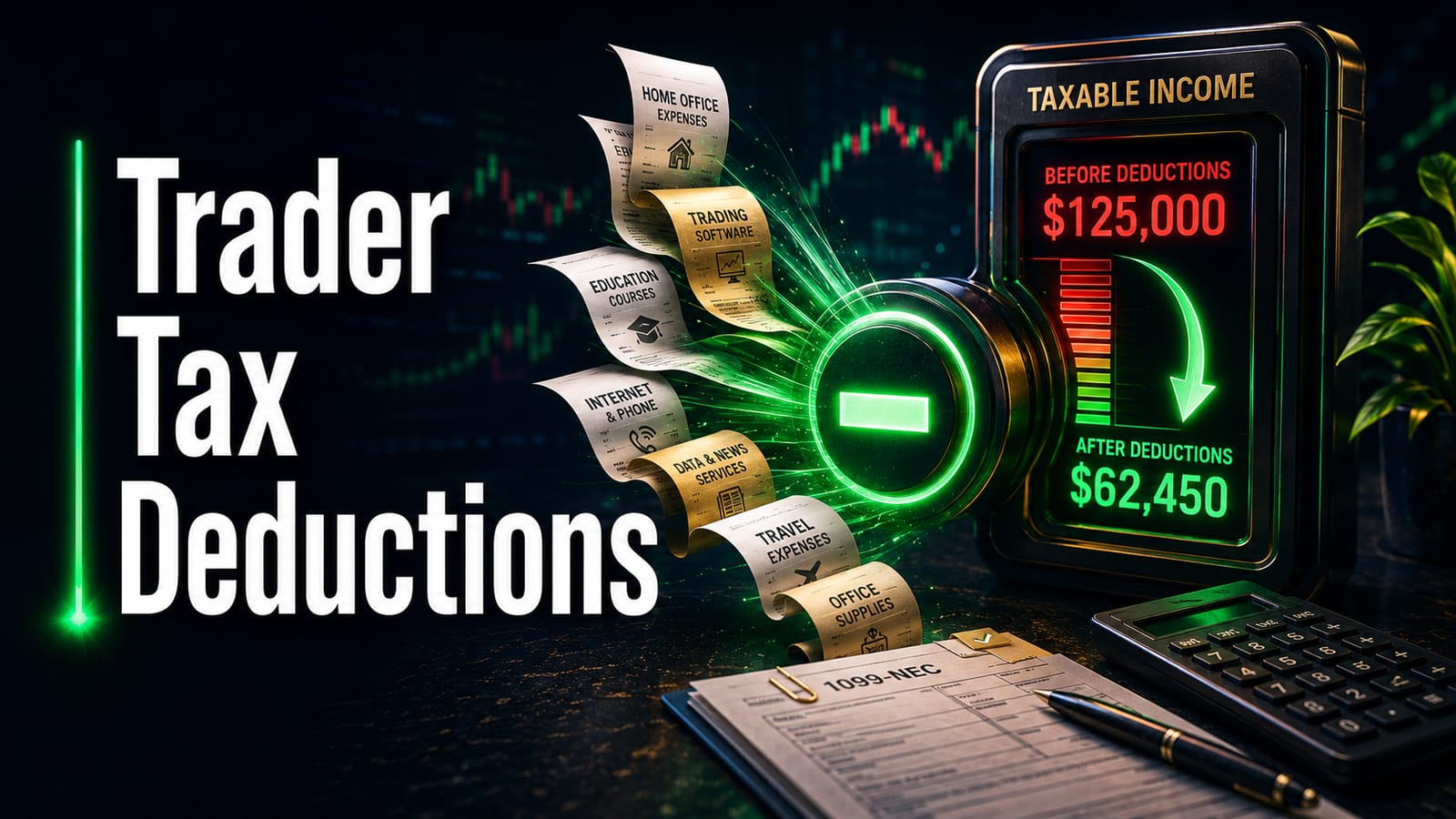
- Professional fees are typically deductible as a business expense for an active trader with established trader tax status. That means the "real" out-of-pocket cost is lower than the sticker price — you save your marginal tax rate on the fee itself.
"Can't my regular accountant just do this?"
Most general CPAs see one to three active-trader returns per year. They're competent at standard W-2 returns, small business taxes, and the occasional Schedule D. They've often never filed a 1099-NEC from Apex or TopStep, never run a Section 1256 60/40 worked example, and never advised on a §475 mark-to-market election. Trader tax is its own specialty — TraderTax-matched CPAs file hundreds of trader returns a year. The difference shows up in what they catch, what they elect, and how much you keep.
What an S-Corp Election Actually Looks Like
This is a multi-step setup, not a single form. A TraderTax-matched CPA typically handles every step:
- Form (or confirm) your LLC with your state — Articles of Organization, EIN, operating agreement
- File Form 2553 with the IRS to elect S-Corp status — deadline is March 16, 2026 for the 2026 tax year (because March 15 falls on a Sunday); late elections via Rev Proc 2013-30 may still qualify under specific conditions
- Set up payroll for the reasonable-salary portion (Form 941 quarterly, W-2 issued annually)
- Open a dedicated business bank account — never commingle personal and business funds
- File the annual S-Corp return (Form 1120-S) and the related K-1 to your personal return
- Maintain state-level filings as required by your state of formation
When the S-Corp Election Is NOT the Right Answer
Honest caveat: an S-Corp doesn't help every trader. Cases where it typically doesn't pencil out:
- Net trading income under ~$60K–$80K — the S-Corp maintenance cost often eats the SE-tax savings
- Inconsistent year-over-year income — losing years still trigger entity filings and payroll obligations
- You don't have trader tax status — without TTS, the deduction strategy is much narrower
- You're trading exclusively futures in a personal account — Section 1256 60/40 treatment already does a lot of the lift, and prop firm payouts (where SE tax bites hardest) aren't in the picture
Frequently Asked Questions
How much can a prop firm trader save with an S-Corp election?
Savings depend on income, state, and entity costs. On $80,000 of net prop firm payouts, an S-Corp election with reasonable salary in the $35,000–$45,000 range typically saves $5,000–$10,000 per year in self-employment tax, net of S-Corp maintenance costs. Every situation varies — a CPA models the math before electing.
At what income does the S-Corp election start making sense?
For most active traders, around $80,000+ in net self-employment income, after accounting for S-Corp maintenance costs of roughly $2,000–$3,000 per year (payroll filings, S-Corp return, state filings). Below that, the added complexity often outweighs the SE-tax savings.
Is the CPA fee tax-deductible?
For most traders with an active trading business, professional fees paid to a CPA for the trading business are typically deductible as a business expense. That means the net out-of-pocket cost of the service is lower than the sticker price. Eligibility depends on your trader tax status and how the expense is documented — confirm with a CPA.
I missed the March 16 election deadline — am I out of luck for 2026?
Not necessarily. The IRS allows late S-Corp elections under Rev Proc 2013-30 in many cases, especially when there's reasonable cause and the entity has acted consistent with S-Corp status. A trader-specialist CPA can evaluate whether your situation qualifies for a backdated election.
See What an S-Corp Could Save YOU
Answer 8 quick questions about your trading and income. Get a personalized AI summary of your SE-tax exposure and whether the S-Corp election makes financial sense for your numbers — reviewed by a real CPA.
Get My Free Tax Snapshot →3 Ways to Get Started
Tax Snapshot
2-minute AI assessment of your tax exposure + recommendations.
Start Snapshot →Prop Firm Calculator
Model federal + SE + state tax on your prop firm payouts.
Run Calculator →Get Matched
Skip ahead — pair with a TraderTax CPA who files trader returns daily.
Get Matched →Adjacent topics most prop firm traders also need to think through: