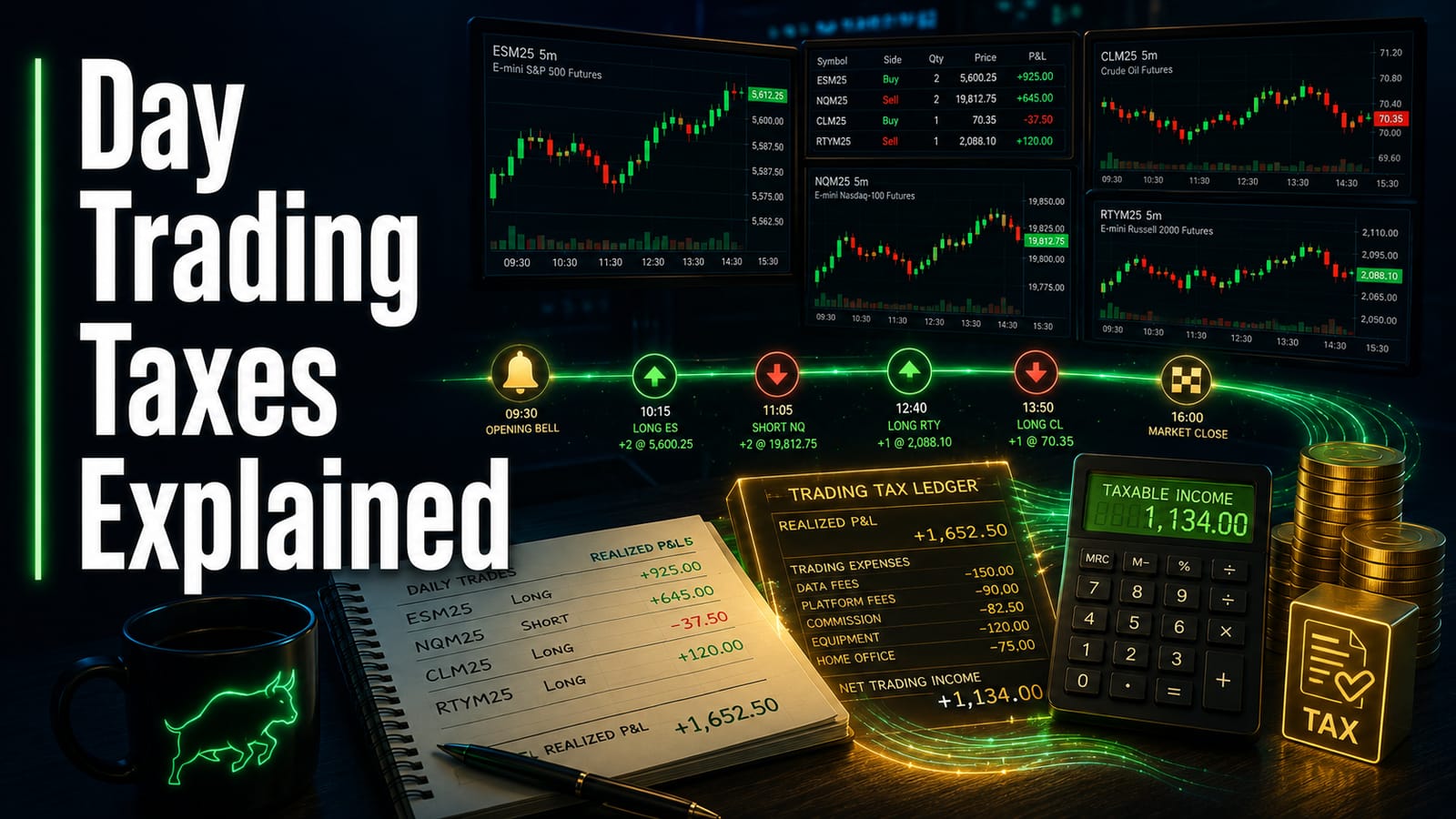
- Personal-account day trading profits are capital gains — nearly all short-term, taxed at ordinary federal rates of 10%–37% in 2026, plus state tax and possibly the 3.8% net investment income tax.
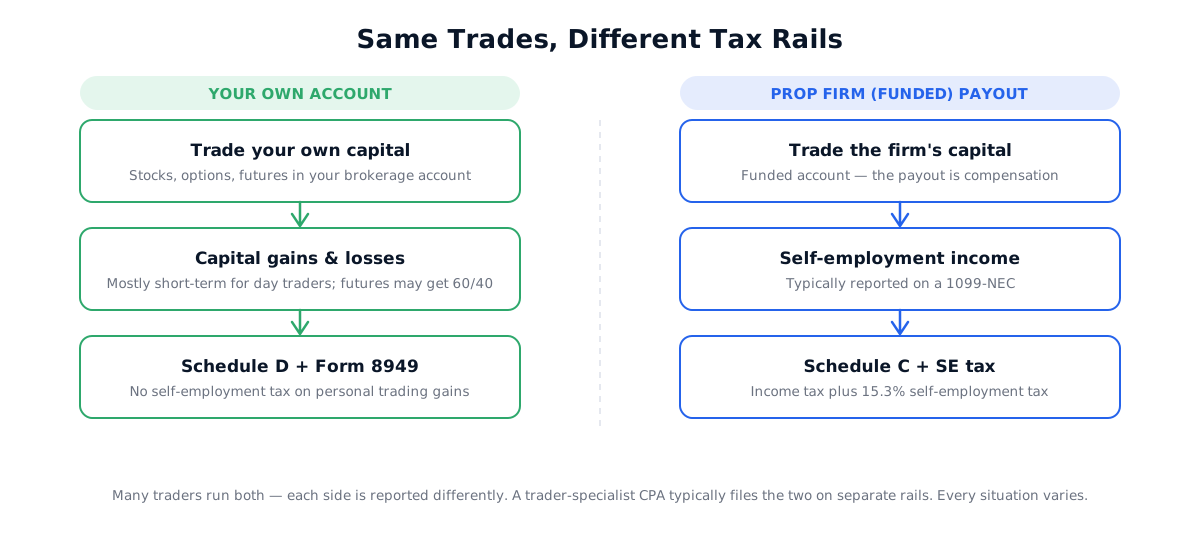
- Day traders typically do NOT owe self-employment tax on personal-account gains — the 15.3% SE tax usually belongs to funded prop firm payouts, which are compensation, not capital gains.
- The wash sale rule is the biggest year-end trap. In-and-out trading of the same tickers triggers it constantly — and broker 1099-Bs typically only adjust identical securities inside the same account.
- Trader Tax Status unlocks business expense deductions, and for qualifiers the §475(f) Mark-to-Market election adds ordinary loss treatment and eliminates wash-sale tracking — strengthened by the OBBBA (signed July 2025), which made §475 income QBI-eligible.
- Futures get Section 1256 treatment: 60% long-term / 40% short-term regardless of holding period, with no wash sales — a structural edge for futures day traders.
- Every situation varies — a TraderTax-matched CPA who specializes in trader taxation can confirm what actually applies to a specific trader.
"Day trading taxes" is one of the most searched — and most misunderstood — topics in trading. Half the internet says day traders pay self-employment tax (mostly false for personal accounts). The other half says wash sales make day trading untaxable-chaos (only true for traders who ignore them until December). The reality is simpler and more interesting: the tax treatment depends far more on what and where a trader trades than on how often.
This guide is the full picture for US day traders in 2026: how gains are classified, the rates that actually apply, the wash sale minefield, Trader Tax Status, the Mark-to-Market election, the Section 1256 futures advantage, the completely different rules for prop firm payouts, deductions, quarterly estimates, entities, and losing years. It links out to deeper TraderTax guides on every topic — think of this page as the map.
Most day trading falls into one of three buckets, each taxed differently: stocks and options in a personal account (short-term capital gains, wash sales apply), futures in a personal account (Section 1256 60/40, no wash sales), and funded prop firm payouts (self-employment income, 15.3% SE tax). Many traders have all three on one return.
How Is Day Trading Taxed?
For most traders, day trading a personal brokerage account produces capital gains and losses — reported on Form 8949 and Schedule D, not on a business schedule. Because positions close within minutes or hours, nearly everything is short-term and taxed at ordinary federal rates of 10%–37%. Frequency alone doesn't change the character of the income.
That surprises a lot of new traders: making 2,000 trades a year doesn't automatically turn trading into a "business" for tax-character purposes. Gains from trading your own capital stay capital gains whether there's one trade or ten thousand. What high frequency can change is eligibility for Trader Tax Status (business expense deductions) and the §475(f) Mark-to-Market election (ordinary treatment) — both covered below.
The classification stack for a typical day trader looks like this:
- Stocks and equity options, personal account — capital gains/losses, almost entirely short-term, wash sale rule applies.
- Regulated futures and broad-based index options — Section 1256 contracts, 60/40 treatment, no wash sales. See Futures Taxes.
- Funded prop firm payouts — typically self-employment income on Schedule C, a completely different regime. See Prop Firm Taxes.
- Crypto day trading — property, capital gains treatment; notably still exempt from the wash sale rule for 2026 (the OBBBA declined to extend §1091 to digital assets).
| What's Being Day Traded | Income Character | Wash Sale Rule | Typical Forms |
|---|---|---|---|
| Stocks (personal account) | Short-term capital gains, ordinary rates | Applies | 1099-B → Form 8949 / Schedule D |
| Equity options | Short-term capital gains, ordinary rates | Applies — including via the underlying | 1099-B → Form 8949 / Schedule D |
| Futures & broad-based index options | Section 1256 — 60% long-term / 40% short-term | Exempt | 1099-B → Form 6781 |
| Crypto | Capital gains (property) | Exempt for 2026 (OBBBA declined to extend §1091) | Form 8949 / Schedule D |
| Funded prop firm account | Self-employment income — 15.3% SE tax on top | N/A | 1099-NEC → Schedule C + SE |
For the broader foundation — how all trading income is classified, common mistakes, choosing a CPA — the Ultimate Guide to Trader Taxes is the companion read. This page goes deep on the day-trading-specific mechanics.
Do Day Traders Pay Self-Employment Tax?
Typically no. Gains from trading a personal account are not earnings from services, so the 15.3% self-employment tax generally does not apply — even for full-time traders who qualify for Trader Tax Status. The "day trading = self-employment tax" idea is mostly a myth born from conflating personal-account trading with prop firm payouts.
The confusion is understandable. Funded prop firm traders do typically pay SE tax, because a payout from a firm like Apex Trader Funding or TopStep is compensation for trading the firm's capital — a service — not a gain on the trader's own money. Content about prop firm taxes gets read by personal-account traders, and the myth spreads. The two regimes are compared side-by-side in the table below.
There's a flip side worth knowing: because personal-account trading gains aren't earned income, they typically don't generate Social Security credits and don't count as compensation for IRA or Solo 401(k) contribution purposes. Some full-time traders deliberately create earned income through an entity structure for exactly that reason — one of the scenarios covered in LLC vs S-Corp for Traders.
Trader Tax Status does not convert trading gains into self-employment income. TTS changes what a trader can deduct, not how gains are taxed. A TTS trader's personal-account gains remain capital gains — no Schedule SE, no 15.3%. Every situation varies, but this is one of the most reliable rules in trader taxation.
What Rates Do Day Traders Actually Pay? Short-Term vs Long-Term
Nearly all day trading profits are short-term capital gains taxed at the trader's ordinary federal bracket — 10% to 37% in 2026 — because the preferential long-term rates of 0%/15%/20% require holding more than one year. Higher earners typically add the 3.8% net investment income tax above $200,000 single / $250,000 joint MAGI.
| Short-Term Gains | Long-Term Gains | |
|---|---|---|
| Holding period | One year or less | More than one year |
| Federal rate (2026) | Ordinary rates, 10%–37% | 0%, 15%, or 20% |
| NIIT exposure | +3.8% above $200K single / $250K MFJ MAGI | +3.8% above the same thresholds |
| Day trading reality | Nearly every day trade | Rare — long-term swing/investment positions only |
Two mechanics matter for planning. First, short-term gains stack on top of other income — a trader with a W-2 job typically pays tax on trading profits at their marginal rate, not their average rate. Second, short-term and long-term results net within Schedule D before the rates apply, so a trader running both a day trading account and a long-term portfolio typically wants losses harvested in the bucket where they do the most good. The TraderTax calculator gives a quick ballpark of the blended picture, and the state layer on top varies from 0% to double digits depending on residency.
Why Is the Wash Sale Rule a Minefield for Day Traders?
The wash sale rule (IRC §1091) defers a loss whenever a substantially identical security is repurchased within 30 days before or after the losing sale. Day traders re-entering the same tickers all year trigger it constantly — usually harmlessly, until a December loss gets deferred into January and lands on next year's return.
Mechanically, a washed loss isn't destroyed — it's added to the cost basis of the replacement shares, so it typically comes back the next time the position closes for good. A trader who goes in and out of the same ticker fifty times and is flat by year end (and stays out through the 30-day window) usually ends up with the economics fully recognized. The minefield is everything short of that clean exit:
- December wash sales — a loss realized in late December and re-entered within 30 days defers into January, inflating the current year's taxable income even though the cash is gone.
- Cross-account blindness — a broker's 1099-B typically only adjusts wash sales on identical securities (same CUSIP) inside the same account. The rule itself reaches across all accounts — including a spouse's — and across "substantially identical" instruments like options on the same underlying. The 1099-B is a starting point, not the answer.
- The IRA trap — repurchasing the losing ticker inside an IRA within the window typically disallows the loss permanently. No basis adjustment, no recovery.
- Options layering — selling stock at a loss and buying calls on the same underlying can constitute a wash sale even though the broker's software rarely flags it.
Section 1256 futures are exempt from wash sales entirely, and crypto remains exempt for 2026 — the OBBBA explicitly declined to extend §1091 to digital assets. For the full mechanics, see the Wash Sale Rule guide, and the Wash Sale Calculator models how a deferral chain actually plays out.
The classic day trader year-end surprise: heavy December trading in a favorite ticker, losses re-entered within 30 days, and a 1099-B in February showing taxable gains far above the account's actual P&L. The cleanest escape most traders use: exit repeat-loss tickers by late November and stay out 31 days — or qualify for §475 and make the problem disappear prospectively.
What Is Trader Tax Status (TTS) — and What Does It Typically Take to Qualify?
Trader Tax Status is the IRS classification that treats trading as a business. There's no form to file and no box to check — it's facts-and-circumstances. Per IRS Topic 429, the activity must be substantial, and carried on with frequency, regularity, and continuity, seeking profit from short-term market movements rather than dividends or long-term appreciation.
Courts and the IRS have looked at the same cluster of factors for decades. No single one decides it, but the profile of a trader who typically qualifies looks like:
- Volume and frequency — trading most available market days, with hundreds of round-trip trades across the year rather than sporadic bursts.
- Short holding periods — positions measured in minutes to days, not months.
- Substantial time commitment — treating it like a job; several hours a day of trading, research, and execution is the pattern that has fared well.
- Continuity — activity through most of the year, not one hot quarter.
- Intent — trading to produce income from price swings, with the operational trappings of a business (dedicated capital, setup, records).
What TTS unlocks: business expense deductions on Schedule C — platforms, data, education, home office and more (detailed below) — plus eligibility to make the §475(f) election. What TTS does not do: it doesn't change gains into ordinary or SE income by itself, and it doesn't guarantee the IRS agrees — borderline cases are exactly where a trader-specialist CPA earns their fee. The TTS Qualifier tool gives a quick read on how a trading pattern stacks up against the factors.
What Does the Mark-to-Market §475(f) Election Do for Day Traders?
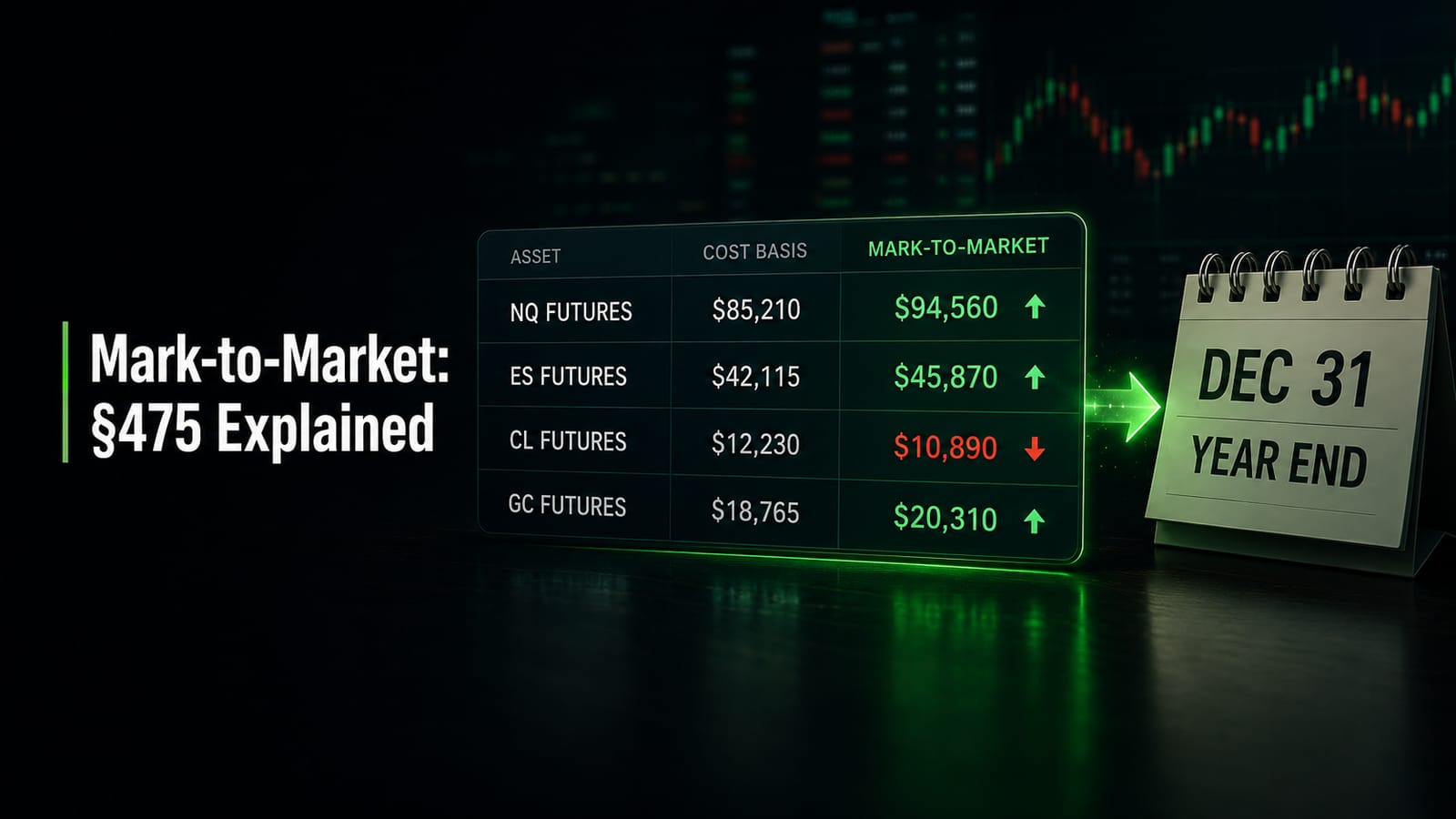
For traders who qualify for TTS, the Section 475(f) election changes the character of trading results: gains and losses become ordinary, the wash sale rule stops applying to elected positions, and open positions are marked to market at year end. It's most powerful for traders with large losses or heavy wash-sale exposure.
The two headline effects for day traders:
- Ordinary loss treatment — a losing year is deductible in full against other income rather than trickling out at $3,000 a year. For a trader with a W-2 spouse or other income, that difference can be worth five figures immediately.
- Wash-sale elimination — because everything marks to market, §1091 tracking on elected trading positions simply stops mattering. The December trap disappears prospectively.
The One Big Beautiful Bill Act (signed July 2025) materially strengthened the §475 election: §475 ordinary losses are now exempt from the wash-sale and capital-loss limits, and §475 income is QBI-eligible — opening the door to the §199A deduction for qualifying traders. For many active day traders, the MTM math looks meaningfully better in 2026 than it did two years ago.
The trade-offs and timing matter. Gains become ordinary too — losing the (rarely relevant for day traders) long-term rate on trading positions — and most electing traders choose securities only, preserving 60/40 treatment on their futures. Timing is the part that catches people: for existing individual taxpayers the election statement is typically due by the original due date of the prior year's return (mid-April, no extensions for the statement itself), while a newly formed entity typically gets a fresh 75-day window — one reason entities and §475 often arrive together. Revoking later requires its own procedure, so this is a model-first decision. The full walkthrough is in the Mark-to-Market guide.
How Are Futures Day Trades Taxed? The Section 1256 60/40 Advantage
Regulated futures contracts — and broad-based index options like SPX — fall under Section 1256: gains are split 60% long-term and 40% short-term regardless of holding period. A trade held ninety seconds gets mostly long-term rates, the wash sale rule doesn't apply, and the top blended federal rate works out to roughly 26.8% versus 37% for short-term stock gains.
This is the quiet structural reason many high-frequency traders gravitate to futures. The compliance side is lighter too:
- One number, not thousands — the broker reports an aggregate figure on Form 1099-B, and it flows to Form 6781, not a trade-by-trade Form 8949.
- No wash sales — in-and-out trading of the same contract all year creates zero §1091 tracking.
- Year-end mark-to-market — open positions are marked to market at December 31 automatically, built into the regime.
- Loss carryback — Section 1256 losses can typically be carried back up to three years against prior 1256 gains, an option stock traders don't get.
The deep dive is at Futures Taxes, and the Section 1256 Calculator shows what the 60/40 split typically saves versus the same P&L in stocks.
How Is Day Trading Through a Prop Firm Taxed?
Funded prop firm day trading is a different tax animal entirely. Payouts are compensation for trading the firm's capital — typically self-employment income on Schedule C, with 15.3% SE tax on 92.35% of the net amount — not capital gains. US-based firms like Apex Trader Funding and TopStep typically issue a 1099-NEC; many international firms issue nothing, but the income is fully taxable either way.
The numbers that frame it for 2026: the 15.3% SE tax splits into 12.4% Social Security — which applies up to the $184,500 wage base for 2026 — and 2.9% Medicare with no cap. Under the OBBBA, the 1099-NEC reporting threshold rises from $600 to $2,000 starting tax year 2026, so more small payouts will arrive without a form — which changes the paperwork, not the taxability. On the plus side, prop traders reporting on Schedule C typically deduct evaluation fees, data, platforms, and other business costs directly against payouts.
| Personal-Account Day Trading | Prop Firm Day Trading | |
|---|---|---|
| What the income is | Capital gains on your own capital | Compensation for trading the firm's capital |
| Typical forms | 1099-B → Form 8949 / Schedule D (Form 6781 for futures) | 1099-NEC → Schedule C + Schedule SE |
| Federal rate | Ordinary rates on short-term; 60/40 on futures | Ordinary rates on net profit |
| Self-employment tax | Typically none — even with TTS | 15.3% on 92.35% of net (SS portion up to $184,500 in 2026) |
| Wash sale rule | Applies to stocks/options (not §1256 futures) | N/A — no personal capital gains involved |
| Losing year | $3,000/yr capital-loss limit (unless §475 applies) | Business expenses/losses on Schedule C |
| Typical deductions | Business expenses generally require TTS | Eval fees, data, platform typically deductible on Schedule C |
| Quarterly estimates | Typically yes, when profitable | Typically yes — nothing is withheld |
Traders who run a funded account and a personal account file both regimes on one return — Schedule C for the payouts, Schedule D/Form 6781 for the personal trading. The Complete Guide to Prop Firm Taxes covers firm-by-firm specifics, multi-firm setups, and the entity math unique to funded traders.
What Deductions Can Day Traders Typically Take?
With Trader Tax Status, day traders typically deduct ordinary and necessary business expenses on Schedule C: platform fees, market data, education, home office, and equipment. Without TTS, most of those costs are nondeductible for individuals — miscellaneous itemized deductions remain suspended — though commissions and fees still adjust cost basis for everyone.
The deductions most TTS day traders capture:
- Platform and software — charting, execution, journaling, and backtesting subscriptions.
- Market data feeds — real-time quotes, depth-of-book, news services, scanners.
- Home office — a dedicated trading space, typically via the simplified square-footage method or actual-expense method.
- Equipment — monitors, computers, and peripherals, commonly expensed in year one under §179 or bonus depreciation.
- Education and mentorship — courses and coaching that maintain or improve the existing trading business (startup-phase education is treated differently, a classic CPA conversation).
- Internet and phone — the business-use portion.
- Professional fees — CPA, tax prep, bookkeeping, entity maintenance.
- Margin interest — investment interest for most traders; TTS traders typically deduct business interest on trading margin without the investment-income cap.
The itemized version with dollar-figure ranges lives in the Trader Deductions List. Prop firm traders get most of the same list against Schedule C payouts — plus evaluation fees — without the TTS qualification question.
Do Profitable Day Traders Owe Quarterly Estimated Taxes?
Typically yes. No one withholds tax on trading profits, so profitable day traders generally make quarterly estimated payments to avoid underpayment penalties. Most rely on a safe harbor: paying 100% of last year's total tax (110% if AGI exceeded $150,000), or 90% of the current year's tax, whichever they can predict.
The prior-year safe harbor is popular with day traders for one reason: it's a known number in January, while current-year P&L is anyone's guess. A trader coming off a small year can typically lock in the safe harbor cheaply and settle the balance in April. Traders whose income lands mostly in one quarter sometimes use the annualized-installment method (Form 2210) instead, matching payments to when profits actually happened. The habit that makes all of it painless: sweeping a fixed percentage of profits — many traders use 25–35% — into a separate tax account as the year goes.
Q1: April 15, 2026 · Q2: June 16, 2026 · Q3: September 15, 2026 · Q4: January 15, 2027. The strategy-level breakdown — safe harbors, annualizing, and the year-end Q4 decision — is in the Q4 Estimated Taxes for Traders guide.
When Does an LLC or S-Corp Typically Make Sense for a Day Trader?
An LLC by itself typically changes nothing on the tax return — a single-member LLC is disregarded, and capital gains stay capital gains. Entities start earning their keep in two situations: prop firm income large enough for S-Corp payroll savings (commonly modeled around $80K+ of net self-employment income), and TTS traders engineering benefits an individual filer can't reach.
The two paths, briefly:
- The prop trader path — Schedule C payouts above roughly $80K of net income are where an S-Corp election typically starts beating the extra payroll and filing costs, by converting part of the SE-taxed profit into distributions. Below that, the admin usually eats the savings.
- The TTS trader path — a trading entity can pay its owner compensation, unlocking retirement plan contributions and health insurance deductions that pure capital gains can't support. A newly formed entity also typically gets a fresh 75-day window to elect §475 — the do-over for traders who missed the individual April deadline.
Entity choice is genuinely situational — state fees, health coverage, retirement goals, and whether income is capital-gains or SE-flavored all move the answer. The full decision framework, with the S-Corp math worked out, is in LLC vs S-Corp for Traders.
What If I Lost Money Day Trading?
Capital losses offset capital gains in full; beyond that, most traders deduct up to $3,000 per year ($1,500 married filing separately) against other income and carry the remainder forward indefinitely. A $60,000 losing year recovered at $3,000 a pop is a twenty-year drip — which is precisely the problem the §475 election exists to solve.
Three things typically matter most in a losing year:
- File anyway. Most traders benefit from filing trading activity even at a loss — it typically protects against IRS notices (the broker's 1099-B shows gross proceeds either way) and it's what preserves the loss carryforward for future years.
- Check the wash sales. Disallowed December losses can make a bad year look profitable on paper. Reviewing open positions and repurchase windows before year end typically keeps the reported loss real.
- Consider §475 for the future. The election is prospective — it can't rescue last year's capital loss — but a qualifying trader who elects going forward typically converts future losing years into fully deductible ordinary losses, now free of the wash-sale and capital-loss limits under the OBBBA.
The recovery playbook — carryforward mechanics, netting order, and when amending makes sense — is in Taxes for Losing Traders.
Not Sure Where You Stand on Taxes?
Answer 8 quick questions. Get a personalized AI summary of your tax exposure, missed deductions, and what to consider next — reviewed by a real CPA.
Get My Free Tax Snapshot →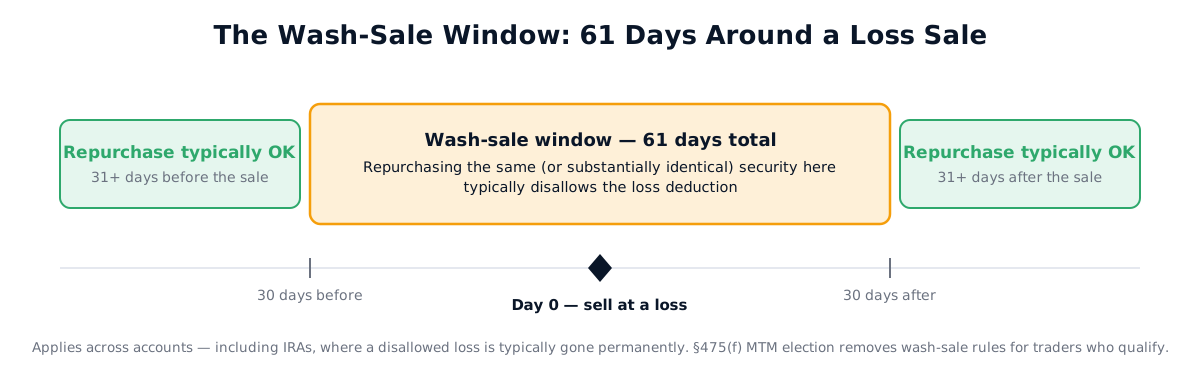
Frequently Asked Questions
Do day traders pay self-employment tax?
Typically no. Profits from day trading a personal brokerage account are capital gains, not earnings from services — so the 15.3% self-employment tax generally does not apply, even for full-time traders with Trader Tax Status. SE tax typically shows up for funded prop firm traders, whose payouts are compensation for trading the firm's capital.
How much tax do day traders typically pay?
Most day trading profits are short-term capital gains taxed at ordinary federal rates of 10%–37% in 2026, plus state income tax and — above $200,000 single / $250,000 joint MAGI — the 3.8% net investment income tax. The preferential 0%/15%/20% long-term rates rarely apply, because day trades close within minutes or hours.
Does the wash sale rule apply to day traders?
Yes — trading in and out of the same tickers means most day traders trigger wash sales constantly. Under IRC §1091 a loss is deferred, not erased, when a substantially identical security is repurchased within 30 days. December wash sales are the real danger: the deferred loss can land in the next tax year. Section 1256 futures are exempt.
What is Trader Tax Status and how do day traders typically qualify?
Trader Tax Status is an IRS classification — not an election or a form — for traders whose activity is substantial, frequent, regular, and continuous, seeking to profit from short-term price swings rather than long-term appreciation. Qualifying traders typically deduct business expenses on Schedule C. There is no bright-line test; it is facts-and-circumstances, and every situation varies.
Is the Mark-to-Market election worth it for day traders?
For traders who qualify for TTS, the §475(f) election converts trading losses to ordinary losses, eliminates wash-sale tracking on elected positions, and — under the OBBBA — §475 income is QBI-eligible. The trade-off is that gains become ordinary too. Most electing traders choose securities only, preserving 60/40 treatment on futures. Election timing rules make CPA guidance valuable.
How are futures taxed for day traders?
Regulated futures contracts fall under Section 1256: gains are split 60% long-term and 40% short-term regardless of holding period — even a trade held ninety seconds — and the wash sale rule does not apply. For most active traders, that blend produces a meaningfully lower effective rate than short-term stock trading, with a top blended federal rate around 26.8%.
What happens if I lose money day trading?
Capital losses first offset capital gains in full. Beyond that, most traders deduct up to $3,000 per year ($1,500 married filing separately) against other income and carry the remainder forward indefinitely. Traders with a valid Mark-to-Market election typically deduct trading losses as ordinary losses without the $3,000 cap. Filing even in a losing year preserves the carryforward.
See what your day trading taxes typically look like
Most day traders' bills come down to a handful of levers: short-term rates, wash-sale exposure, futures mix, prop payouts, and deductions. The exact number depends on bracket, state, and structure — every situation varies. The tools below give a ballpark; a TraderTax-matched CPA confirms what actually applies.
Or create a free account to get matched with a CPA →This page is the map — each topic above has a dedicated deep-dive guide or tool. Keep going wherever your situation points:
Related Articles


This guide is informational only and is not personalized tax advice — every trader's situation varies, and the right answers depend on facts a page can't see. TraderTax matches traders with independent licensed CPAs who specialize in trader taxation. Curious how client data is protected? See our security practices.