- Yes — typically. Eval fees, reset fees, and monthly subscriptions are commonly deductible as ordinary and necessary business expenses against prop firm self-employment income on Schedule C.
- Deductibility typically does not depend on passing the eval. Failed eval fees are still typically deductible against future prop firm income.
- Most prop traders track every payment to Apex, TopStep, Tradeify, Lucid, FTMO throughout the year. Credit card statements and email receipts are typically the documentation CPAs work from.
- The $600 → $2,000 1099-NEC threshold change from OBBBA (effective tax year 2026) doesn't change deductibility — payments below $2,000 may not appear on a 1099 but are typically still deductible expenses against the trader's prop firm income.
- Every situation varies — entity structure, business-purpose framing, and recordkeeping all affect the deduction. A CPA who specializes in prop firm taxation confirms what applies.
If you've paid evaluation fees to Apex Trader Funding, TopStep, Tradeify, Take Profit Trader, FTMO or any other prop firm — whether you passed or failed — those fees are generally deductible, and there is one situation where they are not. This page covers both, because the second one is where traders actually get caught.
Yet most prop firm traders either don't know this, or don't claim it correctly. This guide explains exactly how to deduct prop firm evaluation fees in 2026.
Generally yes — once your trading business is actually underway. Evaluation fees, reset fees and funded-account fees are typically ordinary and necessary business expenses under IRC §162, including attempts you failed and multiple attempts, and whether or not this year was profitable.
The condition matters. §162 deducts the expenses of carrying on a business. A funded trader taking payouts clearly is. A trader who has never been funded, has no payout history and nothing else going on may not be — and for that trader the same dollars are treated differently. That case is covered in full below.
Why Are Prop Firm Fees Deductible?
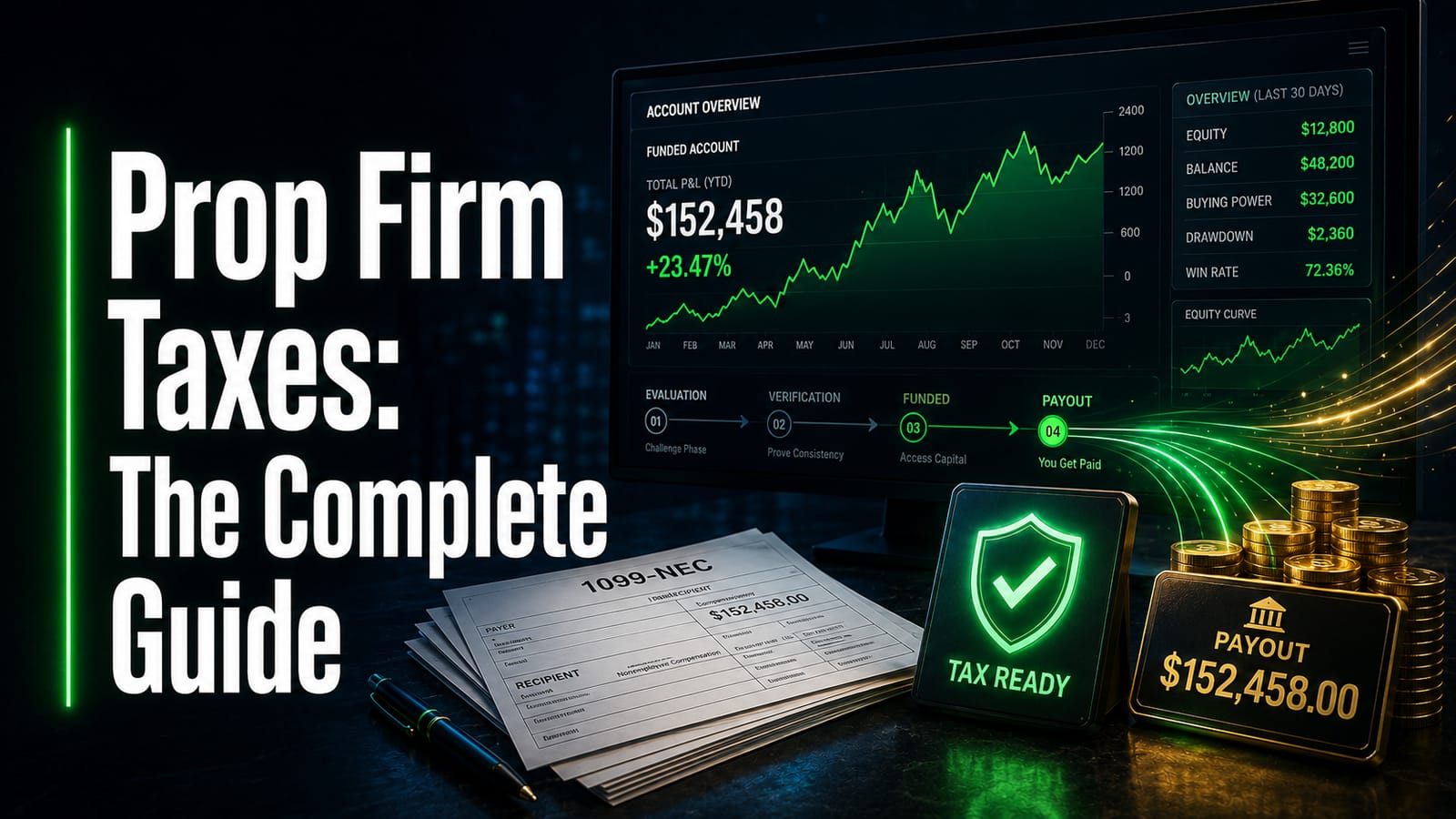
A funded prop firm trader is generally not trading their own capital — they are providing a trading service to the firm and being paid a share of the results, which is why the payout arrives on a 1099-NEC rather than a brokerage 1099-B. That service is the trade or business, and once it is underway you can deduct its ordinary and necessary business expenses — and the IRS defines "ordinary" as common in your industry, and "necessary" as helpful and appropriate for your business. Those definitions, and the records the IRS expects behind a deduction, are published on its Deducting Business Expenses page.
Paying evaluation fees to gain access to funded capital is a normal, necessary expense for prop firm traders. It's no different from a contractor paying for licensing exams or a delivery driver paying for their CDL test.
Which Fees Are Deductible?
| Fee Type | Deductible? | Notes |
|---|---|---|
| Evaluation / Challenge fees | Generally yes | Including attempts you failed — if your business was underway |
| Reset fees | Generally yes | Inherits the treatment of the evaluation it resets |
| Monthly subscription / platform fees | Generally yes | Strongest of the four — paid while the account is live |
| One-time activation fee | Generally yes | The only category with a capitalisation question — see below |
| Upgrade fees | Generally yes | Upgrading account size or conditions |
| Add-on fees | Yes — generally | Extra account, scaling plan fees |
| Capital contribution to prop firm | Usually not | Treated as investment, not expense |
What If You Failed the Evaluation?
Failing does not by itself cost you the deduction. §162 asks whether an expense was ordinary and necessary, not whether it worked. A trader already in the business who failed three Apex evaluations and spent $1,800 is generally deducting all $1,800 — the same way any business deducts a bid it did not win.
What does change the answer is whether you were in business at the time. This is the part most guides skip, and it is the difference between a full deduction and no deduction at all.
- Already funded, here or at another firm. The business is being carried on. Failed attempts are ordinary costs of it. Generally deductible.
- Never funded, no payout history, shopping across firms. These look like costs of deciding whether and which business to enter — start-up expenditures under §195. Those are not lost: you deduct up to $5,000 in the year the business becomes active (reduced if start-up costs exceed $50,000) and amortise the rest over 180 months. But you do not deduct them this year.
- Never funded, and you had committed to one specific firm’s program. Rev. Rul. 99-23 treats costs of an attempt to acquire a specific business as capital rather than §195 — which generally become a deductible loss under §165 when the attempt is abandoned.
- No real profit motive. If the activity is not engaged in for profit under §183, the route that used to rescue these fees is gone. Before 2018, expenses of a not-for-profit activity were deductible up to the income from it as a miscellaneous itemized deduction. §67(g) suspended that whole class of deduction, and OBBBA made the suspension permanent — so for 2026 forward there is no miscellaneous-itemized fallback. §183 does still allow deductions that would be allowable without regard to a profit motive, so “nothing is deductible” overstates it as a general rule — but an evaluation fee is not in that category, and which of a given trader's costs survive is fact-specific rather than one answer for everybody. One evaluation attempt, no records, no plan, nothing else going on is exactly the fact pattern §183 is for.
The nine factors under Treas. Reg. §1.183-2(b) weigh objective evidence more heavily than stated intent, which in practice means the records you keep from the first attempt, not the first payout, are what carry the deduction. Separate account, every receipt, a written approach, time logged.
The One-Time Activation Fee: Where the Capitalisation Question Lives
Three of the four fee types are plain period expenses. The fourth — a one-time fee you pay to obtain the funded account, such as TopStep’s Express Funded activation fee or a PA activation fee — is the one where someone could argue you acquired a contract right rather than bought a service, and that the cost should be capitalised rather than deducted.
The intangibles regulations are where people go looking for a way out of that argument, and they are narrower than the summaries suggest. Treas. Reg. §1.263(a)-4 carries two provisions that get quoted in this context. Neither is a blanket exemption for prop-firm fees, and the first is routinely misread:
- The $5,000 figure is a de minimis rule for transaction costs — not for the fee itself. §1.263(a)-4(e)(4) is a convention for amounts paid to facilitate the acquisition or creation of an intangible, and it carries its own conditions. It is about the cost of papering a deal, not about converting the price of a right you acquired into a current deduction. “My fee was under $5,000, so it is deductible” is not what that rule says.
- The 12-month rule is the one that could actually reach the fee. §1.263(a)-4(f) relieves capitalisation where the right or benefit created does not extend beyond the earlier of 12 months after the taxpayer first realises it, or the end of the tax year following the year of payment. That turns entirely on how long your funded-account right runs under the firm’s contract — a fact in the paperwork, not a price point.
- The size of the fee is not the test. Both provisions are written around an agreement, a right, and in the de minimis case costs that facilitate a transaction. Whether your activation payment creates a right at all, what agreement it sits under, how long that right runs, and whether any part of what you paid is facilitative rather than the price itself are all facts in the firm’s contract — and firms do not write those contracts the same way.
- Where the de minimis rule does apply, it is an aggregate test, not a per-payment one. It is measured across the transaction rather than payment by payment, so a trader paying one firm repeatedly can sit nearer that line than they expect — and whether a firm’s evaluations, resets and activations are one arrangement or several is a contract question we cannot verify firm by firm.
- So we do not use this regulation to reach the answer. It is a reason the capitalisation objection is not automatic. It is not a basis for concluding that a prop-firm activation or evaluation fee is deductible.
Where that leaves it. The provision that decides a prop-firm fee is not in the intangibles regulations at all — it is the question at the top of this page: was your trading business actually being carried on when you paid? If it was, §162 is the operative provision. If it was not, §195 start-up treatment, Rev. Rul. 99-23 or §183 is — and no threshold in §1.263(a)-4 changes that. Where a one-time activation fee plainly buys a multi-year right, or you are into four figures with one firm in a single year, that is the point to have someone read the actual agreement.
How to Report Prop Firm Fee Deductions
Prop firm evaluation fees are reported as business expenses on Schedule C — the same form where you report your prop firm income. They reduce your net self-employment income, which reduces both income tax and self-employment tax.
Keep all receipts and payment confirmations. Most prop firms don't send annual expense summaries — most prop traders track payments themselves throughout the year.
Prop Firm Fees + Prop Firm Income: The Net Tax Calculation
Here's how prop firm fees interact with your income to reduce your tax bill:
| Example | Amount |
|---|---|
| Total prop firm payouts received | $28,000 |
| Evaluation fees paid | -$3,200 |
| Monthly subscription fees | -$960 |
| Platform and data fees | -$1,440 |
| Net taxable self-employment income | $22,400 |
| SE tax on net income (~14.1%) | $3,158 |
| Federal income tax (22% bracket) | $4,928 |
| Total tax owed | ~$8,086 |
Without deducting the $5,600 in fees, the trader would pay tax on the full $28,000 — resulting in approximately $9,940 in tax. The deductions saved approximately $1,854 — more than enough to cover a year of professional tax preparation.
What Records Should You Keep?
- Payment confirmations or receipts from the prop firm for every fee paid
- Bank or credit card statements showing the payments
- A log of evaluation attempts (date, firm, fee paid, result)
- Evidence you were actively trading as a business (trading journal, account statements)
Does This Apply Even If You're Not Yet Profitable?
Yes. Traders who are in the process of building their funded trading business — paying evaluation fees and not yet consistently profitable — can still deduct these expenses. The IRS allows deductions for legitimate business expenses even in loss years, as long as you have a profit motive and are conducting your trading like a business.
A trader who spent $4,000 on prop firm fees and received no payouts has a $4,000 business loss — which can offset other income (like a W-2) up to certain limits.
Frequently Asked Questions
Are prop firm evaluation fees tax deductible?
Generally yes, once your trading business is underway. Prop firm evaluation fees are typically ordinary and necessary business expenses under IRC §162, including attempts you failed. This includes challenge fees, reset fees, monthly subscription fees, and upgrade fees.
Can I deduct failed prop firm challenge fees?
Generally yes, if your trading business was already underway. §162 asks whether an expense was ordinary and necessary, not whether it succeeded. The case that differs is a trader who has never been funded and has no payout history: those fees can instead be start-up expenditures under §195, or not deductible at all if the activity is not engaged in for profit under §183.
How much can I save by deducting prop firm fees?
Most active prop firm traders have $3,000 to $6,000 or more in deductible fees annually from evaluation costs, subscriptions, and resets across multiple firms.
Not Sure Where You Stand on Taxes?
Answer 8 quick questions. Get a personalized AI summary of your tax exposure, missed deductions, and what you should do next — reviewed by a real CPA.
Get My Free Tax Snapshot →Dig deeper into the adjacent topics most relevant for active traders: