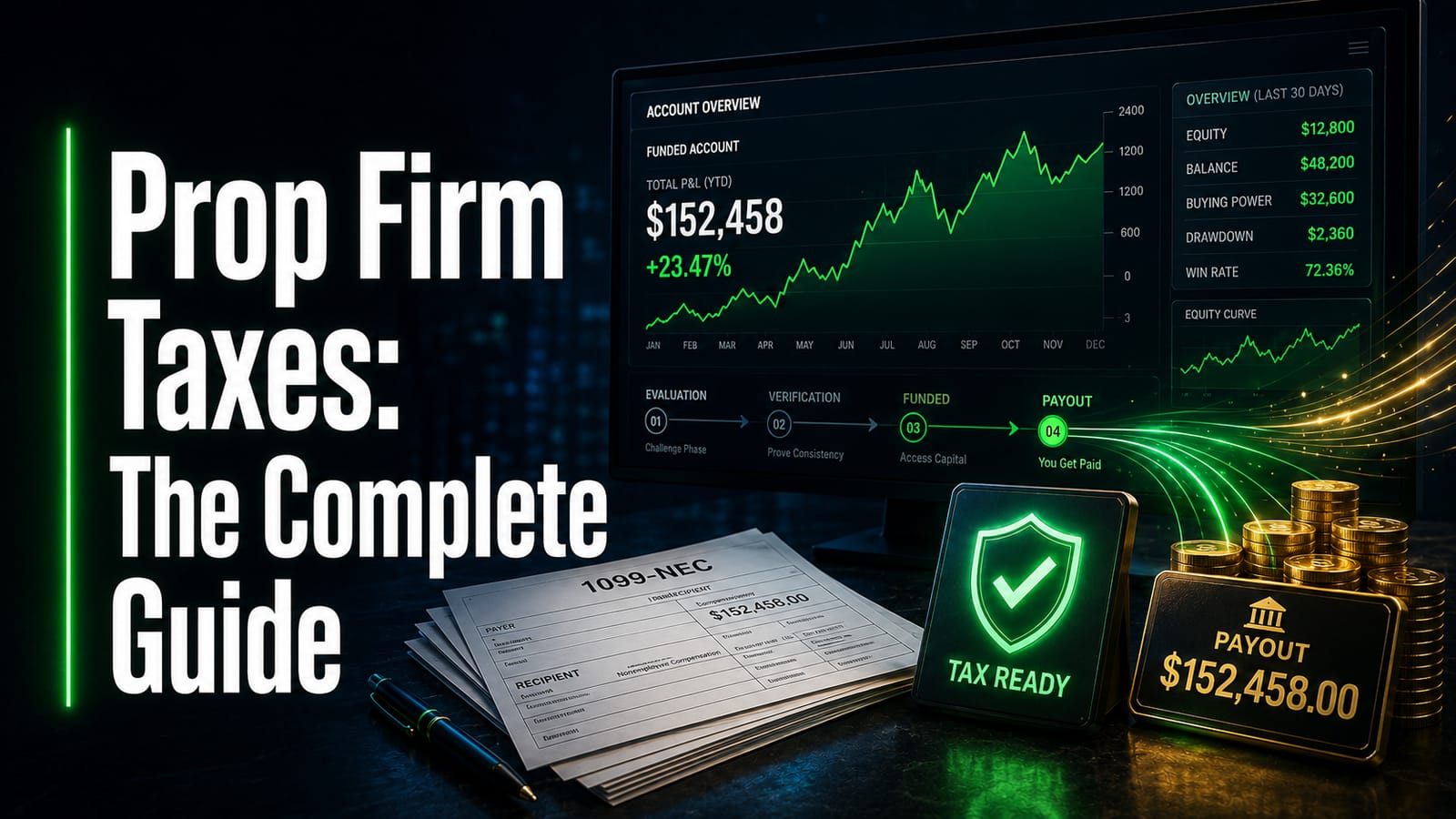
- TopStep typically issues a 1099-NEC for traders who exceed the IRS reporting threshold — same treatment whether earned via the Trading Combine or Express Funded path.
- In most cases, TopStep payouts are reported as self-employment income on Schedule C — federal income tax plus 15.3% self-employment tax on the net amount.
- Trading Combine fees, Express Funded fees, monthly subscriptions, data fees, and a portion of home office costs are typically deductible — even for failed evaluations.
- Most TopStep traders track payouts year-round and reconcile against the 1099-NEC at tax time; quarterly estimated payments are commonly recommended.
- Every situation varies — a CPA who specializes in trader taxation can confirm what applies, including entity election (LLC / S-Corp) and Mark-to-Market.
The OBBBA (signed July 2025) raised the 1099-NEC reporting threshold from $600 to $2,000 starting tax year 2026 (what the form does and does not change is covered in the prop firm 1099-NEC guide). Traders with payouts under $2,000 typically will not receive a 1099 — but the income remains fully taxable on Schedule C.
TopStep is one of the most established prop firms in the futures trading industry. Whether you earned your funded account through the Trading Combine or Express Funded path, the tax treatment is the same — and it catches many traders off guard.
If you've received payouts from TopStep in 2025 or 2026, this guide explains exactly how that income is classified, what forms you'll receive, what you can deduct, and how to file correctly.
TopStep payouts are self-employment income — NOT capital gains. You owe income tax plus 15.3% self-employment tax on your net earnings. This catches many traders off guard when their tax bill is thousands higher than expected.
How TopStep Classifies Your Income
TopStep pays you a percentage of the profits you generate in your funded account. In the eyes of the IRS, this makes you an independent contractor — not an investor. You are performing a service (trading) in exchange for compensation (profit share).
This means TopStep income is ordinary self-employment income, subject to:
- Federal income tax at your marginal rate (10%–37%)
- Self-employment tax of 15.3% on net earnings up to $184,500 (2026)
- State income tax (varies by state)
The 15.3% rate and the wage-base cap above it are set by the IRS, not by TopStep — both are published on the IRS's Self-Employment Tax (Social Security and Medicare Taxes) page, along with the Schedule SE mechanics. The cap is re-indexed annually, so most traders confirm the current figure there or with a CPA before running estimates.
TopStep issues a 1099-NEC to all US-based traders who earn $2,000 or more in annual payouts. The IRS receives a copy, so the income must be reported on your return.
Trading Combine vs Express Funded — Tax Differences
TopStep offers two paths to a funded account: the Trading Combine (a multi-step evaluation) and Express Funded (a faster single-step path). From a tax perspective, the distinction matters primarily for deductions:
| Path | Evaluation Cost | Deductible? | How to Report Income |
|---|---|---|---|
| Trading Combine | $49–$149/month | Generally yes | Schedule C as SE income |
| Express Funded | $149–$349 one-time | Generally yes | Schedule C as SE income |
| Reset Fees | $49–$149 per reset | Generally yes | Deducted as business expense |
Both paths produce the same tax outcome: your payouts are self-employment income, and all fees paid to TopStep are deductible business expenses. The only difference is whether your deductions are monthly subscriptions (Trading Combine) or one-time fees (Express Funded).
TopStep Payout Methods and Tax Implications
TopStep processes payouts through direct deposit and Payoneer. Both methods produce taxable income — the payment method does not change the tax treatment.
- Direct deposit — Funds appear in your bank account. Easy to track via bank statements.
- Payoneer — Funds are deposited to your Payoneer account. Make sure to track these separately — Payoneer may not appear on your regular bank statements.
When you receive a payout matters for taxes. A payout received on December 30, 2025 is 2025 income — even if you don't spend it until 2026. A payout on January 2, 2026 is 2026 income. Check the actual deposit date, not the request date.
Do TopStep’s payout methods change the tax?
Not the amount owed, but two things that matter: what you can deduct, and which year a payout lands in.
TopStep reportedly supports several withdrawal routes — ACH, domestic wire, Wise, and international wire/SWIFT — and processing fees may apply depending on the method chosen. Those fees are a cost of collecting business income and are commonly deductible against it, which means the cheap-looking method and the tax-efficient method are not always different. Keep the fee, not just the net amount that arrived.
TopStep has also reportedly partnered with Aeropay to offer instant payouts, with approved withdrawals reaching a US bank account in seconds. That is genuinely useful at tax time, and for an unusual reason: it removes year-end ambiguity.
The year a payout belongs to generally follows when the funds became available to you. A wire requested on December 30 that settles on January 3 sits in a genuinely awkward spot — requested in one tax year, received in the next. An instant payout collapses that gap: requested and received on the same day, in the same year, with no interpretation required. Traders who withdraw near year-end and want a clean answer generally have one here, provided they keep the timestamp.
The practical rule either way: record the request date and the availability date for every withdrawal, plus the method and any fee. Where those two dates fall in different years, that is exactly the record a CPA needs.
Express Funded withdrawal limits and what they mean in December
TopStep’s Express Funded Account reportedly caps a withdrawal at $5,000 or 50% of the account balance, and TopStep reportedly does not charge its own withdrawal fee on Express Funded or Live Funded distributions — though third-party processing fees can still apply depending on the route.
The cap is not a tax rule, but it has a tax consequence worth planning around. A trader sitting on a large balance late in the year cannot necessarily withdraw all of it before December 31, which means income can fall into the following year because of an account limit rather than a choice. That is not a problem — it is simply a fact to know before assuming a given year’s tax position is settled. It also cuts the other way: a trader expecting a lower bracket next year has a structural reason the timing may work in their favour, and one expecting a higher one has a reason to look at the schedule earlier.
The same point applies to the Trading Combine versus Express Funded routes generally: the path to funding does not change how a payout is characterized — both typically produce the same kind of income — but the withdrawal rules attached to each shape when it is received.
What TopStep Traders Can Deduct
As a self-employed trader, you can deduct all ordinary and necessary business expenses against your TopStep income. These deductions reduce your taxable income dollar-for-dollar.
- Trading Combine subscription fees — Each month you paid for the Combine is generally deductible.
- Express Funded activation fees — The one-time fee is generally deductible in the year paid. A one-time fee paid to enter an agreement is the one category where capitalisation is even arguable. The intangibles regulations are narrower here than they look: the $5,000 de minimis rule in Treas. Reg. §1.263(a)-4(e)(4) is a convention for transaction costs with its own conditions, not a “fees under $5,000 are deductible” safe harbour, and the 12-month rule turns on how long the right the fee buys actually runs under the firm’s agreement. In practice the question that decides it is the same as for every other fee: was your trading business underway when you paid it. The four fee types, broken out →
- Reset and retry fees — Paid to restart an evaluation? Deductible.
- Platform software — NinjaTrader, Tradovate, TradingView, Sierra Chart.
- Market data fees — CME data, exchange subscriptions.
- Trading education — Courses, mentorship, paid trading communities.
- Home office — Dedicated trading space in your home (simplified or regular method).
- Equipment — Monitors, computers, desks, keyboards.
- Internet and phone — Business-use percentage deductible.
- Professional services — CPA fees, tax preparation, bookkeeping.
Many TopStep traders cycle through multiple Trading Combine months or Express Funded attempts before getting funded. All of those fees — even for evaluations you failed — are deductible business expenses. See our full guide: Trader Tax Deductions Most People Miss.
Step-by-Step: Filing Your TopStep Taxes
Step 1 — Download Your TopStep Payout History
Log into your TopStep dashboard and export a complete record of all payouts received during the tax year. If you used Payoneer, also download your Payoneer transaction history to cross-reference.
Step 2 — Match Against Your 1099-NEC
TopStep sends the 1099-NEC by January 31. Compare the reported amount against your payout records. If there's a discrepancy, contact TopStep support before filing. Your tax return amount must align with what TopStep reported to the IRS.
Step 3 — Calculate Total Deductions
Review all TopStep-related expenses: Combine subscriptions, Express Funded fees, resets, platform costs, data feeds, equipment, and home office. Organize by category and keep receipts for every expense.
Step 4 — File Schedule C
Report your total TopStep payouts as gross income on Schedule C, Part I. Enter your itemized deductions in Part II. Your net profit (income minus expenses) is what flows to your 1040 and is subject to income tax.
Step 5 — Pay Self-Employment Tax
Complete Schedule SE using your net profit from Schedule C. Self-employment tax is 15.3% on 92.35% of your net earnings. Remember: you can deduct half of SE tax as an adjustment to income on your 1040.
Step 6 — Plan for Next Year
Set up quarterly estimated tax payments to avoid penalties next year. If your net TopStep income exceeds $50,000–$80,000 consistently, consider forming an LLC with S-Corp election to reduce SE tax. See: LLC vs S-Corp for Traders.
Quarterly Estimated Taxes
TopStep does not withhold taxes from your payouts. You receive the full amount and must manage your own tax payments.
Q1: April 15, 2026 · Q2: June 15, 2026 · Q3: September 15, 2026 · Q4: January 15, 2027. Set aside 30–35% of every payout for taxes. Open a separate savings account specifically for tax reserves.
TopStep + Other Prop Firms
If you trade TopStep alongside Apex, Tradeify, or other firms, all prop firm payouts are combined as self-employment income on a single Schedule C. You may receive separate 1099s from each firm — make sure each one matches your records.
For the full breakdown of how all prop firm income is taxed — including international firms, entity structures, and multi-firm strategies — see our Complete Guide to Prop Firm Taxes.
Common TopStep Tax Mistakes
- Not tracking Payoneer payouts separately — Payoneer income may not show on your bank statements. Track it independently.
- Missing evaluation fee deductions — Trading Combine months and Express Funded fees are generally deductible, including failed attempts.
- Skipping quarterly estimated payments — Results in IRS underpayment penalties even if you pay everything when you file.
- Reporting TopStep income as capital gains — Incorrect classification that can trigger an IRS audit.
- Not keeping records of payout dates — The date you received the funds (not requested them) determines which tax year the income belongs to.
Frequently Asked Questions
Are TopStep withdrawal fees tax deductible?
Processing fees on a withdrawal are a cost of collecting business income and are commonly deductible against it. TopStep reportedly supports ACH, domestic wire, Wise and international wire/SWIFT, with fees that vary by method, and reportedly does not charge its own withdrawal fee on Express Funded or Live Funded distributions. Keep the fee figure rather than only the net amount received, since the gross payout is what goes into income and the fee is a separate deduction.
Do TopStep instant payouts change when the income is taxable?
They make the answer clearer rather than different. The year a payout belongs to generally follows when the funds became available to you. A wire requested on December 30 that settles January 3 straddles two tax years; an instant payout via TopStep's reported Aeropay partnership is requested and received the same day, so there is no gap to interpret. Keep the timestamp either way — where the request and availability dates fall in different years, that record is what a CPA needs.
Does the Express Funded withdrawal cap affect my taxes?
Indirectly. The Express Funded Account reportedly caps a withdrawal at $5,000 or 50% of the balance, so a trader with a large balance late in the year may be unable to withdraw all of it before December 31. That can push income into the following tax year because of an account limit rather than a planning decision. It is not a problem, but it is worth knowing before treating a year's tax position as settled.
Is Trading Combine income taxed differently from Express Funded income?
Typically no. The route to funding does not change how a payout is characterized — both generally produce the same kind of income, commonly reported as self-employment income on Schedule C. What differs is the withdrawal rules attached to each, which affect when a payout is received rather than what kind of income it is.
Does TopStep send a 1099?
Yes. TopStep issues a 1099-NEC to US-based traders who receive $2,000 or more in payouts. This form reports your earnings as non-employee compensation, which is self-employment income.
Are TopStep subscription and evaluation fees tax deductible?
Generally yes, once your trading business is underway. TopStep Trading Combine fees, Express Funded activation fees, monthly subscriptions and data fees are typically ordinary and necessary business expenses on Schedule C — including evaluations you did not pass. If you have never been funded and have no payout history, the same fees may instead be start-up expenditures under §195.
Do I pay US taxes on TopStep income if I live outside the US?
If you are a US citizen or resident alien, yes — you owe US taxes on worldwide income including TopStep payouts, regardless of where you live. Non-US persons may not owe US tax depending on their tax treaty.
See what your TopStep taxes typically look like
Most TopStep traders typically owe federal income tax plus 15.3% self-employment tax on their net payouts after deductible expenses. The exact number depends on the trader's bracket, state, deductions, and entity structure — every situation varies. The tools below give a ballpark; a CPA confirms what actually applies.
Or create a free account to get matched with a CPA →TopStep runs futures funded account programs at topstep.com. We handle the tax filings for many TopStep-funded traders. If you trade with TopStep and want to talk through what filing typically looks like for your situation, create a free account and we'll take it from there.
Trade with multiple prop firms? Each firm structures payouts a bit differently, so the tax treatment varies. Here are the dedicated guides for the other major US futures prop firms: