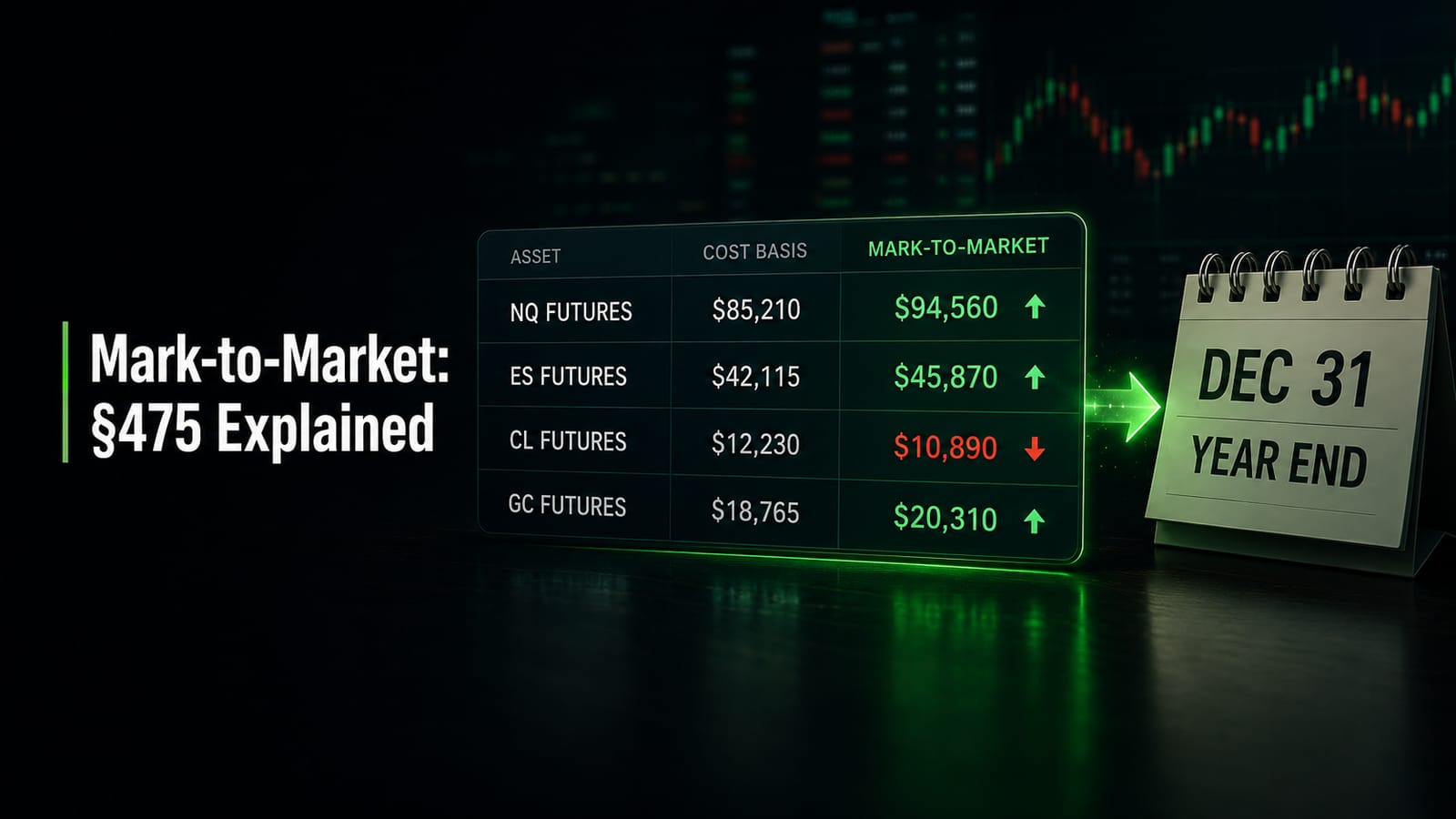
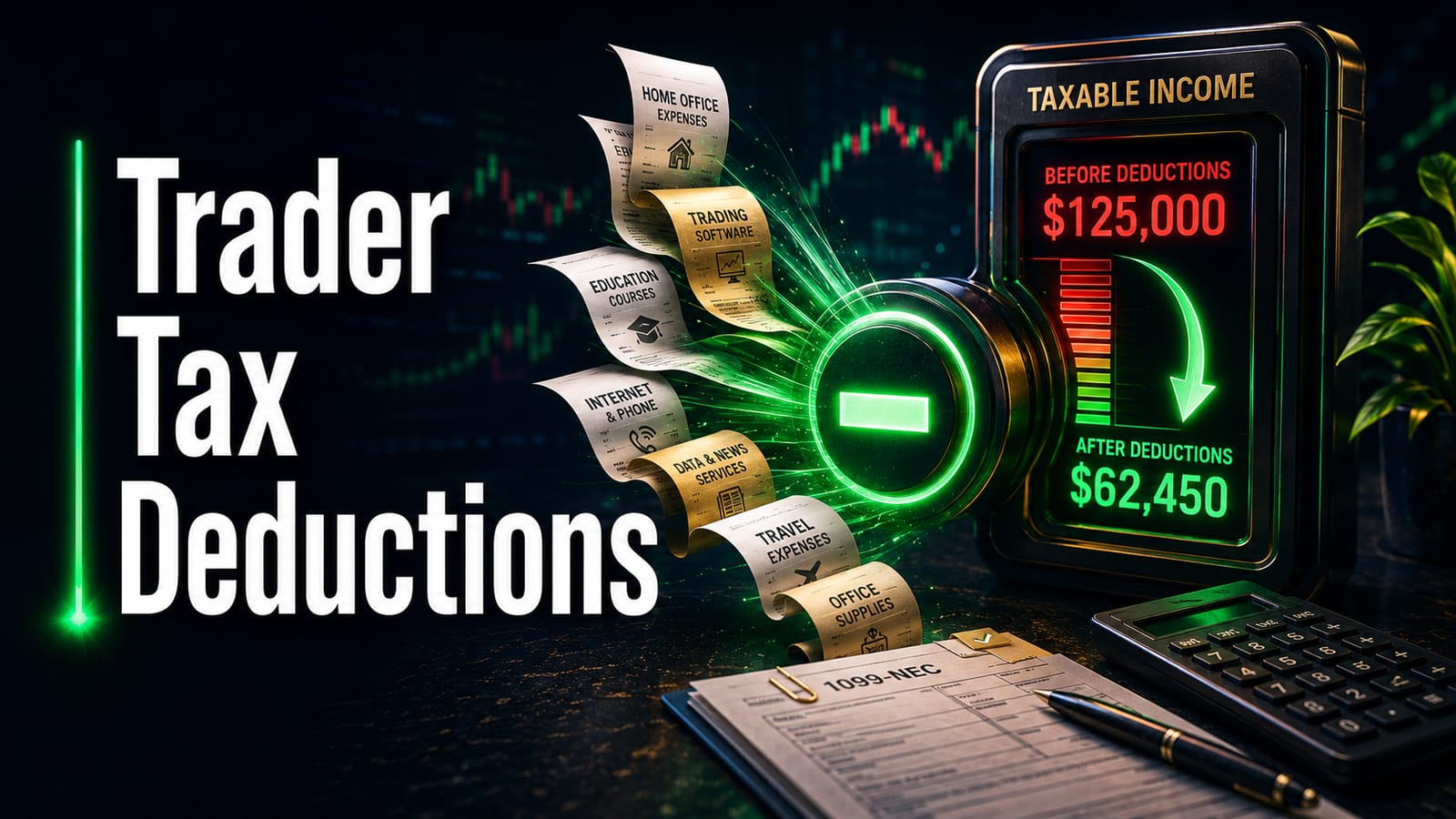
- Robinhood sends one consolidated 1099 — 1099-B, 1099-DIV, 1099-INT, and 1099-MISC combined in a single PDF, typically arriving around mid-February. Corrected versions often follow, so filing off the first version is a classic early-filer mistake.
- For most traders, gains in a personal Robinhood account are capital gains — not self-employment income. Day-trading profits are mostly short-term gains taxed at ordinary rates, with no 15.3% SE tax for most traders.
- Wash sales are only tracked inside the same account. Robinhood — like brokers generally — adjusts for identical securities in that one account; trades in other brokerages or IRAs aren't tracked, so active traders typically can't rely on the 1099-B alone.
- Free-stock promos are typically taxable as other income at fair market value, and crypto is reported separately — digital-asset reporting forms have been changing, so a CPA confirms what applies for the current year.
- Every situation varies — a TraderTax-matched CPA who specializes in trader taxation can confirm cross-account wash sales, Trader Tax Status, the §475(f) mark-to-market election, and margin-interest deductibility for a specific trader.
Robinhood put commission-free trading in millions of pockets, and every one of those accounts generates the same set of tax questions each spring: what the consolidated 1099 actually contains, why a corrected version showed up in March, why the wash-sale column looks bigger than expected, and whether day-trading profits count as a "business." This guide walks through how most Robinhood traders handle each of those — in general, evergreen terms, since forms and features evolve over time.
The good news: for most traders, Robinhood activity is ordinary capital-gains reporting — Form 8949 and Schedule D — with a few broker-specific wrinkles. The catch is that the wrinkles (corrected 1099s, cross-account wash sales, transferred-in cost basis, separately reported crypto) are exactly where early filers and high-volume traders typically get tripped up.
Filing in early February off the first consolidated 1099 is the most common Robinhood tax misstep. Issuers reclassify dividends and brokers update cost basis after the initial mailing, so CORRECTED consolidated 1099s commonly arrive in late February or March. Traders who filed before a correction landed can typically amend with Form 1040-X — but many prefer to simply wait for the form to settle.
What Tax Forms Does Robinhood Send?
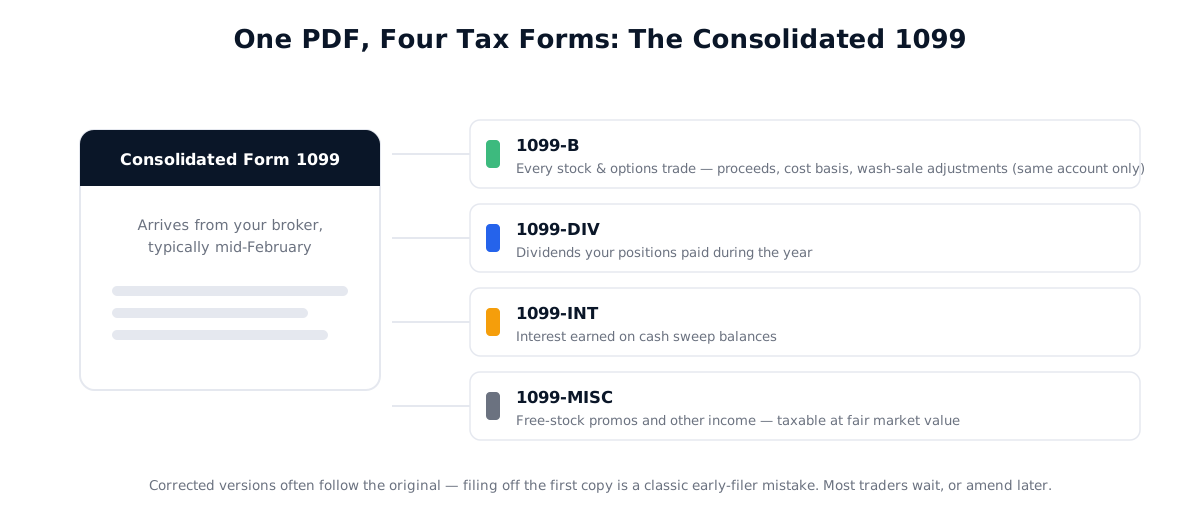
Robinhood typically issues a consolidated 1099 — one PDF combining the 1099-B (stock and options sales), 1099-DIV (dividends), 1099-INT (interest), and 1099-MISC (promotions and other income) — generally arriving around mid-February. Crypto activity is usually reported separately on its own digital-asset forms, and corrected versions of the consolidated form often follow.
The consolidated format is convenient — everything in one place — but it also means one corrected line item regenerates the whole document. A reclassified dividend or a basis adjustment on a single position produces a new CORRECTED consolidated 1099, and the corrected version is the one that matches what the IRS receives. Most traders download the final version directly from the app's tax-documents section rather than relying on the first email.
Consolidated 1099s follow a later deadline than the W-2s and simple 1099s that arrive in January — mid-February is normal, not late. Traders with positions in REITs, ETFs, or foreign stocks tend to see corrections more often, because those issuers commonly reclassify distributions after year-end. Every year varies; the in-app tax center shows the current status.
What the consolidated 1099 does not cover — event contracts
The consolidated form is convenient enough that it creates its own trap: it is reported not to include event contracts. If you have traded Robinhood’s prediction markets, the 1099 package that lands in February is reported to cover your stocks, options, dividends and interest — and not that activity.
What is reported to arrive instead is an Event Contracts Annual Statement: a post-year-end document listing individual transactions, closing dates, costs, proceeds, fees and net profit or loss. Useful, and Robinhood itself is reported to state that it is not a substitute tax reporting form. It is a record, not a return attachment, and nothing corresponding to it is reported to the IRS on your behalf.
Every other trap on this page is about a form being late or corrected. This one is about a form that never arrives at all for part of your activity, inside the same app, in the same tax year — while a very official-looking consolidated 1099 arrives for everything else. The reasonable assumption is that one document covers one account. For event contracts that assumption is reported not to hold.
A missing form changes your evidence, not your liability. Income is reportable whether or not an information return exists, so the practical consequence is that you are the record-keeper for that slice — download the annual statement while it is available rather than next April.
How event contracts are actually taxed is a separate and genuinely unsettled question, and not one this page answers. Practitioners work from several competing frameworks and the IRS has not ruled on event contracts; we lay out the competing treatments without selecting one on prediction market taxes, with the platform-by-platform form picture on do I pay taxes on Kalshi. If you traded both stocks and event contracts in the same year, treat them as two sets of records and two decisions — not one 1099.
Who you are actually trading with — and why sources disagree
Robinhood’s event contracts are reported to run through Robinhood Derivatives, LLC and to be traded on KalshiEx LLC. The exchange underneath is therefore the same one that powers Kalshi’s own app and, on current reporting, Coinbase’s. The document you receive comes from the front end and its broker, not from the exchange — which is why three traders on the same exchange can have three different paperwork experiences.
Public sources genuinely conflict on what Robinhood sends, and it is more honest to name that than to pick a side:
- Robinhood’s own support material has been quoted as saying event-contract settlement payments are reported as miscellaneous income on a 1099.
- Other commentary quotes Robinhood as stating it will not provide 1099s for event-contract trades.
- A third strand describes event-contract activity appearing within the consolidated statement.
These cannot all describe the same thing, and we have not been able to establish which reflects current practice. The possibilities are not mutually exclusive either — a settlement payment reported as miscellaneous income and trade-level P&L going unreported could both be true at once, which may be exactly where the confusion comes from.
What to do with that: treat your in-app tax centre as the only authority for your own year, download the annual statement while it is available, and keep your own position-level records regardless. None of this changes the underlying obligation — income is reportable whether or not an information return exists.
Platform-practice note: which documents a broker issues for event contracts is a broker-by-broker question that changes year to year, and the statements above are what is publicly reported rather than something we have confirmed against Robinhood’s own current documentation. Check your in-app tax centre for what it actually says this year.
Are Day-Trading Gains on Robinhood Self-Employment Income?
Typically no — and this is the most common misconception among active Robinhood traders. For most traders, gains in a personal account are capital gains: mostly short-term, taxed at ordinary income rates, reported on Form 8949 and Schedule D. They are not self-employment income, so no 15.3% SE tax applies for most traders.
The confusion usually comes from prop firms, where funded-account payouts are compensation for trading someone else's capital and typically do carry self-employment tax. Trading your own money in your own brokerage account is different: the IRS generally treats it as investing activity, however frequent. Short-term gains lose the favorable long-term rate — but they don't pick up SE tax in exchange.
For genuinely full-time, high-volume traders, the levers worth evaluating are Trader Tax Status (TTS) and the §475(f) mark-to-market election — which can unlock business expense treatment and, for those who qualify, eliminate wash-sale adjustments entirely. Both have real qualification hurdles and real trade-offs, which is why most serious traders model them with a CPA rather than self-electing. See Day Trading Taxes and Mark-to-Market for Traders for the deeper dive.
Positions held over a year typically qualify for long-term capital-gains rates (0%, 15%, or 20% for most filers). Positions held a year or less — which describes nearly all day-trading activity — are short-term and taxed at the trader's ordinary bracket. Same account, same ticker, very different rates. Capital Gains Tax for Traders covers the brackets in detail.
How Does the Wash-Sale Rule Work on Robinhood?
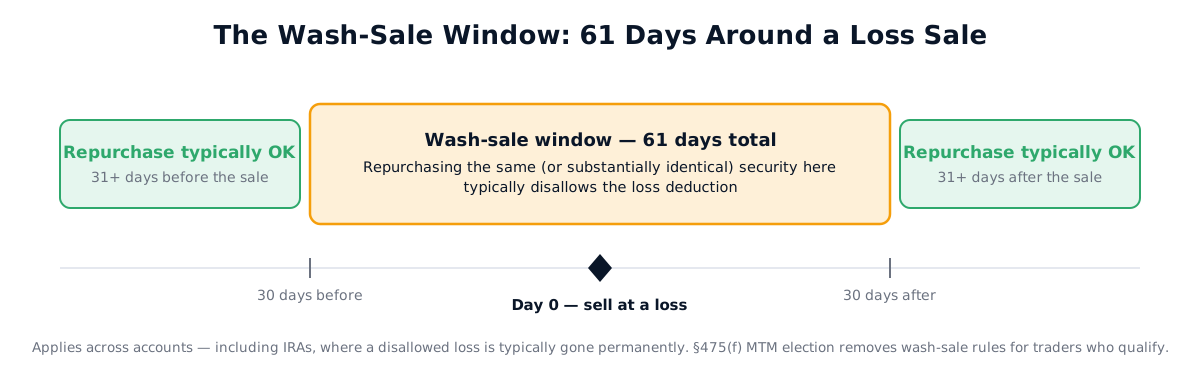
The wash-sale rule disallows a loss when a substantially identical security is bought within 30 days before or after the losing sale — a 61-day window. Robinhood reports these adjustments on the 1099-B, but only for identical securities inside that same Robinhood account. Anything happening in other accounts is invisible to the broker.
This is not a Robinhood shortcoming — it's how broker reporting works industry-wide. Every broker sees only its own account. The taxpayer's wash-sale obligation, though, spans all accounts: another brokerage, a spouse's account on a joint return, and IRAs. The IRA case is the harshest — a repurchase inside an IRA within the window typically disallows the loss permanently, with no basis adjustment to recover it later.
| Scenario | On the Robinhood 1099-B? | What It Typically Means |
|---|---|---|
| Same ticker, same Robinhood account | Reported | Adjustment shown; disallowed loss added to replacement-share basis |
| Same ticker in another brokerage | Not tracked | Taxpayer's responsibility to identify and adjust across accounts |
| Repurchase inside an IRA | Not tracked | Loss typically disallowed permanently — no basis recovery |
| Substantially identical option on the same stock | Often not matched | Options can trigger wash sales on the underlying; commonly reviewed manually |
| §475(f) mark-to-market traders | N/A | The MTM election eliminates wash-sale adjustments for those who qualify |
For active traders who churn the same tickers across December and January or run multiple accounts, this is usually the single biggest gap between "what the 1099-B says" and "what the return should say." The Wash-Sale Rule guide covers the mechanics, and the Wash-Sale Calculator gives a quick way to model a specific sequence of trades.
How Do High-Volume Traders Handle Thousands of Transactions?
For most high-volume traders, every sale technically belongs on Form 8949 flowing into Schedule D — but the IRS generally permits summary reporting for covered transactions, with totals by category and the broker statement attached or referenced. Most tax software ingests the consolidated 1099 digitally, which handles the volume for typical situations.
Where volume traders typically hit friction:
- Cost basis on transferred shares — shares moved into Robinhood via ACATS sometimes arrive with missing or incomplete basis. Sales of those shares can show as "noncovered" with basis blank, and the figure typically comes from the old broker's records rather than the 1099-B.
- Options on the 1099-B — equity options traded on Robinhood are generally reported on the 1099-B alongside stock sales. Assignments, exercises, and expirations each adjust basis or proceeds in their own way; the Options Taxes guide walks through the cases.
- Wash-sale noise at scale — thousands of trades in overlapping tickers generate long wash-sale adjustment columns. The adjustments usually resolve to near-zero if all positions were closed by year-end and stayed closed through the 30-day window, but the interim math can look alarming.
- Corrected forms multiply — more positions means more chances an issuer reclassification triggers a corrected consolidated 1099.
Traders who want losses to count in the current year typically avoid re-entering the same ticker within 30 days after a December losing sale — in any account. A loss harvested on December 20 and repurchased January 5 typically defers into the next tax year via the wash-sale adjustment. Simple calendar awareness in December is worth more than hours of cleanup in April.
Are Free Stocks From Robinhood Taxable?
Typically yes. The fair market value of promotional free stock — referral shares and similar sign-up rewards — is generally treated as other income in the year received, often appearing on the 1099-MISC portion of the consolidated 1099. That reported value then typically becomes the cost basis when the shares are eventually sold.
It's usually a small number, but it surprises people twice: once when a $12 free share generates a tax line item, and again when selling the share later produces a second, separate capital gain or loss measured against that original value. Small, but real — and it's already on the form the IRS receives, so leaving it off a return creates a mismatch.
How Is Crypto on Robinhood Taxed?
Crypto is generally treated as property for US tax purposes, so selling or converting it triggers capital gains or losses just like stock — but Robinhood typically reports crypto activity separately from the stock 1099-B. Reporting forms for digital assets have been changing in recent years, so a CPA confirms which forms apply for the current year.
Two things most Robinhood crypto traders keep in mind. First, the digital-asset question near the top of Form 1040 generally applies to anyone who sold or exchanged crypto during the year, regardless of which forms arrived. Second, as of 2026 the wash-sale rule applies to securities and generally has not been extended to digital assets — Congress has considered it and, in the 2025 OBBBA legislation, declined to extend §1091 to crypto — though proposals recur, so that treatment is worth re-confirming each year. The Crypto Taxes guide covers the broader landscape.
Is Robinhood Margin Interest Tax Deductible?
Sometimes. Margin interest may be deductible as investment interest expense in some situations — typically limited to net investment income for the year and generally requiring itemized deductions rather than the standard deduction. Unused amounts can often carry forward. Whether it actually helps depends on the trader's full picture, which is why a CPA confirms it.
For the minority of traders operating with Trader Tax Status, interest tied to the trading business can land differently. The gap between "deductible in theory" and "deductible on this return" is wide here — this one is genuinely situation-specific.
Step-by-Step: How Most Robinhood Traders Approach Filing
Step 1 — Wait for the Consolidated 1099 to Settle
Most traders let the mid-February consolidated 1099 land, then watch for corrections through late February and March — especially with REIT, ETF, or foreign-stock positions. Traders who prefer filing early typically accept that a corrected form may mean amending later with Form 1040-X.
Step 2 — Reconcile the 1099-B Against All Accounts
The 1099-B covers one account. Traders who touched the same tickers in another brokerage, a spouse's account, or an IRA typically review those trades side-by-side for cross-account wash sales, and fill in cost basis for any transferred-in shares showing as noncovered.
Step 3 — Report on Form 8949 and Schedule D
Stock and options sales flow onto Form 8949 and Schedule D as capital gains and losses — summary reporting handles high volume for most traders. Dividends, interest, and the 1099-MISC promo income each go to their own lines from the same consolidated document.
Step 4 — Account for Promos, Crypto, and Margin Interest
Free-stock value typically reports as other income. Crypto activity comes from its own separately issued forms — which have been changing year to year. Margin interest gets weighed against the investment-interest limits to see whether it helps on this particular return.
Step 5 — Talk with a Trader-Specialist CPA
Every situation has unique facts: multi-account wash sales, whether Trader Tax Status is realistic, whether a §475(f) mark-to-market election is worth modeling, state rules, and what the current year's digital-asset forms require. A TraderTax-matched CPA who works with active traders can confirm what actually applies — create a free account to get matched.
Frequently Asked Questions
What tax forms does Robinhood send?
Robinhood typically sends a consolidated 1099 — one PDF combining the 1099-B (trades), 1099-DIV (dividends), 1099-INT (interest), and 1099-MISC (promotions and other income) — usually arriving around mid-February. Corrected versions often follow, and crypto activity is generally reported separately on its own digital-asset forms.
Is day trading on Robinhood self-employment income?
Typically no. For most traders, gains in a personal Robinhood account are capital gains — mostly short-term, taxed at ordinary income rates — not self-employment income, so no 15.3% SE tax applies. Trader Tax Status and the Section 475(f) mark-to-market election are the levers serious traders evaluate with a CPA.
Does Robinhood track wash sales for me?
Only partially. Like brokers generally, Robinhood reports wash-sale adjustments for identical securities inside the same account. Trades in other brokerage accounts, a spouse's account, or an IRA are not tracked, so active traders with multiple accounts typically can't rely on the 1099-B alone for wash-sale accuracy.
Are free stocks from Robinhood taxable?
Typically yes. The fair market value of promotional free stock is generally treated as other income — often reported on the 1099-MISC portion of the consolidated 1099 — in the year received. That value then typically becomes the cost basis for the shares when they are later sold.
How is crypto on Robinhood taxed?
Crypto is generally treated as property, so sales trigger capital gains or losses, and Robinhood typically reports crypto activity separately from the stock 1099-B. Reporting forms for digital assets have been changing in recent years, so a CPA confirms which forms apply for the current tax year.
When should Robinhood traders file their tax return?
Many active Robinhood traders wait until the consolidated 1099 has settled — corrected versions commonly arrive in late February or March after issuers reclassify dividends or update basis. Filing off the first version is a classic early-filer mistake; traders who already filed before a correction can typically amend with Form 1040-X.
Not Sure Where You Stand on Taxes?
Answer 8 quick questions. Get a personalized AI summary of your tax exposure, missed deductions, and what to consider next — reviewed by a real CPA.
Get My Free Tax Snapshot →See what your Robinhood taxes typically look like
Most Robinhood traders owe capital-gains tax on net trading profits — mostly short-term at ordinary rates — plus tax on dividends, interest, and promo income. The exact number depends on holding periods, wash-sale adjustments, bracket, and state — every situation varies. The tools below give a ballpark; a CPA confirms what actually applies.
Or create a free account to get matched with a CPA →Robinhood pioneered commission-free trading and remains one of the most popular brokerages for active traders at robinhood.com — features, account types, and tax-document details change over time, so their site and in-app tax center are the source of truth for current specifics. TraderTax-matched CPAs handle filings for many active Robinhood traders — wash-sale cleanup, high-volume 8949 reporting, TTS and mark-to-market evaluation, federal + state. Client documents move through an encrypted portal (see how TraderTax handles security). If you trade on Robinhood and want to talk through what filing typically looks like for your situation, create a free account and we'll take it from there.
Robinhood taxes sit inside the bigger picture of stock-trading taxation. These guides cover the adjacent topics most Robinhood traders end up needing: