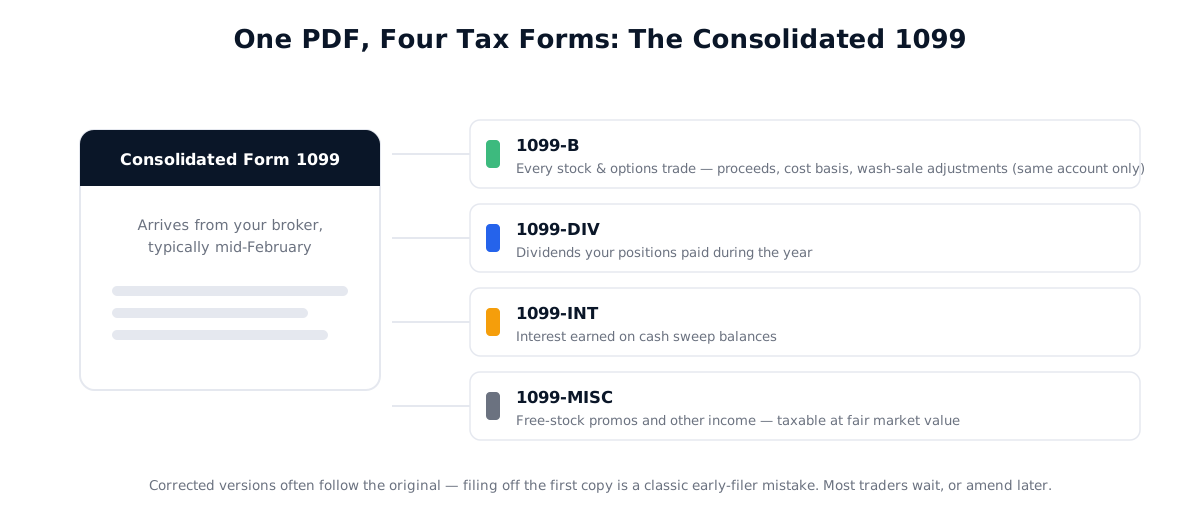
- Webull typically issues a consolidated 1099 in February — and corrected versions are common. Filing off the first version in early February is a classic mistake that leads to amended returns.
- Gains in a personal Webull account are capital gains — mostly short-term for active traders — not self-employment income. No 15.3% SE tax; that's a funded prop-firm payout issue, not a personal-brokerage one.
- The 1099-B only adjusts wash sales for identical securities inside the same account. The IRS rule reaches substantially identical positions across all accounts — including IRAs — 30 days before or after a sale, so multi-account traders typically can't rely on the broker's numbers alone.
- Free-stock promos are typically taxable as other income at fair market value on receipt, and crypto is reported separately from the securities 1099 under still-evolving digital-asset rules.
- Every situation varies — a TraderTax-matched CPA who specializes in trader taxation can confirm what applies, including ACAT basis verification, Trader Tax Status, and the §475(f) mark-to-market election.
Webull has become one of the most popular brokerages for active traders — commission-free stocks and options, extended-hours trading, and charting that rivals desktop platforms. Come tax season, though, an active Webull account generates some of the most commonly misread paperwork in retail trading: a consolidated 1099 that arrives (and often re-arrives, corrected), wash-sale adjustments that only tell part of the story, and promo income hiding on a 1099-MISC.
This guide covers how most US traders handle Webull taxes — what the consolidated 1099 includes, why very active traders face Form 8949 volume, how wash sales work across accounts, and where options, crypto, and free-stock promotions typically land on a return. Every situation varies; this is the general map, not personalized advice.
Filing in early February off the first consolidated 1099. Brokers routinely issue corrected 1099s in March — and sometimes April — when dividend reclassifications and cost-basis adjustments come in late. A return filed off version one of the form often has to be amended when version two arrives. Most active traders wait for the corrected form or file later in the season.
When Does Webull Send Tax Documents?
Webull's consolidated 1099 typically becomes available in February, in the app and by mail. Corrected versions are common — brokers reissue when dividend reclassifications or late basis adjustments arrive, sometimes into March or April. Most active traders wait for the corrected form rather than filing off the first version. Every year's timeline varies slightly.
Why the corrections? Some of the numbers on a consolidated 1099 depend on data the broker receives after year-end — REITs and funds reclassifying dividends, transfer agents finalizing basis on corporate actions, and processors truing up proceeds. None of that is unique to Webull; it's how consolidated 1099s work across the industry. The practical takeaway is the same everywhere: the first version of the form is a draft more often than traders expect.
Traders who want to file early typically check the form's revision status first. If the account held dividend-paying ETFs, REITs, or positions involved in corporate actions, a corrected 1099 is more likely — and for most traders, waiting a few weeks costs less than amending a return later.
What's on the Webull Consolidated 1099?
A consolidated 1099 bundles several forms into one document: 1099-B for trading proceeds and cost basis, 1099-DIV for dividends, 1099-INT for interest, and 1099-MISC for miscellaneous income such as free-stock promotions. Each section flows to a different place on the return, which is why most traders review all of them rather than just the trading section.
| Section | What It Reports | Where It Typically Lands |
|---|---|---|
| 1099-B | Stock and option sales — proceeds, basis, wash-sale adjustments | Form 8949 → Schedule D |
| 1099-DIV | Ordinary and qualified dividends | Schedule B / Form 1040 |
| 1099-INT | Interest — including cash-management interest | Schedule B / Form 1040 |
| 1099-MISC | Free-stock promos and other miscellaneous income | Other income, Schedule 1 |
| Crypto statement | Digital-asset activity — reported separately | Form 8949 / digital-asset forms |
What the table above leaves out — event contracts
Look at that list again and notice what is not on it. Webull is reported to offer event contracts — prediction markets — routed through Kalshi, a CFTC-regulated exchange, following a partnership announced in early 2025, and reportedly available across all 50 states. None of the rows above covers that activity.
Trading event contracts on Webull is reported to require a separate account from your brokerage account. That single structural detail is what makes this a recordkeeping problem rather than a footnote: a consolidated 1099 is produced for an account, so a separate account means separate documents at best, and no 1099 at all at worst — while the familiar February consolidated 1099 arrives for your stocks and options and looks complete.
What a reader should take from this is narrow and practical: check what arrives for the event-contract account specifically, rather than assuming the brokerage document covers both. And download it when it appears, because for this category you are more likely than not to be the only one holding the record.
Because the contracts themselves are reported to be Kalshi’s, the form picture that applies is Kalshi’s rather than a Webull-specific one — and Kalshi’s practice is mapped platform-by-platform on do I pay taxes on Kalshi. The broader point holds either way: a missing form changes your evidence, not your liability.
How event contracts are taxed is a separate question, and a genuinely unsettled one. It is not something this page answers, and anyone offering you a single confident rate for event contracts is giving you a conclusion the IRS has not supplied — there is no ruling on them. The competing frameworks are laid out, without one being selected, on prediction market taxes. If you traded stocks and event contracts in the same year, that is two sets of records and two decisions.
Platform-practice note: account structure, state availability and which documents are issued are all broker-by-broker and change year to year. The statements here are what is publicly reported, not something we have confirmed against Webull’s own current documentation — check the in-app tax centre for what it says this year.
How Are Webull Trading Gains Taxed?
For most traders, gains in a personal Webull account are capital gains: positions held a year or less are short-term and taxed at ordinary rates, while positions held longer get long-term rates of 0%, 15%, or 20%. Active traders are typically almost entirely short-term. Losses offset gains, with up to $3,000 deductible against other income per year.
The full mechanics — netting, loss carryforwards, and holding periods — are covered in the Stock Trading Taxes guide. For traders in and out of positions daily, the Day Trading Taxes guide goes deeper on the high-frequency picture.
The Big Misconception: Day Trading Gains Are Not Self-Employment Income
A persistent myth says frequent trading turns gains into self-employment income subject to 15.3% SE tax. For personal-account trading, that's typically not the case — day-trading gains remain capital gains no matter how active the trader is. Self-employment tax is generally a funded prop-firm payout issue, where the trader is compensated for trading the firm's capital rather than their own.
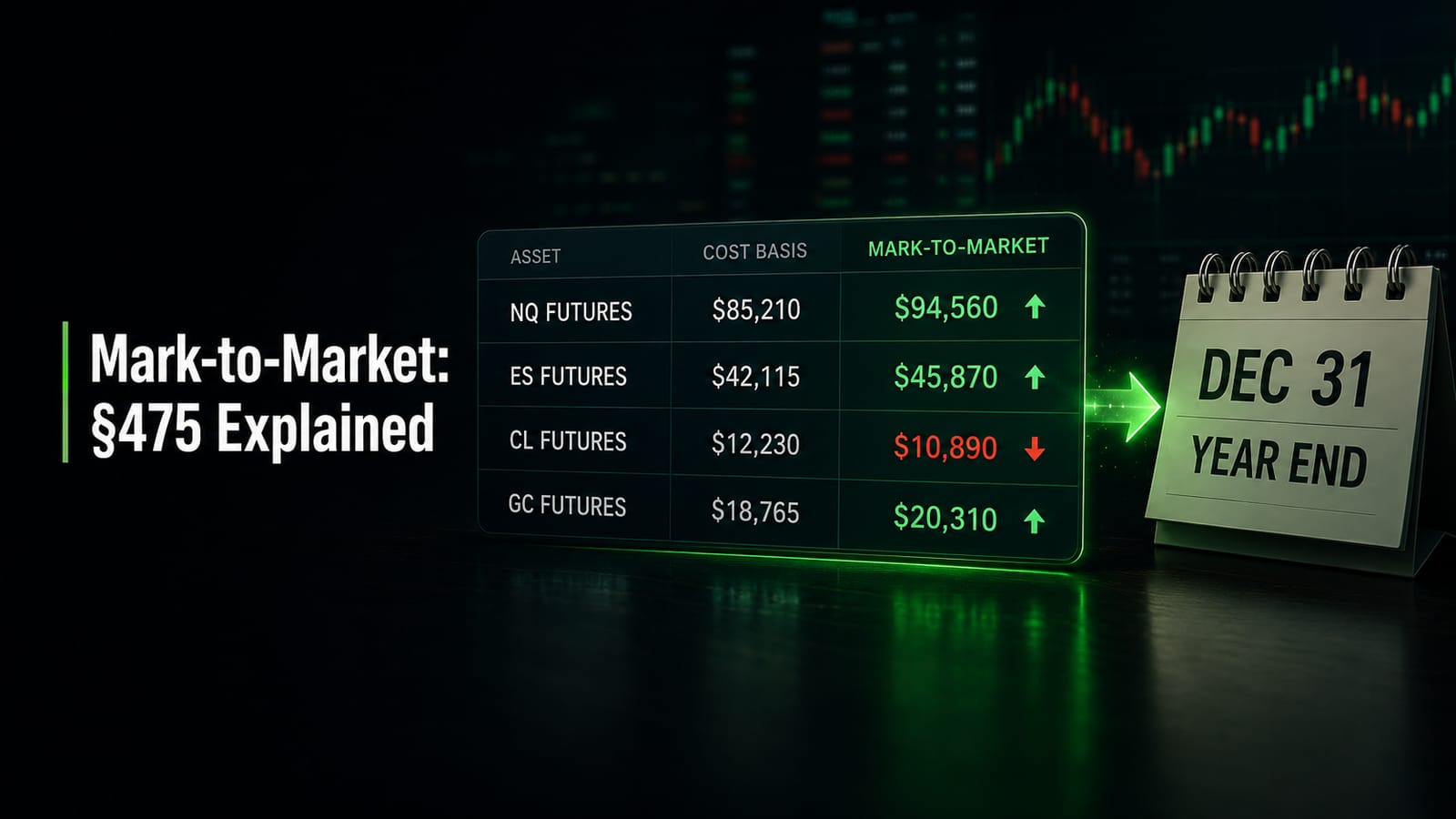
For serious traders, the levers that actually change tax treatment are Trader Tax Status (TTS) — which can unlock business expense deductions for qualifying traders — and the Section 475(f) mark-to-market election, which converts trading gains and losses to ordinary treatment and eliminates wash-sale concerns for qualifiers. Both have real qualification hurdles and real trade-offs; see the Mark-to-Market guide, and note that a CPA typically evaluates whether either fits before anything is elected.
How Do Wash Sales Work on Webull?
The wash-sale rule disallows a loss when a substantially identical security is purchased within 30 days before or after the losing sale. Webull's 1099-B typically adjusts wash sales automatically — but only for identical securities inside that same account. The IRS rule itself reaches across every account a trader touches, which the broker cannot see.
That gap is where multi-account traders get surprised. Selling a position at a loss in Webull and rebuying it within the window at another brokerage — or in an IRA, or in a spouse's account — can still trigger a wash sale that no 1099-B reflects. The IRA version stings most: a loss washed into an IRA is typically disallowed permanently rather than deferred into the replacement shares' basis.
- Same account, same ticker — Webull's 1099-B typically handles the adjustment automatically.
- Different brokerage accounts — the rule still applies, but no broker reports it; the trader (or their CPA) reconciles it.
- IRA repurchases — typically the harshest outcome: the disallowed loss generally never comes back.
- Substantially identical securities — the rule can reach beyond the exact ticker (for example, options on the same stock).
The full rule — including how disallowed losses roll into replacement-share basis — is covered in the Wash Sale Rule guide, and the free Wash Sale Calculator models how an adjustment plays out. For qualifying traders, a §475(f) mark-to-market election eliminates wash-sale tracking entirely — one of the main reasons very active traders evaluate it.
A 1099-B with wash-sale adjustments on it is not the same as a return with wash sales handled. The broker adjusts what it can see — identical securities, one account. Traders running Webull alongside another brokerage or an IRA typically review December–January trades especially closely, since the 30-day window spans year-end.
How Are Webull Options Taxed?
Equity options — calls and puts on individual stocks and most ETFs — are typically capital gains and losses reported on the 1099-B like stock trades, with the usual short-term and long-term rules. Broad-based index options are the exception: they may qualify as Section 1256 contracts with 60/40 treatment, regardless of holding period.
Section 1256 treatment means 60% of gains taxed at long-term rates and 40% at short-term rates — even on a position held for minutes — reported on Form 6781 with year-end mark-to-market. Whether a specific product qualifies depends on how it's classified, and mixing §1256 contracts in with regular equity-option reporting is a common filing error. The Options Taxes guide covers the distinctions, and the free Section 1256 Calculator shows what 60/40 treatment typically does to the bill. Assignments, exercises, and expirations each have their own basis mechanics — another spot where a trader-specialist CPA typically earns their fee.
Are Webull Free Stocks Taxable?
Typically yes. Promotional shares from sign-up and referral offers are generally treated as other income at their fair market value on the date received, commonly showing up on the 1099-MISC when totals cross the reporting threshold. That fair market value then becomes the cost basis, so later sales are only taxed on movement from there.
The amounts are usually small, but they're the kind of line item that quietly goes unreported — the form arrives bundled inside the consolidated 1099 and gets skimmed past. Traders who claimed several promos across the year typically double-check the 1099-MISC section before filing.
How Is Webull Crypto Reported?
Crypto activity is typically reported separately from the securities consolidated 1099, on its own statement. Broker reporting for digital assets is still evolving — new IRS digital-asset forms have been phasing in, and what arrives can change year to year. Most traders keep their own disposal records as a hedge, and a CPA confirms which forms apply.
Two things stay stable underneath the shifting paperwork: every crypto disposal — selling, swapping, or spending — is typically a taxable event measured against cost basis, and the digital-asset question on Form 1040 gets answered either way. One notable 2026 wrinkle: the wash-sale rule under §1091 generally does not apply to crypto — Congress declined to extend it in the OBBBA — though that's exactly the kind of rule that can change, which is why most crypto-active traders confirm current treatment with a CPA. The Crypto Taxes guide covers the full picture.
What About Very Active Traders — Thousands of 8949 Line Items?
A high-frequency Webull account can generate thousands of reportable transactions. In most cases that's manageable: covered transactions with correct basis reported to the IRS can typically be summarized on Schedule D by category, with the detail attached or available rather than typed line by line. The real work is verifying the data underneath the summary.
The most common data problem is transferred positions. Cost basis on shares moved into Webull via ACAT from another brokerage often arrives late, incomplete, or wrong — and a wrong basis flows straight into every subsequent sale's gain calculation. Most traders who transferred accounts spot-check transferred lots against the old broker's final statement before filing. The second common problem is the multi-account wash-sale gap covered above, which grows with trade count.
- Summary reporting — covered lots with accurate basis typically summarize cleanly by holding-period category.
- ACAT transfers in — basis on transferred lots often needs verification against the prior broker's records.
- Noncovered lots — older or transferred positions may report proceeds without basis, leaving the trader to substantiate it.
- Serious-trader levers — at real volume, TTS and the §475(f) election are typically the structural questions worth modeling with a CPA.
Step-by-Step: How Most Webull Traders Approach Filing
Step 1 — Wait for the Final Consolidated 1099
Most active traders let February breathe: download the consolidated 1099 when it posts, then watch for a corrected version before filing — especially if the account held dividend-paying funds, REITs, or anything touched by a corporate action. Filing off version one and amending later is the avoidable path.
Step 2 — Verify Cost Basis and Cross-Account Wash Sales
Transferred-in lots get checked against the old broker's records, noncovered positions get basis documentation, and traders with multiple accounts or an IRA review the 30-day windows around losing sales — particularly trades spanning year-end, where the wash-sale window crosses into the new tax year.
Step 3 — Report Each Income Type in Its Place
Stock and equity-option activity typically flows to Form 8949 and Schedule D, broad-based index options that qualify as §1256 contracts go to Form 6781 with 60/40 treatment, free-stock promos land as other income, and crypto is reported separately under the current year's digital-asset rules.
Step 4 — Talk with a Trader-Specialist CPA
Every situation has unique facts: multi-account wash sales, transferred basis, options edge cases, evolving crypto reporting, state residency, and whether Trader Tax Status or a §475(f) mark-to-market election is worth evaluating at this volume. A TraderTax-matched CPA who works with active traders can confirm what actually applies — create a free account to get matched.
Not Sure Where You Stand on Taxes?
Answer 8 quick questions. Get a personalized AI summary of your tax exposure, missed deductions, and what to consider next — reviewed by a real CPA.
Get My Free Tax Snapshot →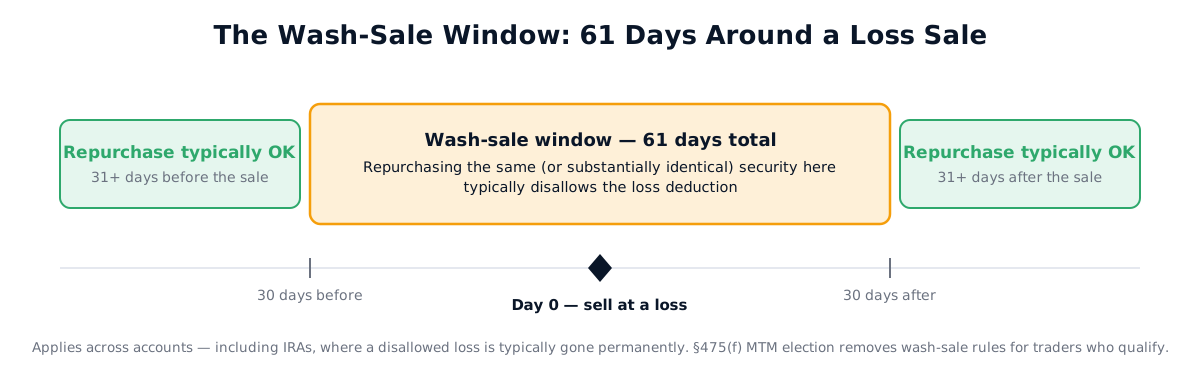
Frequently Asked Questions
When does Webull send the consolidated 1099?
Typically in February, delivered through the app and by mail. Corrected versions are common — brokers reissue when dividend reclassifications or basis adjustments arrive late, sometimes into March or April. Filing off the first version in early February is a classic mistake; many active traders wait for the corrected form or file closer to the deadline.
Do Webull day traders pay self-employment tax?
Typically no. Gains in a personal Webull account are capital gains — mostly short-term for day traders — not self-employment income, so no 15.3% SE tax applies. Self-employment tax is generally a funded prop-firm payout issue, not a personal-brokerage issue. For serious traders, Trader Tax Status and the Section 475(f) mark-to-market election are the levers that change the picture.
Does Webull's 1099-B handle wash sales automatically?
Only partially. Brokers typically adjust wash sales for identical securities within the same account. The IRS wash-sale rule reaches substantially identical positions across all accounts — another brokerage, a spouse's account, an IRA — within 30 days before or after the sale. Traders with multiple accounts typically can't rely on the 1099-B alone.
Are Webull free stocks taxable?
Typically yes. Promotional shares are generally treated as other income at their fair market value on the date received, commonly reported on a 1099-MISC when totals cross the reporting threshold. That fair market value then becomes the cost basis for the shares, so the same dollars aren't taxed twice when they're eventually sold.
How is Webull crypto reported for taxes?
Separately from the securities consolidated 1099. Crypto activity typically arrives on its own statement, and broker digital-asset reporting forms are still evolving as new IRS requirements phase in. Most traders keep their own record of every crypto disposal — date, proceeds, basis — as a hedge, and a CPA confirms which forms apply for the year.
What if a trader has thousands of Webull trades?
Very active traders can generate thousands of Form 8949 line items. In most cases, covered transactions with correct basis can be reported in summary on Schedule D, with detail attached where required. The bigger risk is data quality: cost basis on positions transferred into Webull via ACAT often needs verification before filing. A trader-specialist CPA typically reconciles this.
See what your Webull taxes typically look like
Most active Webull traders typically owe capital gains tax — largely short-term at ordinary rates — shaped by wash-sale adjustments, holding periods, and state taxes. The exact number depends on the trader's bracket, losses, and account setup — every situation varies. The tools below give a ballpark; a CPA confirms what actually applies.
Or create a free account to get matched with a CPA →Webull runs a solid, trader-focused platform at webull.com — commission-free stocks and options, extended-hours trading, and strong charting. Account features and tax-document timelines change over time, so their site is the source of truth for current specifics. TraderTax-matched CPAs handle the filings for many active Webull traders — wash-sale reconciliation, options, crypto, and TTS/MTM evaluation where it applies. If you trade on Webull and want to talk through what filing typically looks like for your situation, create a free account and we'll take it from there.
Trade across multiple brokerages? Each platform reports a bit differently — and wash sales don't stop at account boundaries. Here are the related guides: