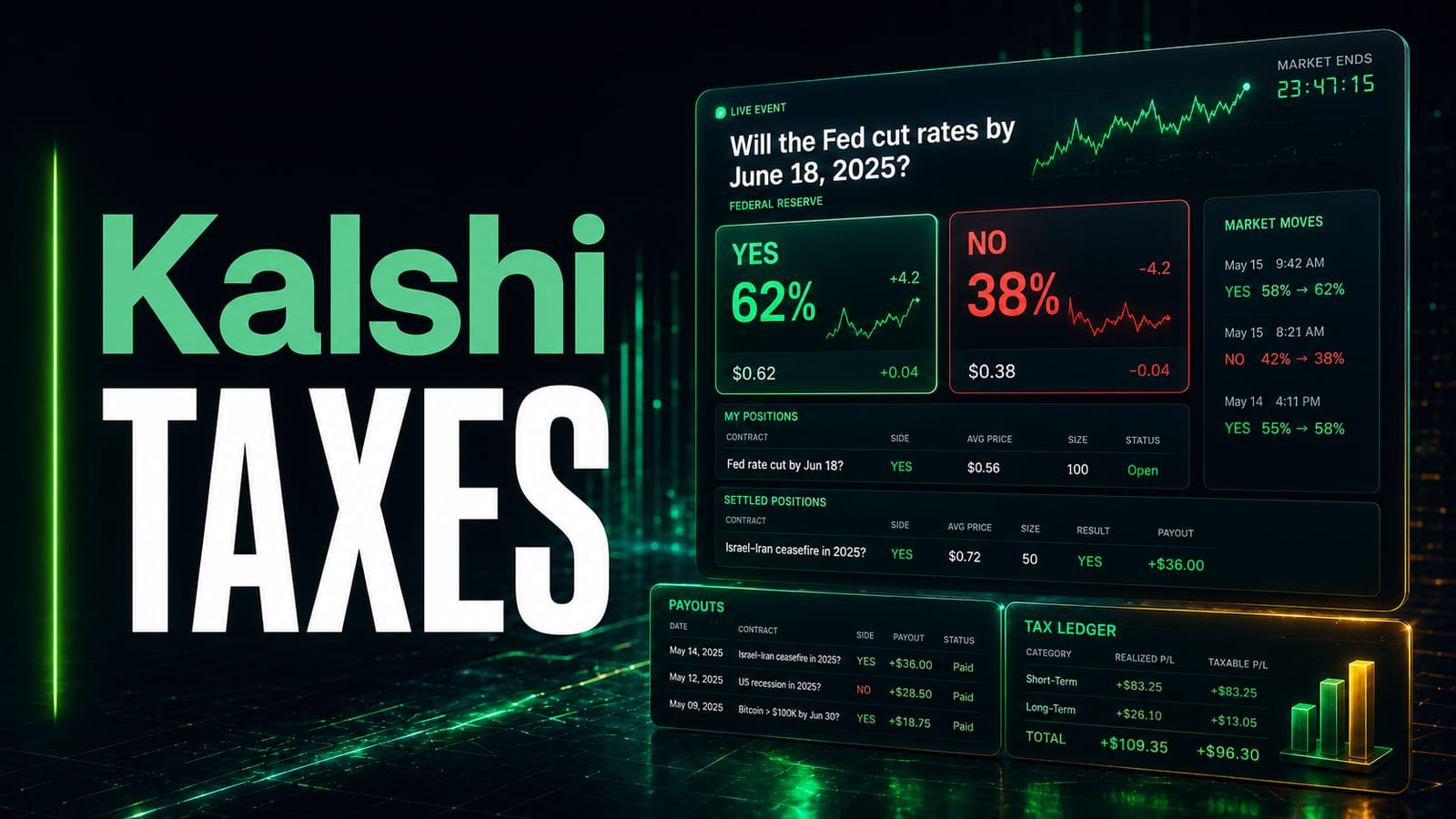
- Kalshi winnings are fully taxable under IRC §61 — even though, as of July 2026, no comprehensive trade-level 1099 for event-contract profits appears to be issued on a direct Kalshi account. The forms Kalshi does describe cover interest, referral credits, and limited digital-asset activity.
- The IRS has issued no formal tax guidance on how event contracts are characterized — the CFTC has been busy on the regulatory side, but the tax question sits untouched. Practitioners typically weigh four approaches — Section 1256 (60/40), short-term capital gain, gambling, or ordinary income — with meaningfully different bills.
- The Section 1256 argument is generally considered aggressive: the CFTC — and Kalshi's own regulatory filings — classify event contracts as swaps, which §1256(b)(2)(B) excludes. Kalshi itself takes no position on tax characterization.
- The 2026 stakes are higher: the OBBBA capped wagering-loss deductions at 90% of losses. That rule bites Kalshi traders only if their contracts are treated as gambling — a question the IRS hasn't answered. Sports contracts carry the highest risk.
- Every situation varies — most traders pick one reasonable approach, apply it consistently, keep complete records, and confirm the choice with a CPA who understands trader taxation.
This area is evolving; we update this page as guidance lands. As of July 2026 the IRS and Treasury have issued no formal tax guidance on prediction-market event contracts — no revenue ruling, notice, regulation, published private letter ruling, or FAQ that we're aware of — and no event-contract project appears on the current Treasury/IRS priority guidance plan.
That silence is specific to the tax side: the CFTC itself has been active, including a June 2026 notice of proposed rulemaking on prediction markets and public-interest determinations, with comments due July 27, 2026. The next realistic checkpoint for tax guidance is the 2026–2027 priority guidance plan, generally expected around September or October. Court decisions, pending regulations, and platform reporting practices described below can all change quickly.
Written by the TraderTax Editorial Team and checked against primary and professional sources rather than other tax blogs: the Internal Revenue Code (§61, §165(d), §1256, §1091, §1221), IRS form and topic pages, the One Big Beautiful Bill Act (P.L. 119-21 §70114) and its still-proposed implementing regulations (REG-113229-25), CFTC designation orders and Kalshi's own regulatory filings and help documentation, published appellate decisions, and specialist practitioner analysis including the June 2026 Tax Notes Federal classification piece.
The Editorial Team are researchers and writers — not CPAs. TraderTax is a referral platform; the filings themselves are handled by independent licensed CPAs in our partner network. Where sources genuinely conflict or a question is unsettled, this page says so instead of picking a side, and the primary IRS material is linked at the bottom of the page.
Kalshi is the first federally regulated event-contract exchange in the United States — a CFTC-designated contract market (DCM) since November 2020, the same regulatory category as the CME. By company-reported figures, its active-trader count grew from roughly 240,000 to about 1.2 million during 2025. Which means an enormous number of people are now holding a very awkward question: how is any of this taxed?
Honest answer: nobody fully knows yet — and that includes the professionals. When a senior economist at the Tax Foundation reportedly netted around $128,000 trading Kalshi, he told Business Insider he wasn't sure how to file it. That's the state of play. What is knowable: the income is taxable, the candidate treatments are well mapped, the dollar difference between them is large, and there's a sensible way to file under uncertainty. This guide covers all four.
No 1099 does NOT mean no taxes. As of July 2026 Kalshi does not appear to issue a comprehensive trade-level 1099 for event-contract profits — but under IRC §61 all income is taxable regardless of whether a form arrives. Traders who skip reporting typically face 20% accuracy-related penalties plus interest if the IRS catches up, and practitioners report prediction-market CP2000 notices already circulating.
Do You Have to Pay Taxes on Kalshi Winnings?
Yes — typically in the year contracts settle or are sold, not the year cash is withdrawn. Under IRC §61, Kalshi profits are taxable income whether or not any tax form arrives. The genuinely unsettled question isn't whether Kalshi winnings are taxed — it's how they're characterized, which can change the bill dramatically.
Three timing points trip up most new Kalshi traders:
- The taxable event is settlement or sale. When a contract resolves at $1.00 or $0, or you sell it early, that's when gain or loss is realized — not when you move money to your bank.
- Unwithdrawn winnings still count. Profit sitting in a Kalshi balance on December 31 is typically taxable for that year.
- "Deposits minus withdrawals" is not the taxable amount. Depositing $5,000 and withdrawing $7,000 does not mean $2,000 of income — the tax math runs per contract, off what each position cost and what it returned.
How Do Kalshi Event Contracts Work (and Why Does It Matter for Taxes)?
Kalshi contracts are binary yes/no positions priced between $0.01 and $0.99 that settle at exactly $1.00 or $0. Gain or loss per contract equals the payout or sale price minus what was paid, with fees adjusting the math. That all-or-nothing structure is precisely what makes the tax characterization hard.
The price is the market's implied probability: a "YES" trading at 40¢ implies roughly a 40% chance. Trading is peer-to-peer on an order book — Kalshi collects fees but isn't the other side of your trade. A quick example of the per-contract math:
- Buy 100 YES contracts at $0.40 → cost basis ≈ $40 (plus trading fees)
- Event resolves YES → contracts settle at $1.00 → $100 proceeds → ≈ $60 gain
- Event resolves NO → contracts settle at $0 → ≈ $40 loss
- Or sell early at $0.65 → $65 proceeds → ≈ $25 gain, no need to wait for resolution
Kalshi's trading fees typically fold into this math as basis or proceeds adjustments rather than a separate deduction — and Kalshi's own P&L statements already reflect fees, so most traders are careful not to double-count them. One more wrinkle for completeness: in June 2026 Kalshi also launched BTCPERP, the first CFTC-regulated perpetual future — and it sits differently from the event contracts this page is about, in a way worth knowing if you trade both.
On the first §1256 prong it is stronger: the CFTC classifies a perpetual future as a futures contract rather than as a binary-option swap, which removes the characterization problem the Nadex story below is entirely about. On the second prong it is in the same trouble: the funding payment exchanged between longs and shorts is the economic signature of a swap, and §1256(b)(2)(B) excludes swaps and similar agreements even on a designated contract market. So BTCPERP trades a weak argument for a contested one rather than for a settled one. Full analysis on perpetual futures taxes.
Why does the binary structure matter? Because a contract that pays all-or-nothing on an event outcome sits uncomfortably between categories the tax code actually defines: it resembles an option (but conveys no right to buy or sell property), a futures contract (but posts full collateral upfront with no margin system), and a wager (but trades on a federally regulated exchange). Every treatment debate below flows from that ambiguity. Traders coming from conventional markets may want to compare how futures and options are taxed — both far more settled areas.
What Tax Forms Does Kalshi Actually Send?
As of July 2026, Kalshi's help center describes a narrow set of forms — a 1099-INT for interest on cash balances, a 1099-MISC for referral and reward credits, and limited digital-asset reporting covering certain broker or crypto-transfer proceeds. None of them covers event-contract trades: no comprehensive, trade-level 1099 appears to be issued for event-contract profits on a direct Kalshi account.
For most Kalshi traders, that means personal records — not a platform form — carry the filing.
The digital-asset piece is the part that surprises people, so it's worth naming precisely. Kalshi's documentation describes a narrow 1099-B for proceeds from certain broker or crypto-transfer transactions, and — beginning with tax year 2025 — Form 1099-DA (Digital Asset Proceeds From Broker Transactions) issued through Kalshi's crypto partner Zero Hash. Both relate to moving crypto in and out, not to buying and selling event contracts. A trader who funds an account with crypto may well see one of those forms and still receive nothing describing their contract P&L.
| Form | What it covers | Typical trigger |
|---|---|---|
| 1099-INT | Interest paid on your idle cash balance | $10+ of interest for the year |
| 1099-MISC | Referral credits and promotional rewards — not trading profits | $600 threshold through 2025; $2,000 for payments made in 2026 (OBBBA), inflation-indexed from 2027 |
| 1099-B (narrow) | Proceeds from certain broker or crypto-transfer transactions — not event-contract trades | Crypto-transfer activity |
| 1099-DA | Digital-asset proceeds, issued via Kalshi's crypto partner Zero Hash — not event-contract trades | Digital-asset activity, beginning with tax year 2025 |
| Trade-level 1099 for contract P&L | None described as of July 2026 | Your own records carry the filing |
Third-party descriptions of Kalshi's tax forms genuinely conflict. Some guides state that Kalshi issues a broad 1099-B once gross proceeds clear $600; others describe a futures-style 1099-B for event contracts. Kalshi's own help documentation (as of July 2026) and most practitioner writeups describe no comprehensive event-contract 1099 at all — the 1099-B it does describe is the narrow digital-asset one, and the digital-asset forms sit alongside event-contract trading rather than reporting it. Platform reporting practices can also change year to year. The reliable move: check your own account's tax documents section each January, and keep independent records regardless of what arrives.
A few related wrinkles worth knowing:
- Earlier years may have looked different. Several 2024–25 sources describe Kalshi issuing 1099-MISC forms for net winnings above $600 in earlier tax years, while current documentation describes the 1099-MISC as rewards-only. If the question is "what form did I get last year," your own account archive is the authority.
- The interest is the settled part. Kalshi pays interest on idle cash; that's ordinary interest income — the one piece of Kalshi taxation with no characterization debate.
- The reporting threshold rose for 2026. The OBBBA lifted the 1099-MISC threshold from $600 to $2,000 for payments made in 2026, with the $2,000 figure inflation-indexed from 2027 — so even more profitable traders will receive no form at all while still owing tax. (The same change hits prop-firm traders' 1099-NECs.)
- This describes a direct Kalshi account. Event contracts placed through a broker still execute on Kalshi's exchange, but the paperwork follows the account rather than the exchange — and a broker's own consolidated 1099 may pick up some of that activity. Broker routing gets its own section below.
- No W-2G, and no withholding appears to occur — which shifts the entire payment burden to quarterly estimates (covered below).
How Are Kalshi Event Contracts Taxed? The Four-Treatment Debate
The IRS hasn't said. Practitioners typically weigh four approaches for Kalshi: Section 1256 60/40 treatment (aggressive), short-term capital gain (the mainstream default), gambling under §165(d) (the harshest for 2026), and ordinary other income (the conservative consumer default). Two identical traders can legally file differently today.
| Approach | Forms | How gains are taxed | How losses work | Who typically takes it |
|---|---|---|---|---|
| A — Section 1256 (60/40) | Form 6781 → Schedule D | 60% long-term / 40% short-term rates, regardless of holding period | $3,000/yr net-loss allowance; 3-year carryback election against prior 1256 gains | Aggressive filers; often paired with Form 8275 disclosure |
| B — Short-term capital | Form 8949 → Schedule D | Ordinary rates (nearly all positions are short-term) | Nets against all capital gains; $3,000/yr against ordinary income; indefinite carryforward | The mainstream practitioner default |
| C — Gambling (§165(d)) | Schedule 1 line 8b + Schedule A | Ordinary rates on gross winnings | Itemizers only; capped at 90% of losses for 2026; no carryforward | Risk-averse filers on sports-style contracts |
| D — Ordinary "other income" | Schedule 1 line 8z | Ordinary rates | Whether losses net inside line 8z is unresolved | The conservative consumer-guide default |
Position A — Section 1256, and why it's contested for Kalshi
The argument for: Kalshi is a CFTC-designated contract market, which is a "qualified board or exchange" under §1256(g)(7)(B). If a binary event contract were a cash-settled listed option, 60/40 treatment could follow — the same treatment futures traders enjoy. Some commentators and tax-tooling startups market this position affirmatively.
The arguments against are substantial, which is why specialist practitioners generally consider this aggressive:
- The swap exclusion. Dodd-Frank added §1256(b)(2)(B), which excludes swaps and similar agreements from Section 1256. The CFTC classifies event contracts as swaps — and Kalshi's own CFTC filings state that its contracts are swaps under the Commodity Exchange Act. A regulatory label may not automatically control the tax question, but the IRS also has a documented pattern of construing §1256 categories narrowly for novel instruments.
- The futures prong fails too. Regulated-futures-contract status requires a mark-to-market margin system; Kalshi contracts are fully collateralized upfront with no variation margin, and no practitioner appears to argue that prong is satisfied.
- The deeper objection: a binary event contract may not be an "option" for tax purposes at all — there's no right to buy or sell underlying property, and an all-or-nothing payout on an event resembles a wager.
Kalshi's help center explicitly disclaims tax advice and takes no position on how its contracts are characterized. Any claim that "Kalshi contracts are Section 1256 contracts" is a filer's position (or a third-party site's) — not Kalshi's, and not the IRS's. Practitioners who do file 60/40 typically recommend attaching a Form 8275 disclosure statement.
Position B — short-term capital gain: the mainstream default
Most practitioner writeups land here: the contract is a capital asset, and settlement, lapse, or sale produces capital gain or loss. Nearly all positions are held under a year, so gains are taxed at ordinary rates anyway — but losses net fully against other capital gains (including stock and options trading), up to $3,000 a year applies against ordinary income, and the rest carries forward indefinitely. No itemizing needed, no self-employment tax for typical traders.
Position C — gambling: the worst outcome for 2026
Under this reading, gross winnings are other income and losses are deductible only for itemizers, only up to winnings — and, new for tax year 2026, only up to 90% of losses. This is where the stakes explode; the next two sections cover why, and the 90% loss-cap breakdown works the numbers in full.
Position D — ordinary "other income": the conservative consumer default
Many consumer tax guides teach reporting net profit as other income on Schedule 1 line 8z, labeled something like "prediction market earnings." It avoids aggressive claims for gains — but whether losses may be netted inside that line is itself an open question no authority has blessed. Practitioners describing this approach implicitly net; nothing formally confirms it.
What Does the Nadex Story Mean for Kalshi and Section 1256?
Nadex — a CFTC-designated exchange offering binaries structurally similar to Kalshi's — issued Section 1256-coded 1099-Bs for years, then reversed course in February 2014 after the CFTC advised its contracts were swaps. It's the closest historical analog to Kalshi's situation, and it cuts against assuming 60/40 treatment is safe.
The story is worth telling properly, because it's the best precedent anyone has. From 2004 through 2013, Nadex traders received 1099-Bs coded for Section 1256 — the paperwork itself seemed to endorse 60/40 treatment. Then, in February 2014, Nadex emailed its members: the CFTC had advised that its binary options are "commodity options" categorized as swaps — instruments that may not qualify for Section 1256 at all. The specialist trader-tax position articulated ever since has been that Nadex-style binaries are probably swaps taxed at ordinary rates, with no private letter ruling, tax opinion letter, or published research supporting the nonequity-option argument.
Now map that onto Kalshi: same binary structure, same DCM status, same swap classification — except Kalshi never issued the Section 1256-coded 1099-B in the first place, and takes no characterization position at all. If the closest analog spent a decade implying 60/40 and then walked it back on regulator advice, that history is a meaningful caution for anyone tempted to treat Kalshi's 60/40 eligibility as obvious. (Nadex itself lives on as Crypto.com's derivatives arm; the legacy platform was retired in December 2025.)
Are Kalshi Sports Contracts Gambling? Where the Courts Stand
Courts are split. The Third Circuit ruled for Kalshi in April 2026, holding sports event contracts are CEA swaps and state gambling law is preempted — but courts in five states went the other way, two federal appeals are pending, and Supreme Court review is widely expected. For taxes, sports contracts carry the highest recharacterization risk.
The scoreboard as of July 2026, in brief: on April 6, 2026 the Third Circuit ruled for Kalshi (Kalshiex LLC v. Flaherty, in a preliminary-injunction posture), while courts in Nevada, New York, Washington, Michigan, and Massachusetts have leaned or ruled the other way. Ninth Circuit and Fourth Circuit merits decisions are pending, roughly eleven states have issued cease-and-desist orders, and both Congress and the CFTC are actively working on the "is this gaming?" question. This fight is about state gambling regulation, not federal tax — but it keeps the wagering characterization alive as a serious possibility.
There's an irony worth noticing: Kalshi's Third Circuit win rests on its contracts being swaps under the Commodity Exchange Act — the very classification that, on the tax side, is the strongest argument against Section 1256 treatment. The legal theory that protects the sports contracts from state regulators is in tension with the tax theory that would give traders 60/40 rates.
Practitioner analyses typically frame a contract-by-contract spectrum rather than one answer for all of Kalshi: sports-outcome contracts sit closest to wagering; macro, Fed, and economic-data contracts present the strongest capital-asset case; election contracts fall in between. A trader holding only CPI and Fed-funds contracts is in a meaningfully different posture than one trading World Cup markets — every situation varies.
The One Big Beautiful Bill Act (signed July 2025) capped the wagering-loss deduction at 90% of losses starting tax year 2026, allowed only up to winnings, itemizers only, with no carryforward. If Kalshi activity were treated as wagering — a question the IRS hasn't answered — a break-even trader with $100,000 of wins and $100,000 of losses could deduct only $90,000 and owe tax on $10,000 of phantom income. Under the prevailing reading the deduction equals the lesser of 90% of losses or total winnings, though the regulations remain only proposed and early commentary differed on the exact computation.
The proposed regulations (REG-113229-25) were published April 17, 2026; comments closed June 16, and a public teleconference hearing was held July 17, 2026, where Rep. Dina Titus, the American Gaming Association, CPAs, and professional gamblers all pressed the phantom-income problem. No final rule had landed as of late July 2026. Repeal efforts have gone nowhere so far — the FAIR BET Act was blocked in the House Rules Committee in January 2026, and a Senate unanimous-consent attempt on the FULL HOUSE Act was blocked as well — so the 90% cap stands for tax year 2026.
How Much Could the Characterization Question Cost? A Worked Example
In an illustrative 2026 scenario — $30,000 of gross wins, $20,000 of gross losses, $10,000 of real profit for a single filer with about $100,000 of other income — the federal bill ranges from roughly $1,860 under Section 1256 to roughly $7,200 under gambling treatment without itemizing. Same trades, nearly a 4x spread.
| Treatment applied to the same trades | Approx. federal tax on $10K profit | Approx. effective rate on real profit |
|---|---|---|
| A — Section 1256 (60/40) | ≈ $1,860 | ≈ 18.6% |
| B — Short-term capital | ≈ $2,400 | ≈ 24% |
| C — Gambling, itemizer | ≈ $2,880 | ≈ 28.8% |
| C — Gambling, standard deduction | ≈ $7,200 | ≈ 72% |
All figures are approximations for illustration — 2026 bracket math varies with each trader's full picture, and every situation varies. A few things the table reveals:
- The itemizing checkbox is enormous under gambling treatment. The standard-deduction taker gets zero loss offset and pays tax on all $30,000 of gross wins — roughly 72% of the real economic profit.
- The 90% haircut shows up even for itemizers: deducting only $18,000 of the $20,000 in losses creates $12,000 of taxable income on a $10,000 profit.
- Ordinary-income treatment (line 8z) lands near the short-term capital figure — if netting inside the line is allowed, which is itself unresolved.
- Break-even years diverge hardest. A trader with $150,000 of wins and $150,000 of losses typically owes $0 under capital treatment; under gambling treatment an itemizer faces roughly $15,000 of phantom income, and a non-itemizer faces tax on the full $150,000 of winnings.
- Loss years diverge too. Capital or 1256 treatment typically allows $3,000 a year against ordinary income plus carryforward (1256 adds a three-year carryback election); gambling treatment allows nothing beyond winnings, ever.
That's the entire case for taking this seriously: a nearly 4x federal spread on identical trades, decided by an unanswered legal question plus an itemizing checkbox. Want to see your own numbers across the branches? Our prediction market tax calculator models all three side by side.
How Do Kalshi Traders Keep Records for Tax Time?
Kalshi currently offers an annual transaction-history CSV under Account → Documents and monthly profit-and-loss statements under Account → Tax Info, typically computed FIFO with fees and rebates included. Most practitioners treat those exports — plus a personal trade log — as the backbone of any filing, since no comprehensive 1099 arrives.
What a complete record set typically looks like for a Kalshi trader:
- Annual transaction CSV — every fill, with dates, contract IDs, quantities, and prices
- Monthly P&L statements — Kalshi's own computed figures (updated around the first of each month), useful as a cross-check
- A personal running log — especially valuable if the characterization ever gets examined, since per-position detail supports capital treatment on Form 8949
- Records of interest and referral income — these arrive on their own forms and belong on the return separately from trading P&L
Kalshi's CSV values are reportedly stored in cents, not dollars. Summing the raw columns without dividing by 100 overstates P&L one hundred-fold — documented as the single most common error in prediction-market tax prep. Kalshi's own P&L statements and most tax tools handle it; hand-built spreadsheets often don't. If your spreadsheet says you made $400,000 on a hobby account, check the units first.
Trading Kalshi Through Robinhood, Coinbase, or Webull — Who Sends Your Forms?
Robinhood, Coinbase, and Webull all route event-contract orders to Kalshi's exchange — and none appears to issue a trade-level 1099 for those trades either. Robinhood's support pages state event-contract trades aren't reported to the IRS at all. Trading through a broker typically doesn't improve the paperwork picture.
The details, hedged appropriately because broker practices can change:
- Robinhood provides an "Event Contracts Annual Statement" that its own materials label as not a substitute tax reporting form — a common trap, because Robinhood users reasonably assume their consolidated 1099-B covers everything in the app. For event contracts, it does not appear to. That said, this is a broker-by-broker question rather than an exchange-wide one — because the order sits in a Robinhood account, some of that activity may still surface on Robinhood's own consolidated 1099, so the document worth reading is whichever one your broker actually sends. More in our Robinhood taxes guide.
- Coinbase has offered Kalshi-powered event contracts in all 50 states since roughly January 2026; no trade-level event-contract 1099 practice has been documented.
- Webull routes to Kalshi as well — same picture. See our Webull taxes guide for the brokerage side.
The practical upshot: whichever door you walk through, the record-keeping burden lands on the trader, and checking each platform's tax-documents section every January remains the reliable move.
Do Kalshi Traders Owe Quarterly Estimated Taxes?
Often, yes. Kalshi doesn't appear to withhold tax on winnings, and no W-2G is issued — so profitable traders who expect to owe $1,000 or more typically make quarterly estimated payments. The 100%/110% prior-year safe harbor is the planning anchor most practitioners start from. Every situation varies.
A profitable World Cup run or election cycle can generate a meaningful liability with zero withholding behind it. Many traders set aside a percentage of net profits as they go, then true up each quarter — a CPA can size the percentage to the bracket and state involved.
State-level activity deserves a footnote, though so far it points at platforms rather than at individuals. North Carolina's SB 257, signed July 7, 2026, applies a 6% tax to operators' net trading-fee revenue apportioned to NC residents beginning January 1, 2027 (and statutorily recognizes exclusive CFTC jurisdiction); Kentucky's HB 757, from April 2026, sets a 14.25% operator excise from the same date.
Roughly fifteen states considered prediction-market bills during 2026. Both of the enacted measures are operator excises rather than individual income taxes, and no state revenue agency appears to have issued individual income-tax guidance on prediction-market winnings — so for most traders these reach the P&L indirectly through fees rather than showing up on a return. Our prediction market taxes guide carries the fuller state picture.
How Do Practitioners Typically File Kalshi Taxes Under All This Uncertainty?
The emerging practitioner consensus: pick one reasonable characterization, apply it consistently year over year, document the reasoning, and keep complete records. Aggressive positions like Section 1256 are typically paired with Form 8275 disclosure. Because the stakes vary so much by situation, most traders confirm the approach with a CPA.
What that looks like in practice:
- Export everything — the annual CSV, monthly P&L statements, and your own log (watch the cents issue).
- Compute per-contract results — basis is what you paid plus fees; proceeds are the sale price or the $1/$0 settlement.
- Choose a characterization deliberately — weigh the four positions against your contract mix (sports vs. economic data), risk tolerance, and loss picture; write down why.
- Stay consistent year over year — flip-flopping between treatments to chase the best answer each season is the pattern practitioners most warn against.
- Talk to a CPA — especially with large gains, net losses, sports-heavy activity, or multi-platform trading. This is exactly the terrain where personalized advice earns its keep.
Two frontier questions don't have answers yet and are worth flagging honestly: whether event contracts count as "securities or commodities" for a Section 475 mark-to-market election, and how trader tax status or an entity structure like an LLC or S-Corp interacts with event-contract trading. Specialist practitioners are only beginning to analyze both — genuinely open territory where a CPA conversation matters more than any article. And if your prediction-market activity runs through the offshore crypto-settled venues, a whole extra digital-asset layer applies — see our crypto taxes guide and the Polymarket taxes guide.
Not Sure How Your Kalshi Activity Fits Your Tax Picture?
Answer 8 quick questions. Get a personalized AI summary of your tax exposure, missed deductions, and what to look at next — reviewed by a real CPA.
Get My Free Tax Snapshot →Frequently Asked Questions
Do I have to pay taxes on Kalshi winnings?
Yes. Under IRC §61, Kalshi gains are taxable income whether or not any tax form arrives. What is genuinely unsettled is how they are characterized — capital gain, Section 1256, gambling, or ordinary income — which changes the forms used and the size of the bill. Most traders confirm their approach with a CPA.
What tax form does Kalshi send me?
As of July 2026, Kalshi's help center describes a 1099-INT for interest on cash balances (typically once interest reaches $10 for the year), a 1099-MISC for referral and reward credits, and limited digital-asset reporting — a narrow 1099-B for proceeds from certain broker or crypto-transfer transactions, plus Form 1099-DA (Digital Asset Proceeds From Broker Transactions) issued through Kalshi's crypto partner Zero Hash beginning with tax year 2025. None of those forms covers event-contract trades, and no comprehensive trade-level 1099 for event-contract profits appears to be issued on a direct Kalshi account. Practices can change, so checking your account's tax section each January is typically wise.
Do I pay taxes when I withdraw from Kalshi, or when contracts settle?
The taxable event is typically when a contract settles or is sold — not when cash is withdrawn. Winnings left sitting in a Kalshi balance are still taxable in the year the positions closed, and "deposits minus withdrawals" is not the taxable amount.
Are Kalshi contracts Section 1256 contracts with the 60/40 rule?
Unsettled. Some practitioners take the 60/40 position because Kalshi is a CFTC-designated exchange, but the CFTC — and Kalshi's own regulatory filings — classify event contracts as swaps, which §1256(b)(2)(B) excludes. It is generally considered an aggressive position; many practitioners recommend Form 8275 disclosure. Kalshi itself takes no position on tax characterization.
Is Kalshi taxed like sports betting or like futures trading?
Nobody can say definitively — the IRS has not ruled on the tax question. Practitioners typically frame a spectrum: sports-outcome contracts sit closest to wagering, economic and Fed-data contracts present the strongest capital-asset case, and election contracts fall in between. Courts are split on the gambling question and appeals are pending.
Do I pay taxes on Kalshi if I lost money overall?
It depends on characterization. Under capital treatment, a net loss typically offsets other capital gains, up to $3,000 per year against ordinary income, with the rest carried forward. Under gambling treatment, losses offset only winnings — itemizers only, capped at 90% of losses for 2026, with no carryforward.
Do I owe taxes on the interest Kalshi pays on my cash balance?
Yes — interest on idle Kalshi cash is ordinary interest income, and it is the one clearly settled piece of Kalshi taxation. Kalshi typically reports it on a 1099-INT once it reaches $10 for the year, and it remains reportable even below that threshold.
Why does my Kalshi CSV show numbers 100x too big?
Kalshi's transaction-history CSV reportedly stores values in cents, not dollars. Summing the raw columns without dividing by 100 overstates P&L one hundred-fold — a commonly documented error in prediction-market tax prep. Kalshi's monthly P&L statements and most tax tools account for this; hand-built spreadsheets often don't.
Does the wash-sale rule apply to Kalshi event contracts?
Probably not clearly. Section 1091 applies to "stock or securities," and event contracts are almost certainly neither — but no IRS authority confirms this, and rapid close-and-reopen patterns could still draw scrutiny. Practitioners typically frame wash sales as "not clearly applicable" to Kalshi rather than definitively excluded. Background: our wash-sale rule guide.
See what your Kalshi taxes could look like — across all the possible treatments
Because the IRS hasn't ruled on event contracts, the honest answer is a range, not a number. Our calculator models the Section 1256, capital-gain, and gambling branches side by side — including the new 90% loss rule and the itemizing toggle. The tools below give a ballpark; a CPA confirms what actually applies.
Or create a free account to get matched with a CPA →Kalshi runs its federally regulated event-contract exchange at kalshi.com. TraderTax-matched CPAs work with active traders across futures, options, crypto, prop firms — and now prediction markets. If you trade on Kalshi and want to talk through what a defensible filing looks like for your situation, create a free account and we'll take it from there.
Disclosure: TraderTax has no affiliate, referral, or commercial relationship with Kalshi, and earns nothing if you sign up there. The link above is provided for reference only. Links to IRS.gov are likewise informational — no IRS page cited here addresses prediction-market event contracts.
Trade on more than one venue? Each platform structures contracts and tax paperwork differently, and the characterization debate plays out differently on each. Here are the dedicated guides:
Important framing: none of the IRS pages below mentions prediction markets or event contracts — as of July 2026 no IRS page does. They are the primary material for the underlying forms and topics each candidate treatment routes through, so a trader (or a CPA) can read the source rather than a summary of it.
- IRS — About Form 6781, Gains and Losses From Section 1256 Contracts and Straddles. The form the 60/40 approach runs through, and the one carrying the three-year loss-carryback election.
- IRS — About Form 8949, Sales and Other Dispositions of Capital Assets, plus Schedule D. The mainstream capital-treatment path; Box C/F covers transactions not reported on a 1099-B.
- IRS — Topic No. 419, Gambling Income and Losses. The baseline framework if event contracts were ever characterized as wagering. Note that it describes the pre-2026 rules in places; the OBBBA 90% limit applies to tax years beginning after December 31, 2025.
- IRS — Publication 550, Investment Income and Expenses. Where capital-asset, holding-period, straddle, and wash-sale mechanics are laid out.
- IRS — About Form 8275, Disclosure Statement. The disclosure practitioners commonly attach when taking an aggressive position such as Section 1256 on event contracts.
- IRS — About Form 1099-DA, Digital Asset Proceeds From Broker Transactions, and the IRS digital assets hub. The digital-asset form Kalshi's crypto partner issues from tax year 2025 — which covers crypto movement, not contract trades.
- IRS — About Form 1040-ES, Estimated Tax for Individuals. Relevant because no prediction-market platform appears to withhold.
Statutory and regulatory citations used on this page: IRC §61 (gross income), §165(d) (wagering losses), §1221/§1234A (capital assets and terminations), §1256 including the §1256(b)(2)(B) swap exclusion and the §1256(g)(7)(B) qualified-board-or-exchange definition, §1091 (wash sales), P.L. 119-21 §70114 and §70433 (OBBBA), REG-113229-25 (proposed wagering-loss and reporting regulations), and Kalshiex LLC v. Flaherty (3d Cir., April 6, 2026).