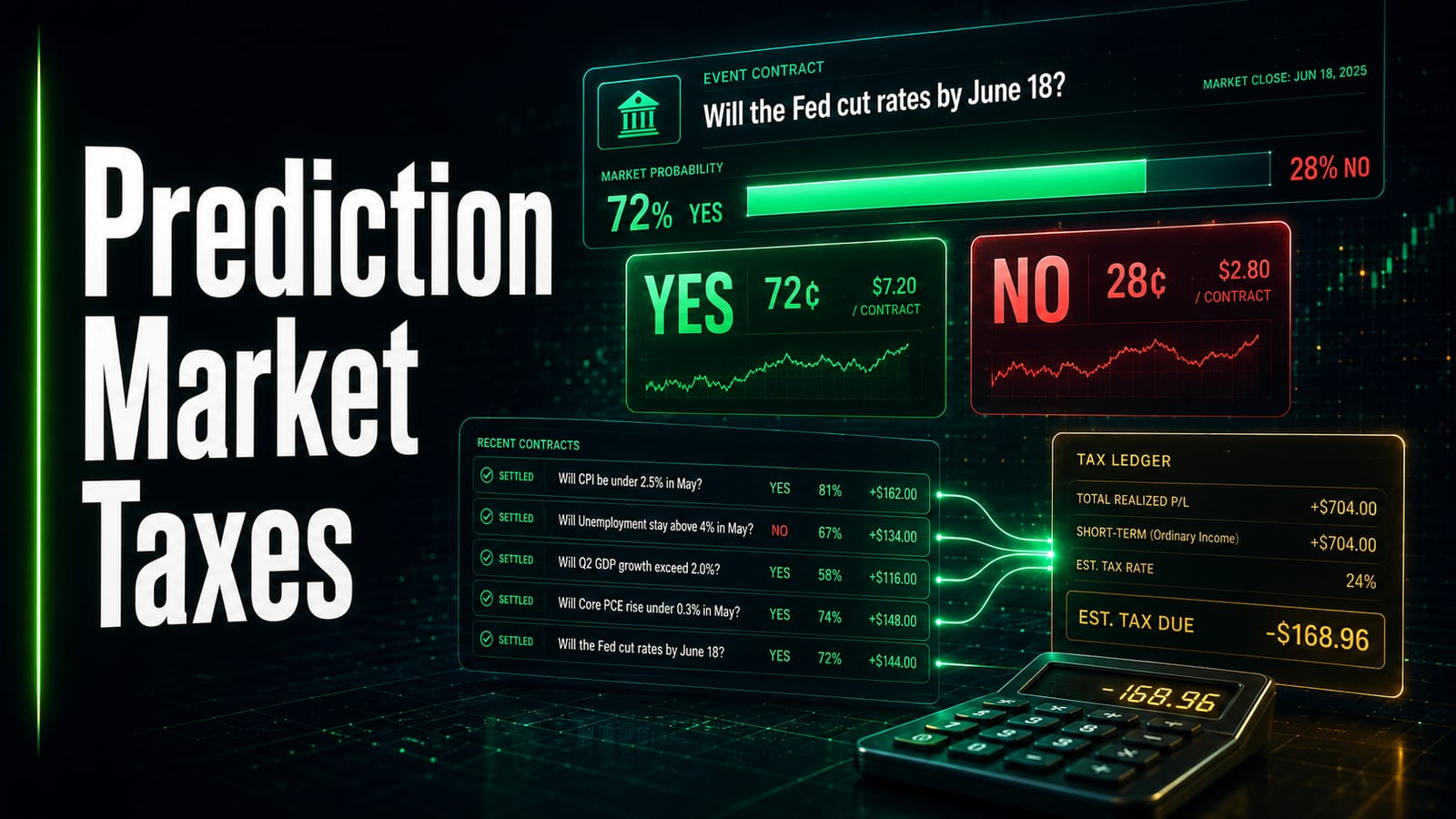
- The IRS and Treasury have issued no formal tax guidance on prediction-market event contracts as of July 2026 — no revenue ruling, notice, regulation, published private letter ruling, or FAQ. That silence is specific to tax: other federal regulators have been active, and the CFTC has an open event-contract rulemaking. The income is still fully taxable; what's unsettled is how.
- Practitioners typically choose among four candidate treatments: Section 1256 (60/40, aggressive), capital gain/loss (a common practitioner default), gambling under §165(d) (the worst 2026 outcome), or ordinary "other income" (the conservative consumer default).
- Starting tax year 2026, OBBBA caps the wagering-loss deduction at 90% of losses — so if event contracts were treated as wagering, break-even traders could owe tax on phantom income. In our illustrative example the spread between treatments is roughly 3.9x on identical trades.
- No major platform sends a comprehensive trade-level 1099 for event-contract profits — Kalshi's forms cover interest, reward credits, and limited digital-asset transfers, Robinhood provides a non-tax annual statement, and offshore Polymarket sends nothing at all. Records are on the trader.
- Every situation varies — the practitioner consensus is to pick one reasonable characterization, apply it consistently, and document the reasoning, ideally with a CPA who specializes in trader taxation.
Regulatory and tax status as of July 2026 — this area is evolving; we update this page as guidance lands.
Prediction markets went fully mainstream in 2026. Kalshi reported monthly trading volume above $30 billion by June (company-reported, driven heavily by the World Cup), Robinhood said its customers traded 8.8 billion event contracts in the first quarter of 2026 alone — roughly 10% of its net revenue, per company reporting — and Polymarket relaunched a regulated US exchange. Millions of Americans now hold contracts on elections, Fed decisions, sports, and inflation prints.
And almost none of them can get a straight answer on the tax question. That's not an accident of bad Googling — as of mid-July 2026 the IRS and Treasury have issued zero formal tax guidance on how event contracts are taxed: no revenue ruling, no notice, no regulation, no published private letter ruling, no FAQ, and nothing on the current Treasury/IRS Priority Guidance Plan.
That silence is specific to tax. Federal regulators have been anything but quiet on prediction markets generally — the CFTC has an open rulemaking of its own ("Prediction Markets; Public Interest Determinations," proposed June 2026, comments due July 27, 2026) — but none of that activity answers the characterization question a return has to answer.
When CNBC covered the question in July 2026, the IRS and Treasury declined to comment. Business Insider reported that a senior Tax Foundation economist who netted roughly $128,000 on Kalshi said he didn't know how to file it. If a professional tax economist is unsure, everyday traders can be forgiven for being confused.
This guide is the hub for our prediction-market tax coverage. It walks through what these markets are, the four competing tax treatments (honestly, without pretending one is "the answer"), the new 2026 gambling-loss rule that raised the stakes dramatically, which platforms send which forms, and how traders typically approach filing while the law is unsettled. Platform-specific detail lives in the dedicated Kalshi taxes and Polymarket taxes guides, the Kalshi vs Polymarket comparison, and the three-treatment tax calculator.
"No 1099 means no taxes" is wrong. Under IRC §61, income is taxable from any source, whether or not a form arrives. No major prediction platform currently issues a comprehensive trade-level 1099 for event-contract profits — but the IRS requires all income to be reported, and non-reporting can mean 20% accuracy penalties plus interest, or worse for willful cases.
What Are Prediction Markets — and Who Are the Major Platforms?
Prediction markets let traders buy and sell contracts that pay out based on real-world events — elections, Fed decisions, sports, inflation data. Most are binary yes/no contracts priced between $0.01 and $0.99 that settle at $1.00 or $0, with the price reflecting the market's implied probability. Major US venues include Kalshi, Polymarket US, Robinhood event contracts, IBKR's ForecastTrader, Crypto.com, and PredictIt.
Gain or loss on each contract is generally simple arithmetic: the settlement payout (or sale price) minus what was paid, with fees adjusting basis or proceeds. What is not simple is everything after that. The main venues, briefly:
- Kalshi — a CFTC-designated contract market (DCM) since November 2020, the first federally regulated event-contract exchange. Contracts trade peer-to-peer on an order book; Kalshi takes fees rather than the other side of trades. Coinbase, Webull, and Robinhood all route event-contract orders to Kalshi's exchange. Full detail: Kalshi Taxes.
- Polymarket (offshore) — the "classic" Polymarket: USDC-collateralized outcome tokens on the Polygon blockchain. It settled with the CFTC in 2022 and geoblocked US IPs from 2022 to 2025, and it adds a second tax layer because every trade also involves disposing of USDC, a digital asset. Full detail: Polymarket Taxes.
- Polymarket US (QCX) — a separate, CFTC-designated US exchange launched December 3, 2025 (beta in November), USD-settled with full KYC and no crypto layer. Its first full tax year is 2026.
- Robinhood event contracts — offered through Robinhood's CFTC-registered futures arm, routing to Kalshi, ForecastEx, and a newer exchange Robinhood part-owns. Arguably the largest US retail venue by contract count.
- ForecastEx / IBKR ForecastTrader — Interactive Brokers' affiliated exchange and clearinghouse, a CFTC DCM since June 2024, focused on economic-data, election, and climate contracts. It also pays interest-like "incentive coupons" on open positions — a second income stream.
- Crypto.com (CDNA) and PredictIt — CDNA is the former Nadex exchange (the legacy Nadex platform was retired in December 2025); PredictIt survived its long CFTC saga and relaunched for the 2026 midterms under a no-action framework.
- New entrants — FanDuel Predicts (a CME Group venture, live December 2025), DraftKings Predictions, Fanatics, and several newly approved exchanges. The category is expanding fast, and most newcomers have published no tax-document policy at all.
How Are Prediction Market Winnings Taxed in 2026?
Winnings are fully taxable — but how is genuinely unsettled. As of July 2026 the IRS has issued no ruling, notice, regulation, published private letter ruling, or FAQ on event contracts, and no court case addresses the characterization. Practitioners typically choose among four treatments — Section 1256, capital gain, gambling, or other income — each with different forms, rates, and loss rules.
This is the load-bearing fact of this entire guide, so it's worth being precise about it. Prediction-market taxation isn't on the 2025–2026 Treasury/IRS Priority Guidance Plan — a list of roughly 105 projects that includes OBBBA implementation and digital assets, but nothing on event contracts. There is no Tax Court or district-court case litigating the question. National practitioner groups openly acknowledge the gap, and specialist CPAs disagree with each other in print. Two traders with identical trades can — and do — legally file differently.
One nuance on how that negative is phrased: private letter rulings publish on a redaction lag, so the honest formulation is that nothing has been published and nothing is publicly known to be in the pipeline — not that no taxpayer has ever asked. And the gap is a tax gap specifically. The CFTC's rulemaking, the state-court gambling-preemption fights, and the state legislation covered further down are all real federal and state activity; none of them tells a preparer which line of the return to use.
That means any page (or app, or platform FAQ) that tells you prediction-market profits are definitively "taxed as X" is overstating the law. The honest answer is a decision framework, not a rule — which is exactly what the next section lays out.
The Four-Way Debate: Capital Gains, Section 1256, Gambling, or Other Income?
Four candidate treatments compete, and each has real practitioners behind it. Capital gain/loss on Form 8949 is a common practitioner default; Section 1256's 60/40 split is the aggressive minority position; gambling under §165(d) is the worst 2026 outcome if it applies; and ordinary "other income" is the conservative approach many consumer guides teach.
| Treatment | Where it's reported | Rate on gains | Loss treatment | Who typically takes it |
|---|---|---|---|---|
| A. Section 1256 (60/40) | Form 6781 → Schedule D | 60% long-term + 40% short-term rates, any holding period | Nets fully; $3,000/yr against ordinary income; carryforward + 3-yr carryback vs prior 1256 gains; year-end mark-to-market | An aggressive minority; often paired with Form 8275 disclosure |
| B. Capital gain/loss | Form 8949 → Schedule D | Short-term (ordinary rates) for nearly all positions | Nets against all capital gains; $3,000/yr allowance; indefinite carryforward | A common practitioner default |
| C. Gambling (§165(d)) | Schedule 1 line 8b + Schedule A line 16 | Ordinary rates on gross winnings | Itemizers only; capped at the lesser of 90% of losses or winnings (2026); no carryforward | Risk-averse filers, mainly for sports-style contracts |
| D. Other income | Schedule 1 line 8z | Ordinary rates | Whether losses can be netted inside line 8z is unresolved | A conservative consumer-guide default |
Position A — Section 1256 and the 60/40 split (the aggressive one)
The argument for: Kalshi, ForecastEx, Polymarket US, and CME are all CFTC-designated contract markets, which qualify as a "qualified board or exchange" under §1256(g)(7)(B). If a cash-settled binary event contract counts as a "listed option," it could ride the nonequity-option pathway into §1256 — meaning 60% long-term / 40% short-term capital gain regardless of holding period, year-end mark-to-market, and a three-year loss carryback election.
The arguments against are substantial, which is why most specialists call this position aggressive. First, the regulated-futures-contract prong of §1256 requires a system of variation margin and marking to market — Kalshi-style contracts are fully collateralized upfront, so that prong isn't seriously argued.
Second, and more fundamentally: Dodd-Frank added §1256(b)(2)(B), which excludes swaps from Section 1256 — and the CFTC classifies event contracts as swaps under the Commodity Exchange Act. Kalshi's own regulatory filings with the CFTC state that its contracts are swaps under the CEA. Third, some practitioners question whether a binary event contract is an "option" for tax purposes at all — there's no right to buy or sell underlying property, and an all-or-nothing payout on an event resembles a wager. The IRS also has a documented history of construing §1256 categories narrowly for novel instruments.
There's an instructive precedent here. Nadex — the closest historical analog, a CFTC-designated exchange listing binary contracts — issued §1256-coded 1099-Bs for years, then emailed members in February 2014 that the CFTC had advised its binaries are commodity options categorized as swaps that may not qualify for §1256. Same binary structure, same exchange status, same swap problem the current debate turns on.
Who actually takes Position A? A Forbes contributor has described 60/40 as a current-practice treatment while acknowledging "substantial tension"; several tax-software startups market it affirmatively; and some filers use it. Practitioners who take it typically recommend attaching Form 8275, a disclosure statement that can reduce penalty exposure on contestable positions. One thing worth being crystal clear about: Kalshi itself takes no position on tax characterization — its help materials disclaim tax advice entirely, and attributing a §1256 claim to Kalshi is simply an error.
Position B — capital gain and loss (a common practitioner default)
The mainstream practitioner approach treats each contract as a capital asset under §1221: settlement, lapse, or sale produces capital gain or loss (via §1234A), reported per-position on Form 8949 flowing to Schedule D. Since nearly all event contracts are held under a year, gains are short-term and taxed at ordinary rates. The payoff is on the loss side: losses net fully against all other capital gains — including stock and options trading — with a $3,000-per-year allowance against ordinary income and indefinite carryforward. No itemizing is required, no self-employment tax applies, and the net investment income tax can apply above the usual thresholds. National preparer groups and specialist trader-tax CPAs generally describe this as the most common practitioner approach.
Position C — gambling under §165(d) (the worst 2026 outcome)
Under a gambling characterization, gross winnings land on Schedule 1 as other income, and losses are deductible only for itemizers, only up to winnings — and starting in 2026, only up to 90% of losses (more below). Non-itemizers get zero loss offset. Professional-level activity under the Groetzinger standard would move to Schedule C with self-employment tax, with business expenses folded into the same capped bucket.
Who holds this view? Some risk-averse filers use it for sports-style contracts. More importantly, state regulators actively argue these products are gambling as a regulatory matter — 38 state attorneys general signed onto an amicus brief taking that position.
The courts are split: the Third Circuit ruled for Kalshi in April 2026, holding its sports event contracts are CEA swaps and state gambling law is preempted, while courts in Nevada, New York, Washington, Michigan, and Massachusetts have gone the other way in various postures. Further appellate decisions are pending and Supreme Court review is widely expected. A regulatory gambling label wouldn't automatically decide the tax question — but it wouldn't help, and sports contracts carry the highest recharacterization risk.
Position D — ordinary "other income" (the conservative consumer default)
The most conservative approach for gains, taught by several consumer tax guides: report net profit as other income on Schedule 1 line 8z, labeled something like "prediction market earnings," taxed at ordinary rates. It avoids aggressive rate claims — but it carries its own open question: whether losses may be netted inside line 8z, or whether gross-winnings logic applies. Practitioner descriptions implicitly net; no authority blesses it. That unresolved loss question is why many practitioners still prefer Position B for traders with meaningful losses.
Where do specific contracts sit on the spectrum?
A June 2026 Tax Notes analysis — co-authored by a former head of the IRS digital-assets office — frames characterization contract-by-contract rather than platform-wide: sports-outcome contracts sit closest to wagering, macro and economic-data contracts present the strongest capital-asset case, and election contracts fall somewhere in between. That framing matters practically: a trader holding Fed-decision contracts and a trader holding game-outcome contracts on the same exchange may face meaningfully different risk profiles under the same unsettled law.
While practitioners disagree on which treatment, they broadly agree on how to file under uncertainty: pick one reasonable characterization, apply it consistently year over year, document the reasoning, and keep complete records — trade history, dates, contract IDs, amounts, and net P&L. Aggressive positions typically warrant Form 8275 disclosure. Every situation varies; this is where a trader-specialist CPA earns their fee.
What Does the 2026 Gambling-Loss Rule (OBBBA) Change?
The One Big Beautiful Bill Act (P.L. 119-21, signed July 2025) capped the wagering-loss deduction at 90% of losses — limited to winnings, itemizers only, no carryforward — effective tax year 2026. Whether it touches prediction markets depends entirely on the unanswered characterization question: it bites only if event contracts are treated as wagering.
Here's the mechanic, because it's widely misunderstood. Under amended §165(d), the deduction is generally the lesser of 90% of losses or total winnings (the prevailing reading of the statutory text; the implementing regulations are still only proposed, so treat the fine print as unsettled). The 90% haircut creates "phantom income" whenever losses are less than roughly 111% of gains. A break-even trader with $100,000 of wins and $100,000 of losses deducts only $90,000 — and owes tax on $10,000 of profit that never existed. Professionals are hit too: business expenses are folded into the same capped bucket, and phantom Schedule C profit is also subject to self-employment tax (15.3% up to the $184,500 Social Security wage base for 2026).
The regulatory timeline is worth tracking, because the mechanics aren't final yet. Treasury's proposed regulations implementing the cap (REG-113229-25) were published as a notice of proposed rulemaking on April 17, 2026; the comment period closed June 16, 2026; and a public teleconference hearing was held July 17, 2026, where Rep. Dina Titus, the American Gaming Association, CPAs, and professional gamblers all pressed the phantom-income problem. No final rule had been issued as of late July 2026 — so what's described above reflects the statute plus proposed regulations, not settled ones.
Repeal efforts have not landed so far, which is worth knowing before planning around one. The FAIR BET Act was blocked in the House Rules Committee in January 2026, and a Senate attempt to move the FULL HOUSE Act by unanimous consent was also blocked. For tax year 2026 the 90% cap stands — and it still reaches prediction markets only if event contracts are characterized as wagering, which no authority has said they are. Separately, OBBBA also raised the general 1099-MISC/NEC reporting threshold from $600 to $2,000 for payments made in 2026 (indexed for inflation starting 2027), which means even more profitable traders will receive no form at all while still owing tax.
This rule — and the fact that it applies only under one of four candidate characterizations — is why the characterization debate stopped being academic in 2026. It's also fueling a widely reported migration story: sports bettors moving from sportsbooks to prediction markets partly for tax reasons, with the obvious counter-risk that a gambling recharacterization would erase the advantage overnight.
A worked example: the same $10,000 profit, four ways
Take a single filer with $100,000 of other ordinary income who has $30,000 of gross prediction-market wins and $20,000 of gross losses in 2026 — a real economic profit of $10,000. The figures below are illustrative, assuming a 24% marginal bracket and a 15% long-term capital-gains rate; exact brackets shift annually and every situation varies.
| Treatment | Taxable amount | Approx. federal tax | Effective rate on the $10K profit |
|---|---|---|---|
| A. Section 1256 (60/40) | $10,000 (60% LTCG / 40% STCG) | $1,860 | 18.6% |
| B. Short-term capital | $10,000 | $2,400 | 24% |
| C. Gambling — itemizer | $12,000 ($30K − min(90% × $20K, $30K)) | $2,880 | 28.8% |
| D. Gambling — standard deduction | $30,000 (no loss offset at all) | $7,200 | 72% |
That's a roughly 3.9x federal spread on identical trades, decided by an unsettled legal question plus an itemizing checkbox. A few more angles from the same setup:
- The break-even trader: $150,000 of wins and $150,000 of losses produces $0 of tax under capital treatment — but around $15,000 of phantom income for a gambling-characterization itemizer, and potentially tax on the full $150,000 gross for a non-itemizer.
- The losing year: a net $10,000 loss under capital or 1256 treatment typically yields a $3,000 deduction now and a carryforward (1256 adds a possible carryback against prior 1256 gains). Under gambling treatment, excess losses simply vanish — forever.
- The AGI cascade: gambling characterization puts gross winnings into AGI even when losses offset them below the line — which can inflate Medicare IRMAA surcharges, phase-outs, and state taxes keyed to AGI.
Our Prediction Market Tax Calculator models all three main branches side by side — including the 90% rule and the itemizing toggle — and shows your outcome as a range, because with no IRS guidance a range is the only honest output. For estimates only; every situation varies.
Do Prediction Market Platforms Send 1099s?
Mostly no. No major platform currently issues a comprehensive trade-level 1099 for event-contract profits: Kalshi's forms cover interest, reward credits, and limited digital-asset transfers, Robinhood provides only a non-tax annual statement, and offshore Polymarket sends nothing at all. Crypto.com is the notable exception. Either way, the income is fully taxable and the records burden falls on the trader.
Here is the canonical matrix — the single table we wish had existed when this category took off. Platform reporting practices can change year to year, so the reliable move is always the same: check your own account's tax-documents section, and keep independent records regardless.
| Platform | Regulatory status | Tax forms typically issued (recent practice) | What that means for traders |
|---|---|---|---|
| Kalshi | CFTC-designated contract market since Nov 2020 | Per its help center: 1099-INT for interest on cash balances (issued at $10 or more) and 1099-MISC for referral/reward credits. Its documentation also covers limited digital-asset reporting — a narrow 1099-B for proceeds on certain broker/crypto-transfer transactions, and, beginning with tax year 2025, Form 1099-DA (Digital Asset Proceeds From Broker Transactions) issued through its crypto partner Zero Hash. None of those forms covers event-contract trades, and Kalshi's documentation describes no comprehensive trade-level 1099-B for event-contract P&L.† | Trading P&L is typically self-reconstructed from Kalshi's statements and CSV exports — its in-app P&L statement is FIFO, updated monthly, includes fees, and is explicitly not tax advice. Kalshi takes no position on tax characterization. This describes a direct Kalshi account; orders routed to Kalshi's exchange through another broker may instead appear in that broker's own year-end reporting. |
| Robinhood (event contracts) | CFTC-registered FCM routing to Kalshi, ForecastEx, and a part-owned exchange | No 1099 for event contracts. Robinhood's own support pages say event trades are not reported to the IRS (orders route to partner exchanges, so treatment can differ by venue); it provides an "Event Contracts Annual Statement" explicitly labeled a non-tax document. | The consolidated 1099-B does not cover event contracts — a very common false assumption. |
| Polymarket (offshore) | Offshore USDC/Polygon exchange; geoblocked US IPs 2022–2025 | None — no 1099 of any kind, no IRS reporting. | Fully taxable regardless, with a second digital-asset layer: every USDC-denominated trade is also technically a crypto disposal. See Polymarket Taxes. |
| Polymarket US (QCX) | CFTC-designated exchange, launched Dec 2025, USD-settled | No confirmed 1099 policy as of July 2026 — 2026 is its first full tax year, and its reporting approach hasn't been announced. | Watch the platform's tax section; keep independent records in the meantime. |
| IBKR ForecastTrader (ForecastEx) | CFTC DCM + clearinghouse since June 2024 | For tax year 2024, IBKR reported gross forecast-contract proceeds on Form 1099-MISC with no cost basis, with notes telling the taxpayer to adjust. Whether later years changed is unverified — check the actual consolidated statement. | The gross-proceeds figure typically needs a basis adjustment on the return, and incentive-coupon income is a second stream to account for. |
| Crypto.com (CDNA, former Nadex) | CFTC DCM + clearinghouse | The outlier: its help center describes 1099-B reporting for contract traders using futures-style aggregate boxes. | A platform's 1099-B presentation does not establish that §1256 treatment is legally correct — Nadex-era binary 60/40 eligibility was itself long disputed. |
| Robinhood, Coinbase and Webull as routes to Kalshi | CFTC-registered intermediaries routing event-contract orders to Kalshi's exchange rather than running their own | None of the three appears to issue a trade-level 1099 for event contracts. Robinhood is reported to provide an Event Contracts Annual Statement instead — a separate document from the February 1099 package, which is reported not to include this activity. Webull is reported to require a separate account for event contracts. Coinbase's event-contract document practice is still not something we can assert — but its market structure is now reported: Coinbase Predict is described as routing orders to Kalshi rather than running its own exchange, with Coinbase Financial Markets acting as the CFTC-registered intermediary. That makes the venue behind the app the same venue behind Robinhood's event contracts — which is a reason to check what your front end sends you rather than to assume the exchange decides it. | The trap is the consolidated 1099 you do get. It looks complete, and for event contracts it is reported not to be — so a trader who hands their preparer only the February package has omitted this activity without noticing. Broker-level detail: Robinhood taxes · Webull taxes. |
| PredictIt | CFTC no-action framework; relaunched for 2026 midterms | Historically a 1099-MISC for net profit of $600 or more. Whether that practice continues — and whether the new $2,000 threshold applies for 2026 — is unconfirmed. | Many profitable traders may receive no form at all for 2026 and still owe tax. |
| † A conflict worth flagging, because it trips traders up: several third-party guides state that Kalshi issues a 1099-B whenever gross proceeds exceed $600. Kalshi's current help documentation doesn't support a comprehensive event-contract 1099-B — the 1099-B and 1099-DA it describes are digital-asset forms. Platform practices do change, so the reliable check is your own account's Tax Info section rather than any summary, including this one. | |||
This is the structural point that makes the table above read differently. Kalshi is reported to sit behind more than one of these front ends — Robinhood's event contracts are described as routed through Robinhood Derivatives, LLC and traded on KalshiEx LLC, and Coinbase Predict is described as routing to Kalshi with Coinbase Financial Markets as the registered intermediary.
So three traders can hold economically identical positions on the same exchange and have three different document experiences, because the document comes from the front end and its broker, not from the exchange underneath. One may get an annual statement that is explicitly not a tax form; one may get nothing; one may get a line on a consolidated package.
The practical rule that follows: when you are working out what paperwork to expect, the question is who did I open the account with, not which exchange am I on. And when you are working out characterisation — which is the genuinely unsettled part — the exchange's regulatory status is part of the argument, but a broker's reporting choice is not a ruling about it either way.
Scope note: routing arrangements are drawn from third-party reporting, not from the platforms' own current documentation, and they change. Check your own account's tax section rather than relying on any chain described here.
A platform's tax form — or its absence — reflects the platform's reporting choice, not an IRS determination of how your trades are taxed. Reporting practices in this category have already changed year to year and may change again for 2026. For the current status of each platform's forms, see the dedicated Kalshi and Polymarket guides.
Which Tax Forms Do Prediction-Market Traders Typically Use?
It follows directly from the characterization: capital treatment uses Form 8949 and Schedule D; the Section 1256 position uses Form 6781; gambling treatment uses Schedule 1 plus Schedule A (or Schedule C for professionals); and the other-income approach uses Schedule 1 line 8z. Same trades, four different filing paths.
- Capital (Position B): per-position detail on Form 8949 (the checkbox for transactions not reported on a 1099-B), flowing to Schedule D. Nearly everything is short-term.
- Section 1256 (Position A): Form 6781, with the 60/40 split flowing to Schedule D — including year-end mark-to-market of positions still open on December 31, a step commonly missed. Practitioners taking this position often attach Form 8275.
- Gambling (Position C): gross winnings on Schedule 1 line 8b; losses on Schedule A line 16, subject to the 2026 caps. Professional-level filers use Schedule C with self-employment tax.
- Other income (Position D): a labeled entry on Schedule 1 line 8z at ordinary rates — with the loss-netting question unresolved.
One practical wrinkle: as of the most recent filing season, no consumer tax software had a dedicated prediction-market flow. TurboTax users report threading it manually through one of three paths — self-entered 8949 transactions, the "Contracts and Straddles" interview for Form 6781, or Miscellaneous Income — and community threads document confusion in all three. Another: if a platform issued a 1099-MISC (as IBKR and PredictIt have), reporting the income elsewhere on the return can create an IRS matching mismatch and a CP2000 notice — there are clean ways to reconcile it, and this is squarely CPA territory.
How Do Traders Typically Approach Filing Under All This Uncertainty?
Most traders follow the same general sequence: gather complete records from every platform, compute gain and loss per contract, weigh the four characterizations with a professional, apply one consistently and document the reasoning, plan for quarterly estimated payments, and confirm the call with a trader-specialist CPA. There is no IRS-blessed path — consistency and documentation are what practitioners rely on instead.
Here's that sequence in more detail, as most trader-specialist CPAs describe it — informational only; every situation varies:
Step 1 — Gather complete records from every platform
Trade-history exports, monthly statements, bank and transfer records, and — for offshore Polymarket — the wallet's on-chain history. Since most platforms send no comprehensive 1099, the trader's own records are typically the documentation everything else is built on.
Step 2 — Compute gain and loss per contract
Basis is generally what was paid plus fees; proceeds are the sale price or the $1/$0 settlement. Two traps to avoid: deposits-minus-withdrawals is not the taxable number, and winnings are typically taxable in the year the position closed — not the year the cash was withdrawn.
Step 3 — Weigh the characterization options with a professional
Capital, 1256, gambling, or other income — the choice interacts with the trader's contract mix (sports vs. macro), loss profile, itemizing status, other trading activity, and risk tolerance. Sports-heavy books typically get the most cautious analysis.
Step 4 — Apply one characterization consistently and document why
Practitioners generally recommend consistency year over year and a written record of the reasoning, with Form 8275 disclosure for aggressive positions. Flip-flopping treatments between years is the pattern most likely to look bad in an exam.
Step 5 — Plan for quarterly estimated payments
No platform withholds tax. Profitable traders typically make quarterly payments once they expect to owe $1,000 or more, using the general 100%–110% prior-year safe harbors.
Step 6 — Talk with a trader-specialist CPA
Every situation varies, and in this area the law itself is a moving target. A CPA who specializes in trader taxation can weigh the four positions against a specific trader's facts — and update the plan when guidance finally lands.
What Records Typically Matter?
The core set is small: trade-history exports from every platform, per-contract details (dates, contract IDs, quantities, prices paid, proceeds, fees), bank and transfer records to reconcile against, and — for offshore Polymarket — full on-chain wallet history. In a category where most platforms send no comprehensive 1099, those records typically are the return's only support.
In practice, most traders keep:
- Trade-history exports — Kalshi provides an annual transaction CSV and monthly P&L statements in its account documents area; other platforms have equivalents of varying quality.
- Per-contract details — dates, contract IDs, quantities, prices paid, sale or settlement proceeds, and fees (fees adjust basis or proceeds).
- Bank and transfer records — deposits and withdrawals, to reconcile against platform statements.
- Wallet history — for offshore Polymarket, the Polygon wallet's full history; crypto tax tools can reconstruct positions and generate pre-filled 8949s. Users of the offshore platform also typically answer "yes" to the 1040 digital-asset question — see crypto taxes for how digital-asset disposals work generally.
- Screenshots of platform-reported P&L — useful corroboration, though platform P&L conventions (like FIFO with fees included) are worth understanding before relying on them.
A widely documented DIY error: Kalshi's transaction CSV has been reported to store values in cents, not dollars. Traders who sum the columns without dividing by 100 overstate their P&L a hundredfold. Sanity-check any spreadsheet total against the platform's own P&L statement before it goes anywhere near a return.
Do Prediction-Market Traders Owe Quarterly Estimated Taxes?
Often, yes — for profitable traders. No prediction platform withholds tax, so a trader who expects to owe $1,000 or more typically makes quarterly estimated payments to avoid underpayment penalties, using the general safe harbors (100% of the prior year's tax, or 110% at higher incomes). Many traders simply set aside a percentage of each win.
This is the same discipline that applies to futures and options traders with no withholding — the difference here is that a prediction-market trader may not even get a year-end form as a reminder.
How Do States Tax Prediction-Market Winnings?
Mostly by inheriting the federal answer. Most states start from federal AGI, so the unsettled federal characterization mechanically drives the state outcome — and no state revenue agency has issued individual income-tax guidance on prediction markets as of July 2026. Under a gambling characterization, gross winnings enter state AGI with losses handled (or not) below the line; under capital treatment, only the net typically flows through.
The spread between states is dramatic. Traders in no-income-tax states (Texas, Florida, Nevada, and others) typically owe nothing at the state level under any characterization. At the other extreme, roughly ten states — Illinois among them — allow no gambling-loss deduction at all, so a gambling characterization there could mean state tax on gross winnings even in a break-even year (Illinois's flat tax applies to federal AGI with no itemized offset).
New Jersey sits near the best case for the gambling branch: it has historically allowed same-year netting of gambling losses without itemizing and did not adopt the federal 90% cap. State rules vary widely and change frequently — state-specific treatment is worth a dedicated conversation with a CPA, particularly for traders in flat-tax states.
States have started legislating — so far at the operator level, not the trader's
Two states moved first in 2026, and the distinction is the whole story: both taxes land on the operator, not on the individual trader. North Carolina's SB 257, signed July 7, 2026, is the first state prediction-market-specific tax — 6% on operators' net trading-fee revenue apportioned to North Carolina residents, effective January 1, 2027. The same law also statutorily recognizes exclusive CFTC jurisdiction over these markets, which is notable given how many states are arguing the opposite in court. Kentucky's HB 757, enacted in April 2026, imposes a 14.25% operator excise, also effective January 1, 2027. Roughly fifteen states considered prediction-market bills during 2026, per a July 2026 Holland & Knight survey.
So the accurate framing has two halves. No state revenue agency has issued individual income-tax guidance on prediction-market winnings — that part of the picture is still blank. But "states have done nothing" is no longer true either: they have acted, at the operator level, and operator excises typically reach traders indirectly through platform fee schedules rather than through a line on a return. For most traders the practical watch items are whether fees move in 2027 and whether any state follows up on the individual side — both worth raising with a CPA who tracks the trader's home state.
What Could Change Next?
Several things, none of them decided. The nearest is the 2026–2027 Treasury/IRS Priority Guidance Plan, expected around September or October 2026. Behind it: any IRS guidance at all, the CFTC's event-contract final rule, further appellate rulings and possible Supreme Court review, final §165(d) regulations, more state legislation, and platform form announcements for 2026.
In more detail — this page describes a moving target, and several pending events could reshape it quickly:
- The 2026–2027 Priority Guidance Plan — expected around September or October 2026, and the nearest single event that could move the no-guidance baseline. Event contracts appearing on it would signal that formal tax guidance is actually being drafted; their absence would suggest another filing season without it.
- IRS guidance of any kind — a ruling, notice, FAQ, or even a form-instruction line on event contracts would instantly narrow the four-way debate.
- The CFTC's prediction-markets rulemaking — a proposed rule issued June 10, 2026 ("Prediction Markets; Public Interest Determinations") would define "gaming" for event-contract purposes; comments are due July 27, 2026, and a final rule could land late 2026 or 2027.
- The courts — further appellate decisions in the state-gambling-law fights are pending after the Third Circuit's April 2026 ruling for Kalshi, and Supreme Court review is widely expected.
- Final §165(d) regulations — the proposed regulations implementing the 90% loss cap (REG-113229-25) drew heavy criticism at the July 17, 2026 hearing; the final version will settle mechanical details, and none had been issued as of late July 2026.
- More state legislation — North Carolina and Kentucky already enacted operator-level taxes effective January 2027 and roughly fifteen states weighed bills in 2026; individual-side state guidance is the piece still missing everywhere.
- Platform form announcements for 2026 — especially Kalshi, Polymarket US, and Robinhood, any of which could change the 1099 matrix above.
- Congressional action — bills to repeal the 90% cap and bills to ban sports event contracts are both pending; none had passed as of mid-2026, and both the FAIR BET Act and a unanimous-consent push on the FULL HOUSE Act were blocked earlier in the year.
We monitor all of these and update this hub as they land — the "as of" date at the top of the page is the tell for how current it is.
One adjacent product is already here and is not covered by this page. Platforms listing event contracts are also listing perpetual futures, and those run on a different analysis: a perp has a continuous payoff rather than a binary one, so the §165(d) wagering question that dominates this page largely falls away — while a new one appears, because the funding payment exchanged between longs and shorts triggers the same §1256(b)(2)(B) swap exclusion the Nadex precedent made famous. If your account holds both, that is two sets of records and two characterization decisions, not one.
When Does a Trader-Specialist CPA Matter?
Typically once the numbers get large enough that the characterization choice moves real money — five figures of profit, meaningful losses, multiple platforms including a crypto layer, professional-looking activity, entity questions, or prior years that need cleanup. For a casual trader with a few hundred dollars of profit on one platform, the stakes are modest under any treatment.
The calculus changes quickly when:
- The characterization spread gets expensive — at five figures of profit, the gap between treatments in our worked example was measured in thousands of dollars.
- Losses are significant — the difference between full capital-loss netting and the gambling regime's vanishing losses is the single biggest dollar swing in this area.
- Multiple platforms are involved — a Kalshi-plus-offshore-Polymarket book means two different record-keeping regimes, including a crypto layer.
- Activity looks professional — whether trader tax status or a §475 mark-to-market election can even apply to event contracts is genuinely open (event contracts aren't clearly "securities or commodities" for §475), and it's the kind of question that gets answered facts-first, not from a blog. Background: Mark-to-Market for traders.
- Entity questions arise — trading through an LLC or S-Corp changes the analysis; see LLC vs S-Corp for traders.
- Prior years need cleanup — unreported prediction-market income from earlier years is typically fixable with amended returns, and doing it proactively usually beats a CP2000 notice.
CPAs in our partner network work in a secure document portal with audit logging — see how we protect client data. And a note on sources for this page: the no-guidance baseline is checkable directly against the IRS's published Priority Guidance Plan, and exchange designations against the CFTC.
Primary Sources Behind This Page
Every treatment described above runs through forms and code sections that already exist and are already documented by the IRS. None of the IRS pages below addresses prediction-market event contracts — that is precisely the gap this guide describes. They are the primary sources for the underlying forms, topics, and rules a preparer would apply once a characterization is chosen, and they are worth reading alongside this page rather than instead of it.
- IRC §61 — gross income from any source. The reason a missing 1099 changes nothing about taxability. General background: IRS Publication 550, Investment Income and Expenses.
- Position A / §1256: IRS About Form 6781 — Gains and Losses From Section 1256 Contracts and Straddles. Practitioners taking a contestable position often pair it with Form 8275, Disclosure Statement.
- Position B / capital: IRS About Form 8949 and About Schedule D (Form 1040).
- Position C / §165(d): IRS Topic No. 419, Gambling Income and Losses — the IRS's general summary of wagering income and loss rules, which is the regime the 2026 90% cap modifies. Whether event contracts are wagering at all is the open question.
- The digital-asset layer (offshore Polymarket, and Kalshi's crypto-transfer reporting): IRS About Form 1099-DA, Digital Asset Proceeds From Broker Transactions.
- The no-guidance baseline: the Treasury/IRS Priority Guidance Plan — the list to watch when the 2026–2027 edition publishes.
- Exchange status and the swap classification: CFTC.gov, including designation orders and the June 2026 event-contract rulemaking docket.
Explore the Prediction Market Tax Hub
This is the pillar page — the platform-specific detail, the comparison, and the calculator each get their own deep dive. Every platform named above that has a dedicated TraderTax guide is linked here, along with the instrument and entity pages the characterization question runs into:
Not Sure Where You Stand on Taxes?
Answer 8 quick questions. Get a personalized AI summary of your tax exposure, missed deductions, and what you should do next — reviewed by a real CPA.
Get My Free Tax Snapshot →Frequently Asked Questions
Do I have to pay taxes on Kalshi and Polymarket winnings?
Typically yes. Under IRC §61, gross income includes income from any source, so prediction-market profits are taxable whether or not a platform sends a tax form. What is unsettled is how they are characterized — capital gain, Section 1256, gambling, or other income — not whether they are taxable.
How are prediction market winnings taxed — as gambling, capital gains, or Section 1256?
The IRS has not said. As of July 2026 there is no ruling, notice, regulation, or published private letter ruling on event contracts, and practitioners openly disagree. Many preparers treat them as short-term capital gains; some report ordinary "other income"; a minority take an aggressive Section 1256 position; sports-style contracts carry gambling-treatment risk.
If I didn't get a 1099, do I still report the income?
Typically yes — this is the most dangerous myth in this area. No major prediction platform currently issues a comprehensive trade-level 1099 for event-contract profits, but the income is fully taxable regardless. Most traders reconstruct their profit from platform statements and their own records.
What is the new 90% gambling-loss rule, and does it apply to prediction markets?
Starting tax year 2026, OBBBA caps the wagering-loss deduction at 90% of losses, limited to winnings, for itemizers only. Whether it reaches prediction markets depends on an unanswered question — whether event contracts are "wagering." If they were treated that way, break-even traders could owe tax on phantom income — walked through line by line in the 90% gambling-loss cap explainer.
Can I owe taxes in a year where I broke even?
Potentially, under a gambling characterization. A trader with $150,000 of wins and $150,000 of losses would deduct only 90% of losses ($135,000) if itemizing, leaving $15,000 of taxable phantom income — and a non-itemizer could be taxed on the full $150,000. Under capital treatment, the same year typically nets to zero.
Do I pay taxes when I withdraw from a platform, or when contracts settle?
Generally when contracts settle or are sold — not at withdrawal. Winnings left sitting in a Kalshi or Polymarket balance are typically still taxable in the year the position closed. Deposits minus withdrawals is not the taxable amount; gain or loss is measured per contract against what was paid.
Do prediction-market losses carry forward?
It depends on characterization. Under capital or Section 1256 treatment, net losses typically offset up to $3,000 of ordinary income per year and carry forward indefinitely. Under gambling treatment, disallowed losses vanish permanently — §165(d) has no carryforward. That asymmetry is one of the biggest stakes in the debate.
Do I need quarterly estimated taxes on prediction-market winnings?
Often, for profitable traders. No prediction platform withholds tax, so traders expecting to owe $1,000 or more typically make quarterly estimated payments to avoid underpayment penalties. The safe-harbor targets are generally 100% to 110% of the prior year's tax. Many traders set aside a share of each win.
Are states starting to tax prediction markets?
Some are, but so far at the operator level rather than the trader's. North Carolina's SB 257, signed July 7, 2026, taxes operators' net trading-fee revenue apportioned to state residents at 6%, and Kentucky's HB 757 imposes a 14.25% operator excise — both effective January 1, 2027. Roughly fifteen states weighed prediction-market bills in 2026. Neither law is an individual income tax, and no state revenue agency has issued individual guidance as of July 2026, though operator costs typically reach traders indirectly through platform fees.
Does the wash-sale rule apply to prediction-market contracts?
Probably not, but it is not settled. Section 1091 applies to "stock or securities," and event contracts are likely neither — so most practitioners view the wash-sale rule as not clearly applicable rather than confirmed inapplicable. No IRS authority addresses it, and rapid close-and-reopen patterns could still draw scrutiny. Background: the wash-sale rule.
What's the safest way to report if the IRS hasn't decided how prediction markets are taxed?
There is no officially blessed answer, but practitioners generally converge on this: pick one reasonable characterization, apply it consistently year over year, document the reasoning, and keep complete records. Aggressive positions like Section 1256 often warrant Form 8275 disclosure. A trader-specialist CPA can help weigh the options.
See what your prediction-market taxes typically look like
With no IRS guidance, the honest answer is a range — and the range depends on characterization, itemizing status, state, and the rest of the trader's return. The calculator below models the three main treatments side by side; every situation varies, and a CPA confirms what actually applies.
Or create a free account to get matched with a CPA →