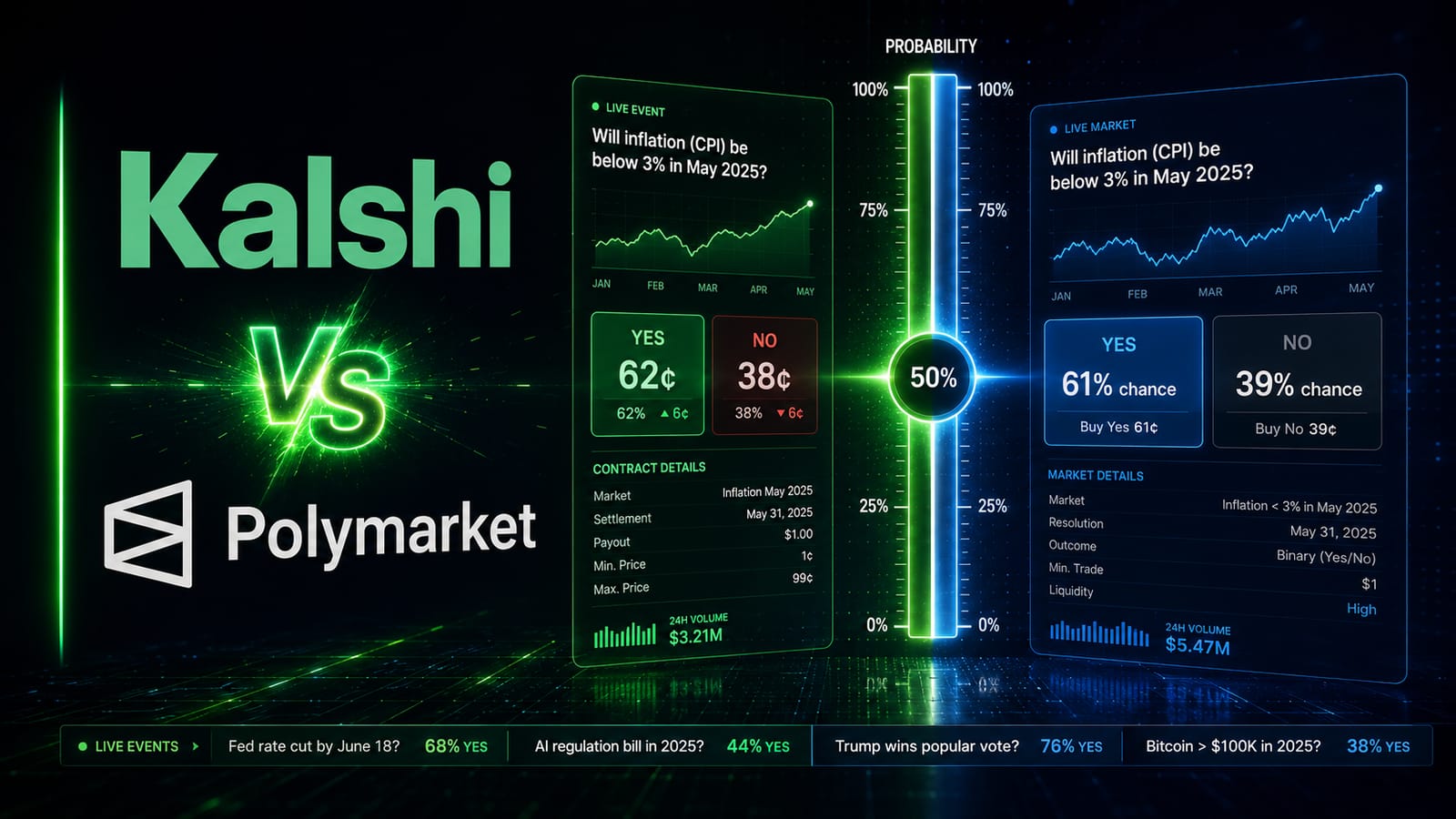
- Kalshi is a CFTC-designated contract market (since November 2020) settled in US dollars. "Polymarket" is really two platforms: the classic offshore USDC exchange (geoblocked for US IPs) and Polymarket US — also a CFTC-designated exchange, USD-settled, launched December 2025.
- The tax difference is layers: Kalshi and Polymarket US typically mean one set of gains and losses to report; the offshore USDC platform typically adds a second, digital-asset layer because the IRS treats USDC as property.
- Neither platform sends a complete tax form. Kalshi typically issues limited forms (interest, referral rewards, plus narrow digital-asset forms) — none covering event-contract trades; offshore Polymarket issues nothing; Polymarket US had no confirmed 1099 policy as of July 2026. Profits are taxable either way.
- How event-contract profits are characterized is unsettled — the IRS has issued no guidance, and practitioners typically take one of several positions (capital gains, ordinary income, gambling, or Section 1256). That question matters more than which platform a trader picks.
- Both platforms are innovating fast and both have attracted serious institutional backing — every situation varies, and a CPA who knows trader taxation can confirm what applies to a particular trader.
This area is evolving; we update this page as guidance lands. As of July 2026 the IRS and Treasury have issued no formal tax guidance on prediction-market event contracts — no revenue ruling, notice, regulation, published private letter ruling, or FAQ that we're aware of — and no event-contract project appears on the current Treasury/IRS priority guidance plan.
That silence is specific to the tax side: the CFTC itself has been active, including a June 2026 notice of proposed rulemaking on prediction markets and public-interest determinations, with comments due July 27, 2026. Court fights over sports contracts are live, and platform reporting practices can change year to year. This page is informational only, not personalized tax advice.
Written by the TraderTax Editorial Team and checked against primary and professional sources rather than other tax blogs or platform marketing: the Internal Revenue Code (§61, §165(d), §1221, §1234A, §1256), IRS form and topic pages, the One Big Beautiful Bill Act (P.L. 119-21 §70114) and its still-proposed implementing regulations (REG-113229-25), CFTC designation and settlement orders plus each exchange's own regulatory filings and help documentation, published appellate decisions, state legislation (NC SB 257, KY HB 757), and specialist practitioner analysis.
The Editorial Team are researchers and writers — not CPAs. TraderTax is a referral platform; the filings themselves are handled by independent licensed CPAs in our partner network. Where sources genuinely conflict or a question is unsettled, this page says so instead of picking a side, and the primary IRS material is linked at the bottom of the page.
Kalshi and Polymarket are the two names that defined the prediction-market boom. Both let traders take positions on real-world events through binary contracts, both have grown at a remarkable pace, and both are innovating quickly — Kalshi as the first federally regulated event-contract exchange, Polymarket as the crypto-native original that later added a regulated US venue of its own.
This comparison focuses on the structural differences that don't change week to week: regulation, who can use each platform, how contracts settle, what tax forms show up (or don't), and what each structure typically means at filing time. Contract lineups, fee schedules, and promotions shift constantly — for current specifics, both platforms' official sites are the place to check. The tax angle is where the differences get real, and it's the lane this guide goes deepest on.
Both platforms are reputable, well-capitalized venues with real track records of paying winners, and both are innovating fast — Kalshi as the first CFTC-designated event-contract exchange, Polymarket as the crypto-native original that went on to build a CFTC-designated US exchange of its own. This page does not pick a winner. It frames the differences as advantages each venue has, and it sticks to the structural facts that don't rot — regulation, settlement currency, who can access what, and what each structure typically means at filing time.
Contract lineups, fee schedules, position limits, and promotions change constantly, so for those specifics kalshi.com and polymarket.com are the authoritative sources. Where TraderTax can add something nobody else does is the tax angle — so that's where this guide goes deepest.
What's the Core Difference Between Kalshi and Polymarket?
Kalshi is a US-regulated, dollar-settled exchange; classic Polymarket is a crypto-settled platform that operates outside US regulation and has geoblocked US IP addresses since 2022. Polymarket's answer for American traders is Polymarket US — a separately regulated, USD-settled exchange launched in December 2025. For taxes, settlement currency is the difference that matters most.
That "two Polymarkets" point trips up more traders than anything else in this comparison. The offshore platform runs on the Polygon blockchain: positions are outcome tokens collateralized in USDC, settling at $1 or $0, and each position is its own instrument with its own cost basis and dates. Polymarket US is a different animal entirely — Polymarket acquired a CFTC-licensed exchange and clearinghouse (QCEX) for $112 million in July 2025 and launched the QCX-based US venue with full KYC, dollar settlement through approved intermediaries, and no crypto involved.
Kalshi, meanwhile, has been a CFTC-designated contract market since November 2020 — the same regulatory class as CME — with binary yes/no contracts priced between $0.01 and $0.99 that settle at $1.00 or $0. The price is the market's implied probability, and trading is peer-to-peer on an order book: Kalshi collects fees rather than taking the other side. Kalshi contracts also reach traders through Robinhood, Coinbase, and Webull, which route event-contract orders to the Kalshi exchange.
Kalshi vs Polymarket: Side-by-Side Comparison
Because "Polymarket" is two platforms with two very different tax stories, the honest comparison has three columns. Figures are company- or press-reported; fees and contract lineups change quickly, so both platforms' sites are the source of truth for current details.
| Kalshi | Polymarket (offshore) | Polymarket US | |
|---|---|---|---|
| Regulation | CFTC-designated contract market since Nov 2020 — same regulatory class as CME | Operates outside US regulation; 2022 CFTC settlement; a new CFTC review opened June 2026 | QCX LLC — CFTC-designated contract market (QCEX acquisition, July 2025) |
| Who can use it | US traders (sports contracts are legally contested in several states) | Non-US users; US IP addresses geoblocked since 2022 | US users — beta Nov 12, 2025, full launch Dec 3, 2025; waitlist dropped May 2026 (iOS first) |
| Settlement | US dollars | USDC on the Polygon blockchain (outcome tokens) | US dollars, via approved FCMs |
| Account / KYC | USD account at a federally regulated exchange; also reachable through Robinhood, Coinbase, and Webull | Self-custodied crypto wallet; no US onboarding | Full KYC — ID, SSN, residency, selfie |
| Tax forms issued | Limited — typically 1099-INT (interest on cash balances, at $10+) and 1099-MISC (referral rewards), plus the narrow digital-asset forms Kalshi's help materials describe: a 1099-B on certain broker/crypto-transfer transactions and, from tax year 2025, a 1099-DA through crypto partner Zero Hash. None of them cover event-contract trades — no comprehensive trade-level 1099, so check your account's tax section | None — no 1099 of any kind | Unconfirmed as of July 2026 — 2026 is its first full tax year |
| Tax reporting complexity | Single layer — contract gains and losses (characterization unsettled) | Dual layer — each position plus a USDC digital-asset disposal leg | Single layer — USD-settled, no crypto leg |
| State-level taxes | The 2026 state laws tax operators, not individual traders: North Carolina (SB 257, signed July 7, 2026 — 6% of net trading-fee revenue apportioned to NC residents, and it recognizes exclusive CFTC jurisdiction) and Kentucky (HB 757 — a 14.25% operator excise), both effective Jan 1, 2027, with roughly 15 states weighing prediction-market bills in 2026. No state revenue agency has issued individual income-tax guidance for prediction-market winnings — though operator costs can reach traders indirectly through fees. More in the prediction market taxes hub guide. | ||
| Sports contracts | Yes, since Jan 2025 — contested in several states | Yes — sports markets (taker fees added Feb 2026) | Evolving — named in similar state-level disputes (KY, RI suits) |
| Fees | Taker fee peaking around $1.75 per 100 contracts at 50¢; no settlement fee; free ACH — see kalshi.com for the current schedule | Historically near-zero; taker fees introduced in 2026 on some markets (reported up to ~0.44%) — see platform | See platform for the current fee schedule |
| Reported scale | ~$31.5B monthly volume (June 2026); active traders grew from ~240K to ~1.2M during 2025 | ~$26.2B Q1 2026 volume; ~840K monthly active wallets (Feb 2026); ICE investment of up to $2B | Newer venue — launched Dec 2025 |
Some third-party guides describe a broad, futures-style 1099-B — a few even tie one to a $600 gross-proceeds threshold. Kalshi's current help documentation doesn't support a comprehensive event-contract 1099-B: the forms it describes are interest, referral rewards, and narrow digital-asset reporting (a 1099-B on certain broker/crypto-transfer transactions, and a 1099-DA from tax year 2025 via crypto partner Zero Hash).
For the trading P&L itself, most traders self-report from exported trade history or Kalshi's in-app PnL statement — FIFO, updated monthly, fees included, and explicitly not tax advice. Reporting practices can also change year to year, so the reliable move for most traders: check the tax section inside the account, and keep independent records regardless — a platform's form (or lack of one) never changes what's taxable.
How Is Kalshi Regulated Compared to Polymarket?
Kalshi has operated as a CFTC-designated contract market since November 2020 — the first federally regulated event-contract exchange. Classic Polymarket settled with the CFTC in 2022 and geoblocked US users; its answer was Polymarket US, a separately CFTC-designated exchange launched in December 2025. Both companies have pushed the regulatory conversation forward in their own way.
Kalshi's regulated status hasn't meant a quiet legal life — its sports contracts, self-certified in January 2025, are contested in several states. A federal appeals court (the Third Circuit) ruled in Kalshi's favor in April 2026, while courts in Nevada, New York, Washington, Michigan, and Massachusetts have gone the other way, and a Supreme Court look is widely expected. The practical takeaway for traders: sports-style contracts carry the most legal and tax uncertainty on every platform, and taxes are owed on gains regardless of how any state fight resolves.
Polymarket's arc runs the other direction: a $1.4 million CFTC settlement in January 2022, federal probes that closed with no charges in July 2025, then the $112 million QCEX acquisition that produced a fully regulated US exchange.
A new CFTC review of certain Polymarket marketing practices opened in June 2026, so "regulated and building, with active scrutiny" is the fair description — not "fully in the clear." Meanwhile Polymarket has formally asked the CFTC to let US users trade the main offshore exchange directly (April 2026); no decision had landed as of late July 2026. Institutional money has taken both companies seriously: ICE — the parent of the NYSE — announced an investment of up to $2 billion in Polymarket, and Kalshi reportedly raised a $1 billion Series F at a $22 billion valuation.
How Do Kalshi and Polymarket Taxes Differ?
The biggest practical difference is layers. Kalshi and Polymarket US settle in dollars, so there is typically one set of gains and losses to report. The offshore Polymarket platform settles in USDC, which the IRS treats as property — so most practitioners see each trade as a position event plus a digital-asset disposal. On every venue, how the income is characterized remains unsettled.
Start with the fact that towers over everything else: as of mid-July 2026 the IRS and Treasury have issued zero formal tax guidance on how prediction-market event contracts are taxed — no revenue ruling, notice, regulation, published private letter ruling, or FAQ that we're aware of, and nothing on the current Treasury/IRS priority guidance plan. What is not in doubt: the profits are taxable either way, because IRC §61 sweeps in income from whatever source derived. What's unsettled is the character of that income, and practitioners typically take one of four positions:
- Capital gains and losses — Form 8949 → Schedule D, on the theory that a contract is a capital asset under IRC §1221 and its settlement or lapse is a termination under §1234A. The most common practitioner default; nearly all positions are short-term, losses net fully against other capital gains with a $3,000-per-year allowance against ordinary income and indefinite carryforward.
- Ordinary "other income" — Schedule 1, line 8z, at ordinary rates. The conservative approach many consumer guides teach. Whether losses may be netted inside that line is itself unresolved.
- Gambling treatment — IRC §165(d): gross winnings as other income, losses only for itemizers and only up to winnings. The worst 2026 outcome if it applies, because of the new 90% wagering-loss cap (more below).
- Section 1256 (60/40) — Form 6781, argued by some because these exchanges are CFTC-designated "qualified boards or exchanges" under §1256(g)(7)(B). Generally considered aggressive: the CFTC — and Kalshi's own regulatory filings — classify event contracts as swaps, and §1256(b)(2)(B) excludes swaps from §1256 by statute. Practitioners who take it often attach Form 8275 disclosure. Kalshi itself takes no position on tax characterization.
The practitioner consensus on filing under uncertainty is consistent across sources: pick one reasonable characterization, apply it consistently year over year, document the reasoning, and keep complete records. That advice applies identically on Kalshi and on either Polymarket.
Where the platforms actually diverge: the crypto layer
On offshore Polymarket, because positions are bought and paid out in USDC, practitioners generally treat every trade as two things at once: a gain or loss on the position itself, and a disposal of USDC — technically reportable even if nothing was ever converted back to dollars, though the gain on the stablecoin leg is usually about zero. Offshore Polymarket users also generally answer "yes" to the Form 1040 digital-asset question. Kalshi and Polymarket US traders skip all of that: dollars in, dollars out, one layer of records. Neither structure changes how much profit is taxed — the dual layer is a reporting-workload difference, not an extra profit tax.
Starting with tax year 2026, the One Big Beautiful Bill Act (P.L. 119-21 §70114, amending IRC §165(d)) caps the wagering-loss deduction at 90% of losses — still limited to winnings, for itemizers only, with no carryforward. If prediction-market activity were treated as wagering — a question the IRS hasn't answered — a break-even trader could owe tax on phantom income. Under capital-gains treatment, losses net fully.
The implementing regulations (REG-113229-25) were still proposed as of late July 2026: the notice was published April 17, 2026, comments closed June 16, and a public hearing was held July 17. Repeal bills have not advanced so far, so the cap stands for tax year 2026. This unresolved characterization question is why the choice of filing approach matters far more than the choice of platform — and why many prediction-market traders work with a CPA this year specifically.
The same $10,000 profit, four ways (illustrative)
Here's the spread on identical trading results — $30,000 of gross wins and $20,000 of gross losses, a $10,000 real profit — under each position practitioners argue for. Figures assume, purely for illustration, a 24% marginal bracket and a 15% long-term capital-gains rate; actual numbers depend on a trader's full situation.
| Filing position (practitioners disagree) | Federal tax | Effective rate on the $10K profit |
|---|---|---|
| Section 1256, 60/40 (aggressive; disclosure often recommended) | $1,860 | 18.6% |
| Short-term capital gains (common default) | $2,400 | 24% |
| Gambling — itemizer (90% loss cap) | $2,880 | 28.8% |
| Gambling — standard-deduction filer | $7,200 | 72% |
That's roughly a 3.9x federal spread on identical trades, decided by an unsettled legal question plus an itemizing checkbox — and it applies the same whether those trades ran on Kalshi or Polymarket. Every situation varies; these are illustrations, not outcomes to expect.
Do Kalshi or Polymarket Withhold Taxes or Send a Complete Tax Form?
No prediction-market platform withholds US taxes, and none issued a comprehensive trade-level tax form for a direct account as of July 2026 (orders routed through another broker may appear in that broker’s own year-end reporting). Kalshi typically sends limited forms (interest, referral rewards, and narrow digital-asset forms that do not cover event-contract trades); offshore Polymarket sends nothing; Polymarket US hadn't confirmed a policy. Income is fully taxable regardless — "no 1099" has never meant "no tax."
Two follow-on points most traders find useful. First, because nothing is withheld, profitable traders typically face quarterly estimated-tax exposure — generally when at least $1,000 would be owed at filing, with prior-year safe harbors (100%, or 110% at higher incomes) as the usual planning anchor. Second, unreported gains aren't invisible: regulated venues run full KYC, blockchain analytics make on-chain activity visible to the IRS, and practitioners report seeing IRS matching notices (CP2000s) involving prediction-market income. Accuracy-related penalties run 20% plus interest. Careful records — platform statements plus an independent log — are the cheap insurance here.
Which Is Better for a US Trader?
For most US traders in 2026, the practical choice is between Kalshi and Polymarket US — both CFTC-designated, both dollar-settled, both fully usable from the United States. The classic offshore Polymarket remains geoblocked for US IPs, though Polymarket has asked the CFTC to open it to US users. Each regulated venue has real advantages.
Kalshi's edge is maturity and reach: five-plus years as a regulated exchange, deep markets across sports, politics, economics, and culture, and access through brokers many traders already use (Robinhood, Coinbase, Webull). One nuance worth knowing: trading Kalshi contracts through a broker doesn't improve the tax-form picture — Robinhood, for example, states on its own support page that event-contract trades are not reported to the IRS and provides only a non-tax annual statement.
Polymarket US's edge is pedigree and momentum: it inherits the market-design DNA of the largest crypto-native prediction platform, runs on regulated US market infrastructure with full KYC, and is backed by the company ICE chose to invest in. Both are innovating quickly, and many active traders simply use both — which works fine at tax time, as long as records from each venue are kept and one consistent filing approach is applied across platforms.
Which Is Better for Taxes Specifically?
For reporting simplicity, the USD-settled venues typically win: Kalshi and Polymarket US mean one layer of gains and losses, while offshore Polymarket typically adds a digital-asset disposal layer and a "yes" on the 1040 crypto question. But the characterization question — capital, ordinary, gambling, or 1256 — is unsettled everywhere, and it drives the actual tax bill.
A few tax-side distinctions between the venues that don't rot:
- Recordkeeping source. Kalshi provides in-account transaction history and monthly P&L statements. Offshore Polymarket history typically gets reconstructed from the Polygon wallet, often with crypto tax tools (Koinly, CoinTracker, PolyTax). Polymarket US runs through traditional regulated infrastructure — its reporting practice is still taking shape, with 2026 as its first full tax year.
- Forms mismatch risk. Kalshi's limited forms (interest, referral rewards, and narrow digital-asset forms) cover things other than event-contract trading P&L — so a trader's reported trading income won't match any form, which is normal here and simply raises the premium on documentation.
- Wash sales are an open question, not an exemption. IRC §1091 reaches "stock or securities," and event contracts are most likely neither — but no authority confirms that, so practitioners typically describe the wash-sale rule as not clearly applicable here rather than inapplicable. On offshore Polymarket the USDC leg is a digital asset, and crypto sits outside §1091 for 2026.
- The VPN-era wrinkle. US taxpayers who used offshore Polymarket via VPN in 2022–2025 still owe tax on those gains — a platform being off-limits never affects taxability.
- Contract mix matters more than venue. Specialist analysis places sports-outcome contracts closest to wagering on the characterization spectrum, with economic-data contracts presenting the strongest capital-asset case — worth weighing on any platform, since a gambling characterization is the worst 2026 outcome.
None of this is a reason to prefer one venue's tax outcome as a settled matter — the honest answer is that the platforms differ in paperwork, while the law is equally unsettled for both. That's precisely the situation where a CPA who knows trader taxation earns their fee.
Which Is Better for Beginners?
For most beginners, a dollar-settled, regulated venue is typically the gentler start: familiar deposits, in-account statements, and no crypto wallet to manage. Kalshi is the most established on-ramp; Polymarket US offers a similar profile with a mobile-first launch. The offshore platform suits crypto-native users comfortable with wallets and crypto tax software.
One beginner-relevant recordkeeping note on Kalshi: its downloadable transaction CSV stores values in cents, not dollars — a commonly documented mistake is summing the file without dividing by 100, which overstates P&L a hundredfold. On the Polymarket side, beginners on the offshore platform typically lean on purpose-built tools to turn wallet history into tax-ready reports rather than assembling it by hand. Wherever a beginner starts, the habit that pays off most is the boring one: keep a running log of positions, dates, amounts, and fees from day one.
How Most Traders Typically Approach the Choice
Mirroring the steps in this page's structured data — informational only, and every situation varies:
- Compare access routes. Kalshi and Polymarket US are the CFTC-regulated, USD-settled options for US traders; offshore Polymarket is wallet-based and geoblocked for US IPs.
- Weigh recordkeeping. USD venues typically mean one layer of records; the USDC platform typically adds a digital-asset layer that crypto tax software helps manage.
- Keep independent records regardless. No venue sends a complete trade-level form, and income is taxable with or without one.
- Respect the unsettled characterization. Practitioners typically pick one reasonable approach, apply it consistently, and document the reasoning.
- Talk to a CPA. Contract mix, itemizing status, other trading income, entity structure, and state residency all change the answer — a trader-specialist CPA can confirm what applies to a particular situation.
What Could Change This Comparison?
Everything above is dated July 2026 on purpose. Seven specific checkpoints could move it, and the first one is the big one:
- The 2026–2027 Treasury/IRS Priority Guidance Plan, generally expected around September or October 2026. It is the nearest realistic event that could put event-contract characterization on the record — or confirm another year of silence.
- The CFTC's final event-contracts rule, following its June 10, 2026 notice of proposed rulemaking on prediction markets and public-interest determinations (comments due July 27, 2026). A regulatory definition of "gaming" wouldn't settle the tax question, but practitioners would read it closely.
- Finalization of REG-113229-25, the proposed regulations implementing the 90% wagering-loss cap and the new $2,000 information-reporting threshold. Still proposed as of late July 2026 after a July 17 hearing.
- Ninth and Fourth Circuit merits decisions in the state sports-contract cases, plus any Supreme Court cert grant. Courts have split — the Third Circuit ruled for Kalshi in April 2026 while several state courts went the other way.
- Platform reporting practices for tax year 2026. Polymarket US is in its first full tax year and hadn't confirmed a 1099 policy; Kalshi's form lineup has already shifted once with the arrival of digital-asset reporting.
- Polymarket's April 28, 2026 petition asking the CFTC to let US users trade the main offshore exchange directly. No decision as of late July 2026; a grant would change the access picture materially.
- The operator excises taking effect January 1, 2027 — North Carolina's 6% (SB 257) and Kentucky's 14.25% (HB 757). These tax operators rather than traders, but costs can reach traders through fees, and roughly 15 states weighed prediction-market bills in 2026.
We revisit this page as those land. If a trader's 2026 filing is already in motion, the practical move most practitioners suggest is to document the reasoning behind whichever approach is taken — a well-documented position ages far better than a lucky one.
Trading Kalshi or Polymarket and Not Sure Where You Stand?
Answer 8 quick questions. Get a personalized AI summary of your tax exposure, the open questions that apply to your situation, and what most traders in your position typically do next — reviewed by a real CPA.
Get My Free Tax Snapshot →Frequently Asked Questions
Does Kalshi report my trades to the IRS?
Kalshi typically issues limited forms — a 1099-INT for interest on cash balances and a 1099-MISC for referral rewards, plus narrow digital-asset reporting: a 1099-B on certain broker/crypto-transfer transactions and, from tax year 2025, a 1099-DA via crypto partner Zero Hash. None of those cover event-contract trades, so most traders self-report their trading gains and losses from exported trade history and check their account's tax section directly. Trading profits are fully taxable regardless of whether any form arrives.
Does Polymarket send a 1099 or report to the IRS?
The offshore Polymarket platform issues no tax forms of any kind — no 1099-B, 1099-DA, 1099-MISC, or W-2G. That does not make gains tax-free: US taxpayers typically owe tax on prediction-market profits whether or not a form arrives. Polymarket US (QCX) had no confirmed 1099 policy as of July 2026.
Is Kalshi taxed like sports betting or like futures trading?
The IRS has not said. As of July 2026 there is no IRS guidance on event contracts, and practitioners typically take one of several positions — capital gains, ordinary income, gambling treatment, or (more aggressively) Section 1256. Two identical traders can reasonably file differently. Most traders confirm their approach with a CPA.
Is every Polymarket trade a taxable crypto event even if I never cash out to dollars?
On the offshore USDC platform, practitioners generally say yes — each position has its own gain or loss, and because the IRS treats USDC as property, the stablecoin legs are technically digital-asset disposals too (usually with roughly zero gain on the USDC itself). Polymarket US settles in USD, so there is no crypto layer there.
Do I answer "yes" to the 1040 digital-asset question if I used Polymarket?
For the offshore USDC platform, practitioners generally say yes — buying positions with USDC and receiving USDC payouts are digital-asset transactions. Polymarket US is USD-settled through regulated intermediaries, so the crypto layer does not apply there. Every situation varies; a CPA can confirm what applies to a particular filer.
Do I pay taxes when I withdraw from Kalshi or Polymarket, or when contracts settle?
The taxable event is typically settlement or sale of the contract — not withdrawal. Winnings left sitting in a Kalshi or Polymarket balance are generally still taxable in the year the position closed. Deposits-minus-withdrawals is not the taxable amount either; basis is typically what was paid for the contracts, plus fees.
Can Kalshi losses offset Polymarket winnings?
It depends on characterization — which the IRS has not settled. Under the capital-gains approach many practitioners use, gains and losses across platforms generally net on Schedule D. Under a gambling characterization, the netting rules are less generous and partly unresolved. Practitioners typically apply one consistent approach across platforms; a CPA can help choose.
I used Polymarket with a VPN before Polymarket US launched — do I still report those trades?
Yes. US taxpayers owe tax on worldwide income, and a platform being geoblocked or off-limits never affects taxability. VPN-era gains from 2022 to 2025 remain reportable. Practitioners typically reconstruct trade history from the Polygon wallet and report each position. A CPA experienced with digital assets can help clean up prior years.
See what your prediction-market taxes could look like — as a range
Because the IRS hasn't settled how event contracts are characterized, the honest estimate is a range across the plausible filing approaches — not a single number. Our calculator models the side-by-side; a CPA confirms what actually applies. For estimates only — every situation varies.
Or create a free account to get matched with a CPA →Kalshi runs its federally regulated event-contract exchange at kalshi.com — current markets and the live fee schedule are there. If you trade on Kalshi and want to talk through what filing typically looks like for your situation, create a free account and we'll match you with a CPA who works with prediction-market traders.
Polymarket's platforms and current market lineup live at polymarket.com. Whether your history is on the USDC platform, Polymarket US, or both, create a free account and we'll match you with a CPA who can sort out the position layer, the crypto layer, and prior years.
Disclosure: TraderTax has no affiliate, referral, or commercial relationship with Kalshi or Polymarket, and earns nothing if you open an account at either. The links above are provided for reference only, and neither platform had any input into this comparison. Links to IRS.gov are likewise informational — no IRS page cited here addresses prediction-market event contracts. TraderTax is a tax-preparation referral platform; filings are handled by independent licensed tax professionals in our partner network.
Each platform structures settlement and tax reporting a bit differently — and the underlying law is unsettled for all of them. Here are the dedicated guides in this hub:
Important framing: none of the IRS pages below mentions prediction markets, Kalshi, or Polymarket — as of July 2026 the IRS has published no ruling, notice, regulation or FAQ addressing them. They are the primary material for the underlying forms and topics each candidate treatment routes through, so a trader (or a CPA) can read the source instead of a summary of it.
- IRS — About Form 8949, Sales and Other Dispositions of Capital Assets, plus Schedule D. The mainstream capital-treatment path on either platform; Box C/F covers transactions not reported on a 1099-B — which is how event-contract trades in a direct platform account typically land today, though orders routed through another broker may appear in that broker’s own reporting.
- IRS — About Schedule 1 (Form 1040), Additional Income and Adjustments to Income. Line 8z is where the ordinary "other income" approach reports, and where gambling-characterization winnings would land.
- IRS — Topic No. 419, Gambling Income and Losses. The baseline framework if event contracts were ever characterized as wagering. Note that it describes the pre-2026 rules in places; the OBBBA 90% limit applies to tax years beginning after December 31, 2025.
- IRS — About Form 6781, Gains and Losses From Section 1256 Contracts and Straddles, and About Form 8275, Disclosure Statement. The 60/40 path — generally considered aggressive for these contracts — plus the disclosure practitioners commonly pair with it.
- IRS — Publication 550, Investment Income and Expenses. Where capital-asset, basis, holding-period, straddle, and wash-sale mechanics are laid out.
- IRS — Digital assets hub, plus About Form 1099-DA, Digital Asset Proceeds From Broker Transactions. The property-treatment framework behind offshore Polymarket's USDC layer, the Form 1040 digital-asset question, and the form issued for transactions from tax year 2025 — including through Kalshi's crypto partner, covering crypto movement rather than contract trades.
- IRS — About Form 1040-ES, Estimated Tax for Individuals. Relevant because no prediction-market platform appears to withhold.
Statutory, regulatory, and case citations used on this page: IRC §61 (gross income), §165(d) (wagering losses), §1221/§1234A (capital assets and terminations), §1256 including the §1256(b)(2)(B) swap exclusion and the §1256(g)(7)(B) qualified-board-or-exchange definition, §1091 (wash sales), P.L. 119-21 §70114 (OBBBA), REG-113229-25 (proposed wagering-loss and information-reporting regulations), NC SB 257 and KY HB 757 (operator excises effective January 1, 2027), the CFTC's 2020 designation of KalshiEX and its 2022 Polymarket settlement order, the amended QCX order of designation (November 25, 2025), and Kalshiex LLC v. Flaherty (3d Cir., April 6, 2026).