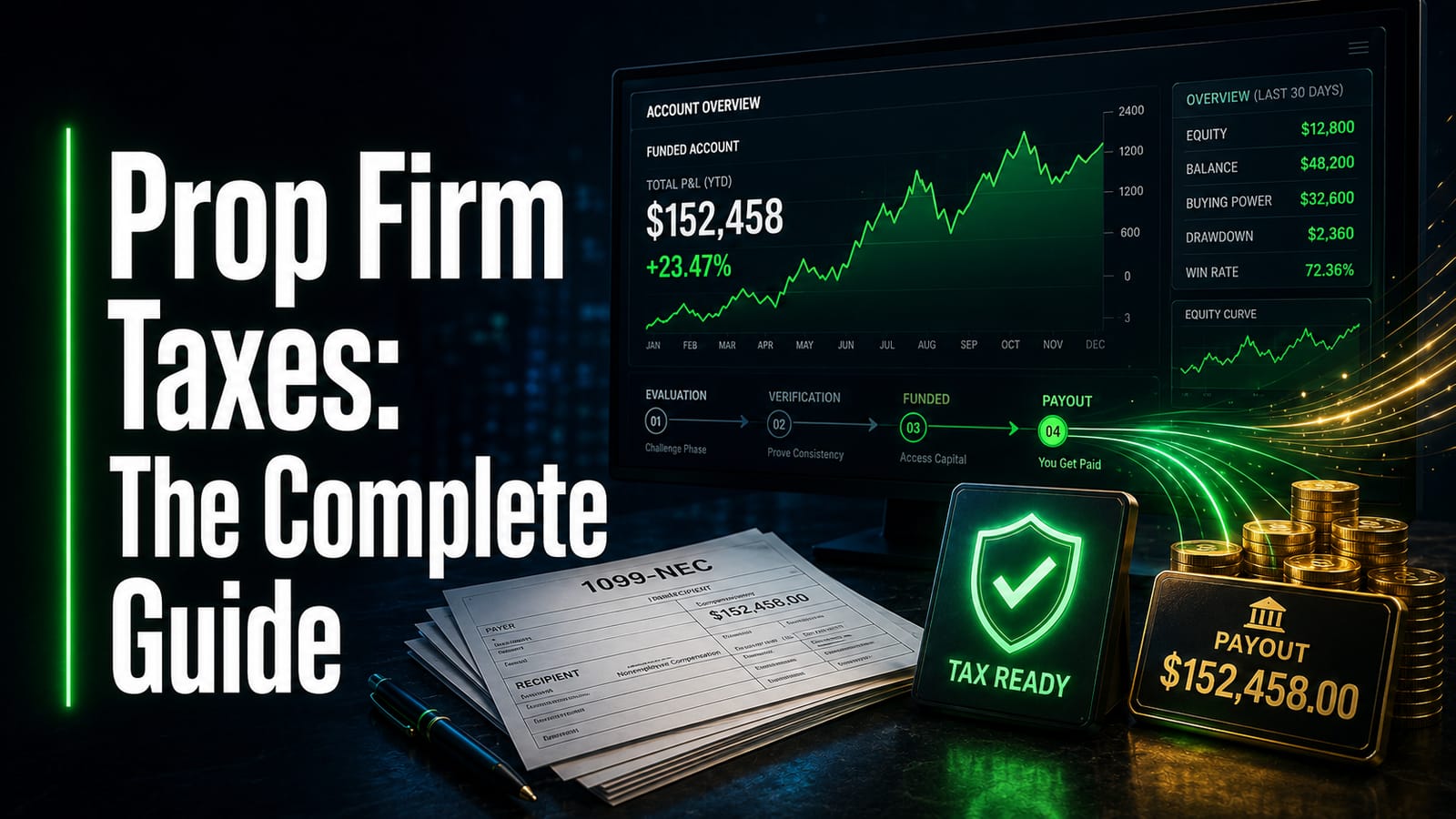
- For most traders, Take Profit Trader payouts are 1099-NEC self-employment income — not capital gains and not Section 1256 futures income, because funded traders trade the firm's capital rather than their own.
- In most cases, that means Schedule C reporting — federal income tax at the ordinary bracket plus 15.3% self-employment tax on 92.35% of net self-employment income.
- Evaluation fees, reset fees, data subscriptions, and platform costs are typically deductible when the activity is reported as a business — even for evaluations that did not pass.
- Starting tax year 2026, the OBBBA raised the 1099-NEC issuance threshold from $600 to $2,000 — payouts below the threshold typically arrive without a form but remain fully taxable.
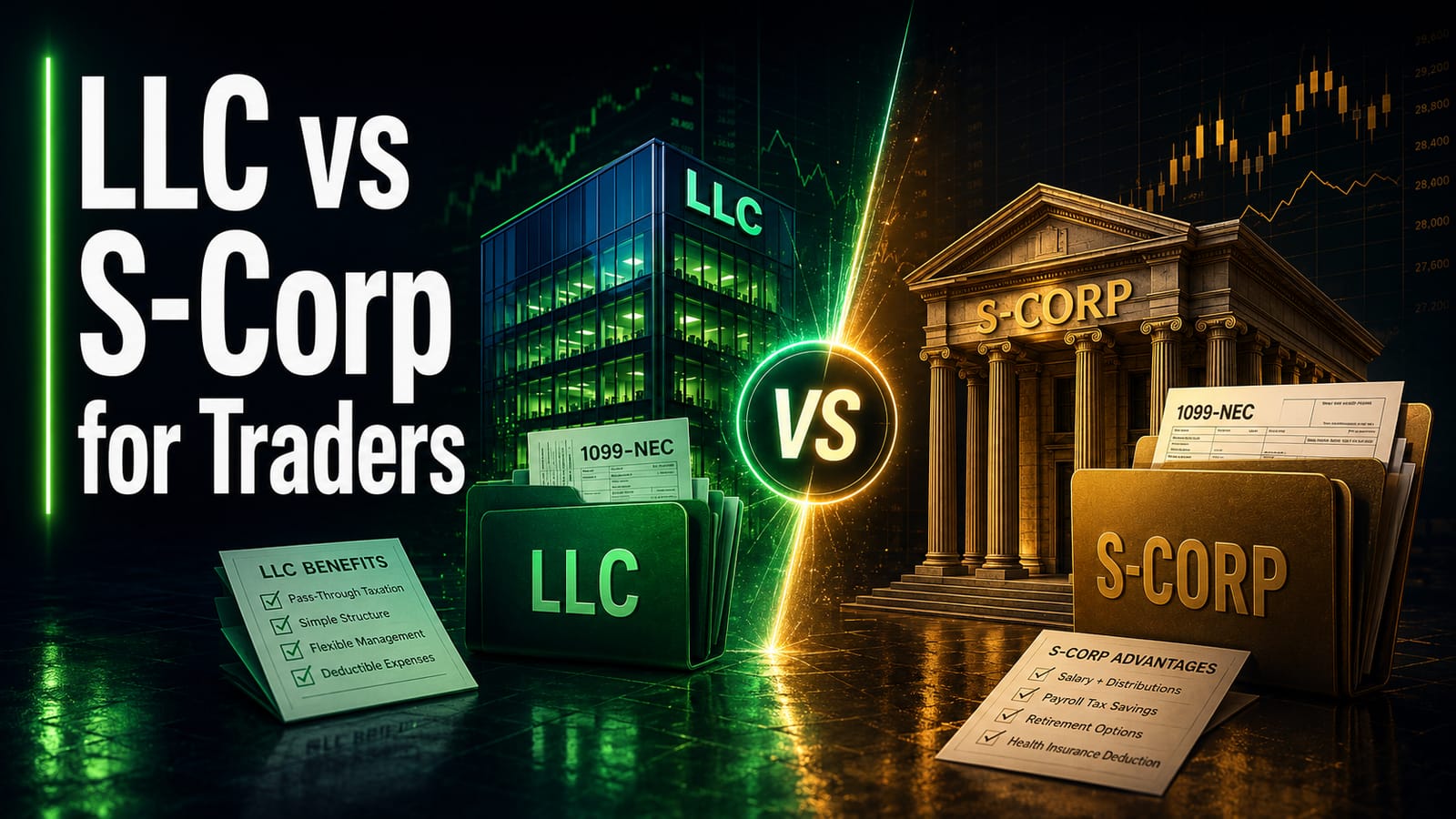
- Every situation varies — a CPA who specializes in trader taxation can confirm what applies to a particular trader, including entity election (LLC / S-Corp, typically worth modeling above roughly $80K net).
The OBBBA (signed July 2025) raised the 1099-NEC reporting threshold from $600 to $2,000 starting tax year 2026 (what the form does and does not change is covered in the prop firm 1099-NEC guide). Traders with payouts under $2,000 typically will not receive a 1099 — but the income remains fully taxable on Schedule C.
Take Profit Trader is a US-based futures prop firm known for one of the friendliest payout policies in the funded-account space — the firm pays out reliably and has built a strong reputation with futures traders. But fast, dependable payouts also mean taxable income arrives all year long, and the tax treatment surprises many first-year funded traders.
This guide covers how Take Profit Trader payouts are typically classified, what forms to expect, which expenses are typically deductible, and how most funded traders approach filing. One note up front: plans, account rules, and payout policies change regularly — for current program details, the firm's own site at takeprofittrader.com is the source of truth. The tax treatment below is what tends to stay constant.
Take Profit Trader payouts are typically self-employment income — NOT capital gains and NOT Section 1256 futures income. Funded traders trade the firm's capital, so the favorable 60/40 futures treatment generally does not apply. Many traders discover this only when the bill arrives thousands higher than expected.
How Are Take Profit Trader Payouts Classified for Taxes?
For most traders, Take Profit Trader payouts are self-employment income — compensation for a service (trading the firm's capital), not investment gains. The IRS generally treats funded-account profit splits like independent-contractor pay, which means Schedule C and Schedule SE for most filers, not Schedule D or Form 6781.
That classification typically brings three layers of tax:
- Federal income tax at the trader's marginal rate (10%–37%)
- Self-employment tax of 15.3% on 92.35% of net self-employment income — the Social Security portion caps at the $184,500 wage base for 2026; the Medicare portion has no cap
- State income tax (varies by state; a few states have none)
Even though Take Profit Trader accounts trade futures, the Section 1256 60/40 capital-gains split typically does not apply — that treatment is for traders risking their own capital in their own accounts, and every situation varies.
Does Take Profit Trader Send a 1099?
As a US-based firm, Take Profit Trader payouts to US traders are typically treated as 1099-NEC non-employee compensation. Starting tax year 2026, the OBBBA raised the issuance threshold to $2,000 — so smaller payout totals may arrive without a form, but the income is still fully taxable either way.
Because reporting practices and payment processors can change from year to year, most traders don't build their tax records around whether a form shows up. The reliable pattern: track every payout as it lands, then reconcile against whatever form (if any) arrives in January. If a 1099-NEC does arrive, the IRS has a copy too — so matching the reported figure before filing avoids mismatch notices.
Whether or not a 1099 arrives, the trader's own records — dashboard payout history, bank statements, deposit dates — are what most CPAs actually work from. A payout that lands December 30, 2026 is typically 2026 income; one that lands January 2, 2027 typically belongs to 2027. The deposit date, not the request date, usually controls.
What Can Take Profit Trader Traders Deduct?
When the trading activity is reported as a business on Schedule C, ordinary and necessary expenses are typically deductible against Take Profit Trader income — reducing both income tax and self-employment tax. For most funded traders, that typically includes:
- Evaluation fees — test-account costs are typically deductible, even for attempts that did not pass.
- Reset fees — paid to restart an evaluation? Typically deductible the same way.
- PRO account and subscription costs — recurring fees paid to the firm are generally business expenses.
- Trading platform software — NinjaTrader, Tradovate, TradingView, Sierra Chart, and similar.
- Market data subscriptions — CME data and exchange feeds.
- Home office — a dedicated trading space, via the simplified or regular method.
- Equipment — monitors, computers, desks, keyboards.
- Education — courses, mentorship, paid trading communities.
- Professional fees — CPA and tax-preparation costs.
Traders who cycle through several evaluations before getting funded often leave real money on the table — every one of those fees is typically deductible, passed or failed. See the full breakdown: Can You Deduct Prop Firm Evaluation Fees?
How Do Most Traders Keep Records for TPT Payouts?
Take Profit Trader is known for paying out quickly and frequently, which is great for cash flow — and means more individual deposits to track. Most funded traders keep a simple running log and reconcile it once at tax time. The records most CPAs ask for:
| Record Type | What to Save | Why It Matters |
|---|---|---|
| TPT Dashboard | Export or screenshot of all payouts | Primary income documentation |
| Bank Statements | Highlight all TPT-related deposits | Confirms income was received and when |
| 1099-NEC (if issued) | Keep the form and match it to deposits | The IRS has a copy — figures should align |
| Fee Receipts | Evaluation, reset, and subscription invoices | Supports the deduction side of Schedule C |
| Personal Spreadsheet | Date, amount, method for every payout | The running tax record CPAs love to see |
A spreadsheet with date, gross payout, and net deposit takes seconds per entry and typically saves hours in April — especially for traders receiving frequent payouts.
How Do Most Traders Approach Filing Take Profit Trader Taxes?
Every tax situation has unique facts, but the typical sequence for most funded traders looks like this — with the last step being the one that matters most:
Step 1 — Pull the Full Payout History
Most traders export their complete payout record from the Take Profit Trader dashboard early in tax season and cross-reference it against bank deposits. The deposit date typically determines which tax year each payout belongs to.
Step 2 — Reconcile Against Any 1099-NEC
If a 1099-NEC arrives (typically by late January for totals above the $2,000 threshold), most traders compare it line-by-line against their own records. Discrepancies are usually easier to resolve with the firm before filing than after.
Step 3 — Tally Typically-Deductible Expenses
Evaluation fees, resets, subscriptions, platform costs, data feeds, equipment, and home office documentation get organized by category. Receipts make each deduction defensible if questions ever come up.
Step 4 — Estimate the Combined Tax Picture
For most traders: gross payouts minus deductible expenses flows to Schedule C, then 15.3% self-employment tax applies to 92.35% of the net via Schedule SE — with half of the SE tax typically deductible as an adjustment to income. Federal bracket and state tax stack on top.
Step 5 — Talk with a Trader-Specialist CPA
Entity choice, other income, filing status, state residency, and prior-year facts all change the answer. A CPA who specializes in trader taxation can confirm what actually applies — including whether an S-Corp election or other structuring is worth it. TraderTax matches traders with tax professionals who work with prop firm income every day.
What About Quarterly Estimated Taxes?
Take Profit Trader does not withhold taxes from payouts — traders receive the full amount, and the tax bill accrues quietly in the background. Quarterly estimated payments are commonly recommended for funded traders to avoid IRS underpayment penalties, even when everything gets paid at filing time.
Q1: April 15, 2026 · Q2: June 16, 2026 · Q3: September 15, 2026 · Q4: January 15, 2027. Many funded traders set aside 25–35% of every payout in a separate savings account so the quarterly payments are painless.
When Is an S-Corp Typically Worth Modeling?
For most prop traders, an LLC with S-Corp election starts becoming worth modeling once net self-employment income consistently runs above roughly $80,000. The election can shift part of the income out of the 15.3% self-employment-tax base, but it adds payroll, bookkeeping, and filing costs — so below that range the overhead often eats the savings.
Take Profit Trader's fast payout cadence means profitable traders can cross that threshold sooner than expected. The math is situation-specific — bracket, state, other income, and reasonable-salary requirements all move the answer. See LLC vs S-Corp for Traders for the full comparison, and every situation varies enough that most traders model it with a CPA before electing.
Trading Take Profit Trader Alongside Other Firms?
Traders funded at Take Profit Trader plus Apex, TopStep, or other firms typically combine all prop firm payouts on a single Schedule C. Some firms issue 1099s and some don't — the income is reported together regardless, and each 1099 that does arrive gets matched to its own records.
For the full breakdown of how all prop firm income is taxed — including international firms without 1099s, entity structures, and multi-firm strategies — see our Complete Guide to Prop Firm Taxes.
Frequently Asked Questions
Does Take Profit Trader send a 1099?
Take Profit Trader is a US-based prop firm, and payouts to US traders are typically treated as 1099-NEC self-employment income. Starting tax year 2026, the OBBBA raised the 1099-NEC issuance threshold from $600 to $2,000 — income below the threshold is still fully taxable. Most traders track every payout and report the total whether or not a form arrives.
Are Take Profit Trader payouts capital gains or Section 1256 income?
Typically neither. Because funded traders trade the firm's capital rather than their own, payouts are generally compensation for services — self-employment income reported on Schedule C — not capital gains and not Section 1256 futures treatment. Every situation varies, so a trader-specialist CPA can confirm what applies.
Are Take Profit Trader evaluation and reset fees tax deductible?
Typically yes. When the trading activity is reported as a business on Schedule C, evaluation fees, reset fees, data subscriptions, and platform costs are generally deductible ordinary business expenses — even for evaluations that did not pass. Documentation and receipts make these deductions defensible.
How much do most traders set aside for taxes on Take Profit Trader payouts?
Many prop traders set aside roughly 25–35% of each payout. Most owe federal income tax at their ordinary bracket plus 15.3% self-employment tax on 92.35% of net self-employment income, with the Social Security portion capped at the $184,500 wage base for 2026. State tax varies.
When is an S-Corp worth considering for Take Profit Trader income?
An S-Corp election is typically worth modeling once net self-employment income consistently runs above roughly $80,000, because it can reduce the self-employment-tax portion of the bill. Below that level, the added payroll and filing costs often outweigh the savings. Every situation varies — most traders model it with a CPA first.
Do state taxes apply to Take Profit Trader payouts?
Typically yes — most states tax self-employment income based on the trader's state of residence, on top of federal income and self-employment tax. Traders in states with no income tax generally owe only the federal portion. A CPA familiar with the trader's state can confirm what applies.
See what your Take Profit Trader taxes typically look like
Most Take Profit Trader traders typically owe federal income tax plus 15.3% self-employment tax on their net payouts after deductible expenses. The exact number depends on the trader's bracket, state, deductions, and entity structure — every situation varies. The tools below give a ballpark; a CPA confirms what actually applies.
Or create a free account to get matched with a CPA →Take Profit Trader runs futures funded account programs at takeprofittrader.com — plans and rules change, so the firm's official site is the place for current details. We handle the tax filings for many TPT-funded traders. If you trade with Take Profit Trader and want to talk through what filing typically looks like for your situation, create a free account and we'll take it from there.
Trade with multiple prop firms? Each firm structures payouts a bit differently, so the tax treatment varies. Here are the dedicated guides for the other major prop firms: