- TradeDay is a US-based futures prop firm, so payouts typically arrive with a Form 1099-NEC — the OBBBA raised the reporting threshold from $600 to $2,000 starting tax year 2026, and payouts below it are still fully taxable even when no form arrives.
- For most funded traders, TradeDay payouts are self-employment income reported on Schedule C — federal income tax plus 15.3% self-employment tax on 92.35% of the net amount.
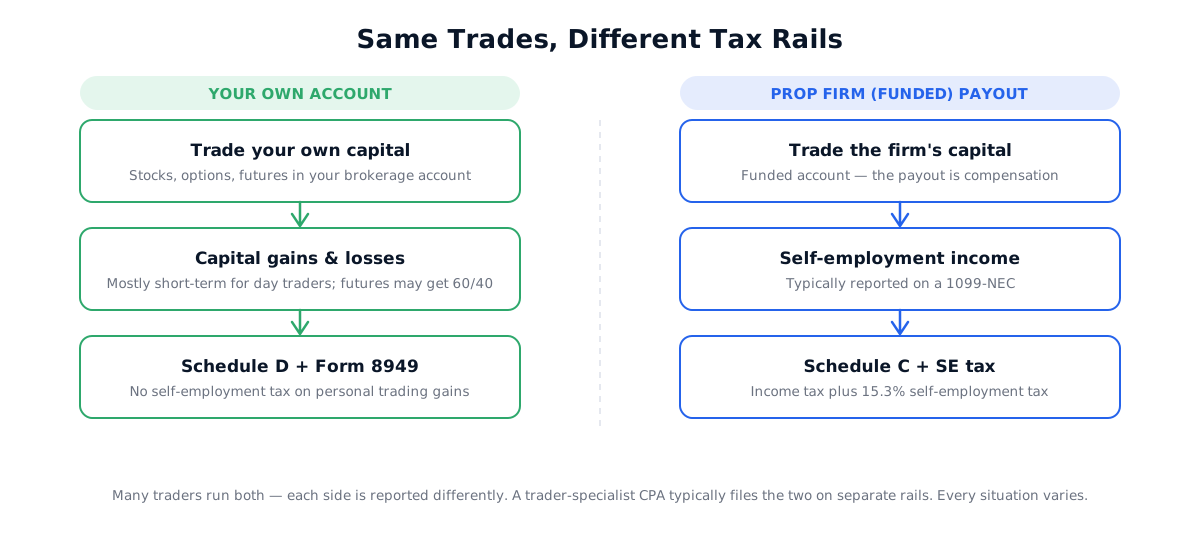
- Funded payouts are NOT Section 1256 contracts. The 60/40 blended rate typically applies only to futures traded in a personal account — funded-account profit splits are typically compensation for services, even though the underlying instruments are futures.
- Evaluation fees, market-data subscriptions, and platform costs are typically deductible when the activity is reported as a business — commonly even for attempts that did not pass.
- Every situation varies — a TraderTax-matched CPA who specializes in trader taxation can confirm what applies, including whether an S-Corp election (typically worth modeling around $80K+ of net self-employment income) fits a particular trader.
The OBBBA (signed July 2025) raised the 1099-NEC reporting threshold from $600 to $2,000 starting tax year 2026 (what the form does and does not change is covered in the prop firm 1099-NEC guide). As a US-based firm, TradeDay typically issues a 1099-NEC above that threshold — and payouts under $2,000 are still fully taxable even if no form shows up in January.
TradeDay is a US-based futures prop firm built by trading-industry veterans out of Chicago, and it has become a popular home for futures day traders. Being a US firm shapes the whole tax picture: TradeDay payouts typically arrive with a Form 1099-NEC, and for most funded traders that income lands on Schedule C as self-employment income.
The part that surprises futures traders most: even though the underlying instruments are futures contracts, funded-account payouts typically do not get the favorable Section 1256 60/40 treatment a personal futures account gets. This guide covers how most US traders classify, report, and deduct against TradeDay income — and how the funded-vs-personal split typically works when both show up on the same return.
A 1099-NEC reports income — it withholds nothing. TradeDay payouts typically arrive gross, with no federal, state, or self-employment tax taken out. Traders who spend every payout as it arrives commonly face a large surprise bill in April, which is why most funded traders set aside a percentage of each payout as it lands.
Does TradeDay Send a 1099 to US Traders?
Typically yes — but not, on current reporting, from TradeDay itself. Third-party guides describe the Form 1099-NEC as being issued by Riseworks, the payment platform TradeDay is reported to use. The threshold is $2,000 starting tax year 2026 under the OBBBA, up from the old $600. Payouts below the threshold may arrive with no form, but the income is still fully taxable.
Most traders reconcile the 1099-NEC against their own payout log rather than filing straight from the form — forms occasionally miss a December payout or report on a different timing basis than the trader's bank records. When the numbers differ, the trader's documented records are what a CPA typically works from to resolve it.
The $2,000 threshold controls when TradeDay files a form — not when income is taxable. A trader who received $1,500 in payouts and no 1099-NEC still has $1,500 of fully taxable income. Bank statements and the TradeDay dashboard are the records most CPAs work from when no form arrives.
Who actually issues the TradeDay 1099?
This is where TradeDay trips people up, and it is worth separating two questions that sound like one. Who owes you the payout and who produces your tax document are different jobs, and at TradeDay they are reported to sit at different companies.
A single payout can involve four roles: the prop firm that owes the money, a contractor or tax platform that collects your W-9 and produces the information return, a payment rail that moves the funds, and your bank. Third-party guides place Rise (Riseworks) in the second role for TradeDay.
A trader searches their inbox for “TradeDay,” finds nothing, and concludes no form was issued — and therefore, wrongly, that nothing needs reporting. Search for the processor as well as the firm, and check spam. The notification may arrive from a company you have no memory of signing up with, because you signed up with it inside TradeDay’s onboarding flow rather than directly. Start with the Rise dashboard rather than TradeDay support.
TradeDay is not unusual in this. Rise appears behind several futures prop firms, which means a trader who switches firms may not switch tax platforms — and forms from two different firms can land in the same dashboard. The firm-by-firm chain is mapped on who issues prop firm 1099s.
“US citizens only” is almost certainly loose wording — and the difference matters
Third-party guides describe TradeDay’s 1099-NEC as going to US citizens, and describe TradeDay as not providing documents for reporting to foreign tax authorities. We originally read that literally. On review, that reading is probably wrong, and we have narrowed it.
The contractor-reporting framework these platforms run on does not turn on citizenship. It turns on whether you are a “US person” — an IRS term that includes US citizens and resident aliens. The mechanism is the form you complete at onboarding:
- W-9 is collected from US persons. That is the path that generally leads to a 1099-NEC.
- W-8BEN (individuals) or W-8BEN-E (entities) is collected from foreign persons. That path generally does not produce a 1099-NEC, and where US-source income is involved a Form 1042-S may be used instead.
So a trader living and trading in the US who is a resident alien is a US person, would ordinarily complete a W-9, and would ordinarily be inside the reporting population — not outside it. A write-up saying “US citizens” is most likely shorthand for “US persons.”
The form you were asked to complete is the real signal, and it is one you can check yourself. If TradeDay or Rise collected a W-9, you are being treated as a US person. If it collected a W-8BEN, you are not. That is more reliable than any third-party description of a firm’s policy, including this one.
What is consistently reported, and is a genuine gap for non-US traders: TradeDay is reported not to provide documents aimed at a foreign tax authority. A trader outside the US generally has to build their own records from payout history, and their local filing obligation is unaffected by the absence of a US form.
Why we are being careful: residency and citizenship are different tests, and general contractor-compliance guidance is explicit that tax residency rather than citizenship is what drives which form applies. No first-party TradeDay or Rise documentation was reachable to confirm which test the firm actually applies, so we describe the framework rather than assert the firm’s policy. If your situation turns on it, ask the firm in writing and confirm the filing side with a professional.
How Are TradeDay Payouts Classified for US Taxes?
For most funded traders, TradeDay payouts are self-employment income — compensation for trading the firm's capital, not gains on the trader's own money. That typically means Schedule C and Schedule SE, not Schedule D capital gains and not Section 1256 treatment. Every situation varies, and a CPA confirms the classification.
In a personal brokerage account, futures profits belong to the trader. A funded TradeDay account is different: the capital belongs to the firm, and the trader receives a profit share for performing a service. For most traders that income is subject to:
- Federal income tax at the trader's marginal rate (10%–37%)
- Self-employment tax of 15.3% on 92.35% of net self-employment income — the Social Security portion applies up to $184,500 of earnings in 2026, and the Medicare portion has no cap
- State income tax (varies by state — some states have none)
Traders operating through an LLC or S-Corp typically report through their entity return instead. See LLC vs S-Corp for Traders for how that changes the picture.
Are TradeDay Payouts Section 1256 Contracts?
Typically no. Section 1256's 60/40 blended treatment — 60% long-term, 40% short-term regardless of holding period — generally applies to futures traded in a trader's own account. Funded traders are trading TradeDay's capital, so payouts are typically self-employment income even though the instruments themselves are futures.
Many TradeDay traders also run a personal futures account, and the two live on different parts of the same return. Here's how the split typically looks for most traders:
| Personal Futures Account | TradeDay Funded Account | |
|---|---|---|
| Whose capital | The trader's own money | TradeDay's capital |
| Typical treatment | Section 1256 — 60/40 blended rates | Self-employment income |
| Typical forms | Form 6781 + Schedule D | Schedule C + Schedule SE |
| SE tax (15.3%) | Typically none | Typically applies |
| Broker/firm form | 1099-B from the broker | 1099-NEC from TradeDay |
Same instruments, different tax character. E-mini profits in a personal account typically get Section 1256's 60/40 blend with no SE tax; the same strategy in a funded TradeDay account typically produces ordinary self-employment income. Both can appear on one return — they just occupy different forms, and a CPA keeps them from getting tangled.
What Can TradeDay Traders Typically Deduct?
When TradeDay income is reported as a business on Schedule C, ordinary and necessary trading expenses are typically deductible against it — reducing both income tax and self-employment tax. Evaluation costs are the big one most traders remember; data feeds and platform fees are the ones most traders miss.
- Evaluation fees — costs of the evaluation are typically deductible, commonly including attempts that did not pass. See: Can You Deduct Prop Firm Evaluation Fees?
- Market data subscriptions — exchange data fees and analytics services.
- Trading platform software — charting, execution, and journaling tools.
- Home office — a dedicated trading space, for most traders via the square-footage method.
- Equipment — monitors, computers, peripherals.
- Education — courses and mentorship tied to the trading business.
- Internet and phone — the business-use portion.
- Professional fees — CPA, tax preparation, and bookkeeping costs.
Recurring costs add up quietly. A trader paying for an evaluation, a data feed, and a platform subscription every month is commonly sitting on well over $1,000 of annual deductions that only survive if the receipts were kept. Most traders log each charge as it hits the card — 30 seconds per entry versus hours of reconstruction in April.
When Does an S-Corp Election Typically Make Sense?
For most traders, an S-Corp becomes worth modeling around $80,000 or more of net self-employment income. The structure typically splits income between a reasonable salary and distributions, and only the salary portion carries the 15.3% employment-tax load — which is where the savings come from at higher income levels.
Below that range, the overhead — payroll processing, a separate business return, state filings — typically eats the savings. Above it, the math commonly turns favorable, but "reasonable salary" is a facts-and-circumstances judgment the IRS watches. Most traders model the numbers with a CPA before electing rather than after; the details are covered in LLC vs S-Corp for Traders.
Step-by-Step: How Most TradeDay Traders Approach Filing
Step 1 — Track Payouts and Reconcile the 1099-NEC
Most traders keep a running log of every TradeDay deposit — date, amount, method — and reconcile it against the 1099-NEC when it arrives in January. If no form arrives because payouts stayed under the $2,000 threshold, the log itself becomes the income record a CPA files from.
Step 2 — Separate Funded Income from Personal Trading
Traders who also run a personal futures account typically keep the two buckets distinct: personal futures gains flow through the broker's 1099-B toward Form 6781 and Section 1256 treatment, while TradeDay payouts head for Schedule C as self-employment income.
Step 3 — Gather Deductions
Evaluation fees, data and platform subscriptions, equipment, education, and home office documentation typically all reduce the net taxable amount when the activity is reported as a business. Deductions reduce self-employment tax as well as income tax, so they're typically worth more here than most traders expect.
Step 4 — Report on Schedule C and Schedule SE
For most funded traders, gross TradeDay income goes on Schedule C Part I and deductions in Part II. Schedule SE then computes self-employment tax — 15.3% on 92.35% of net earnings — and half of that SE tax typically comes back as an adjustment to income on Form 1040.
Step 5 — Talk with a Trader-Specialist CPA
Every situation has unique facts: the funded-vs-personal split, other income, state residency, and whether an S-Corp election (typically worth modeling around $80K+ of net self-employment income) or Mark-to-Market is worth considering. A TraderTax-matched CPA who works with funded traders can confirm what actually applies — create a free account to get matched.
How Do Quarterly Estimated Taxes Work for TradeDay Traders?
TradeDay withholds nothing from payouts, so managing tax payments through the year falls on the trader. Most funded traders expecting to owe $1,000+ make quarterly estimated payments, commonly setting aside 25–35% of every payout in a separate account so the money is there when each deadline arrives.
Q1: April 15, 2026 · Q2: June 16, 2026 · Q3: September 15, 2026 · Q4: January 15, 2027. With no withholding on prop payouts, quarterly payments are the safeguard most traders rely on to avoid a surprise bill plus underpayment penalties.
Trading TradeDay Alongside Other Prop Firms
Many traders run TradeDay alongside firms like Apex, TopStep, or MyFundedFutures. For most traders, all funded-account payouts combine on a single Schedule C — some firms send a 1099-NEC and some don't, but everything is reported together regardless. Deductions across all firms combine on the same schedule.
For the full breakdown of how prop firm income is typically taxed — US firms, international firms without 1099s, entity structures, and multi-firm setups — see the Complete Guide to Prop Firm Taxes.
Not Sure Where You Stand on Taxes?
Answer 8 quick questions. Get a personalized AI summary of your tax exposure, missed deductions, and what to consider next — reviewed by a real CPA.
Get My Free Tax Snapshot →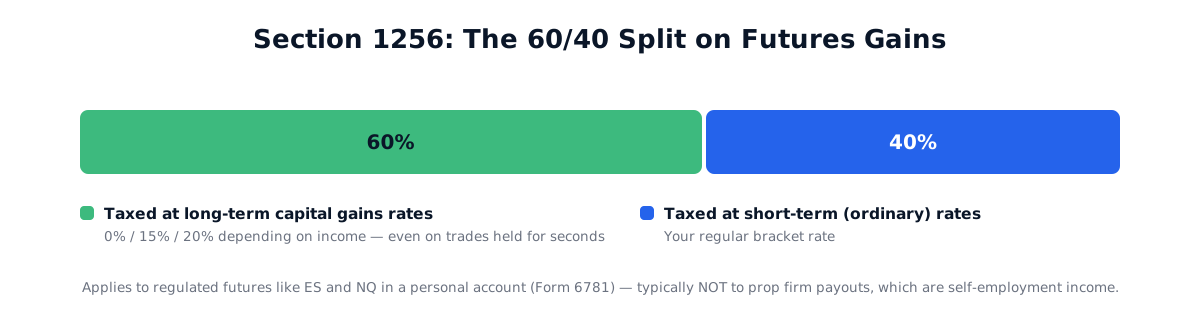
Frequently Asked Questions
Does TradeDay send a 1099 to US traders?
Typically yes. TradeDay is a US-based firm, and US firms typically issue Form 1099-NEC to traders whose payouts cross the reporting threshold — $2,000 starting tax year 2026 under the OBBBA. Payouts below the threshold may arrive with no form, but the income is still fully taxable.
Are TradeDay payouts self-employment income?
For most funded traders, yes. TradeDay payouts are typically compensation for trading the firm's capital, reported as self-employment income on Schedule C and subject to 15.3% self-employment tax on 92.35% of the net amount. Every situation varies, and a trader-specialist CPA can confirm the classification.
Are TradeDay payouts taxed like Section 1256 futures contracts?
Typically no. The 60/40 blended treatment of Section 1256 generally applies to futures traded in a trader's own account. Funded traders are trading TradeDay's capital, so payouts are typically self-employment income — not Section 1256 gains. A personal futures account on the same return typically still gets 60/40 treatment.
Are TradeDay evaluation and data fees tax deductible?
Typically yes. When trading activity is reported as a business on Schedule C, evaluation fees, data and platform costs, and similar ordinary trading expenses are typically deductible — commonly including evaluation attempts that did not pass. Documentation matters, so most traders keep receipts for every fee paid.
When does an S-Corp election make sense for TradeDay traders?
For most traders, an S-Corp becomes worth modeling around $80,000 or more of net self-employment income, where splitting income between salary and distributions can reduce the self-employment-taxed portion. Below that, payroll and filing costs typically outweigh the savings. Every situation varies — most traders model it with a CPA first.
What taxes do TradeDay traders typically owe?
Most US funded traders owe federal income tax at their ordinary bracket plus 15.3% self-employment tax on 92.35% of net self-employment income, with the Social Security portion applying up to $184,500 of earnings in 2026. State income tax may also apply. Deductible expenses reduce the net amount.
See what your TradeDay taxes typically look like
Most TradeDay traders typically owe federal income tax plus 15.3% self-employment tax on their net payouts after deductible expenses. The exact number depends on the trader's bracket, state, deductions, and entity structure — every situation varies. The tools below give a ballpark; a CPA confirms what actually applies.
Or create a free account to get matched with a CPA →TradeDay runs a well-regarded, trader-built funded-account program at tradeday.com — plans, payout details, and program rules change over time, so their site is the source of truth for current specifics. TraderTax-matched CPAs handle the tax filings for many TradeDay-funded traders — federal + state + entity structuring where it applies. If you trade with TradeDay and want to talk through what filing typically looks like for your situation, create a free account and we'll take it from there.
Trade with multiple prop firms? Each firm structures payouts a bit differently, so the tax treatment varies. Here are the dedicated guides for the other major prop firms:
Related Articles
Prop Firm Tax Calculator — Estimate Your Bill
Complete Guide to Prop Firm Taxes

Futures Taxes: Section 1256 and the 60/40 Rule

Can You Deduct Prop Firm Eval Fees?
LLC vs S-Corp for Traders