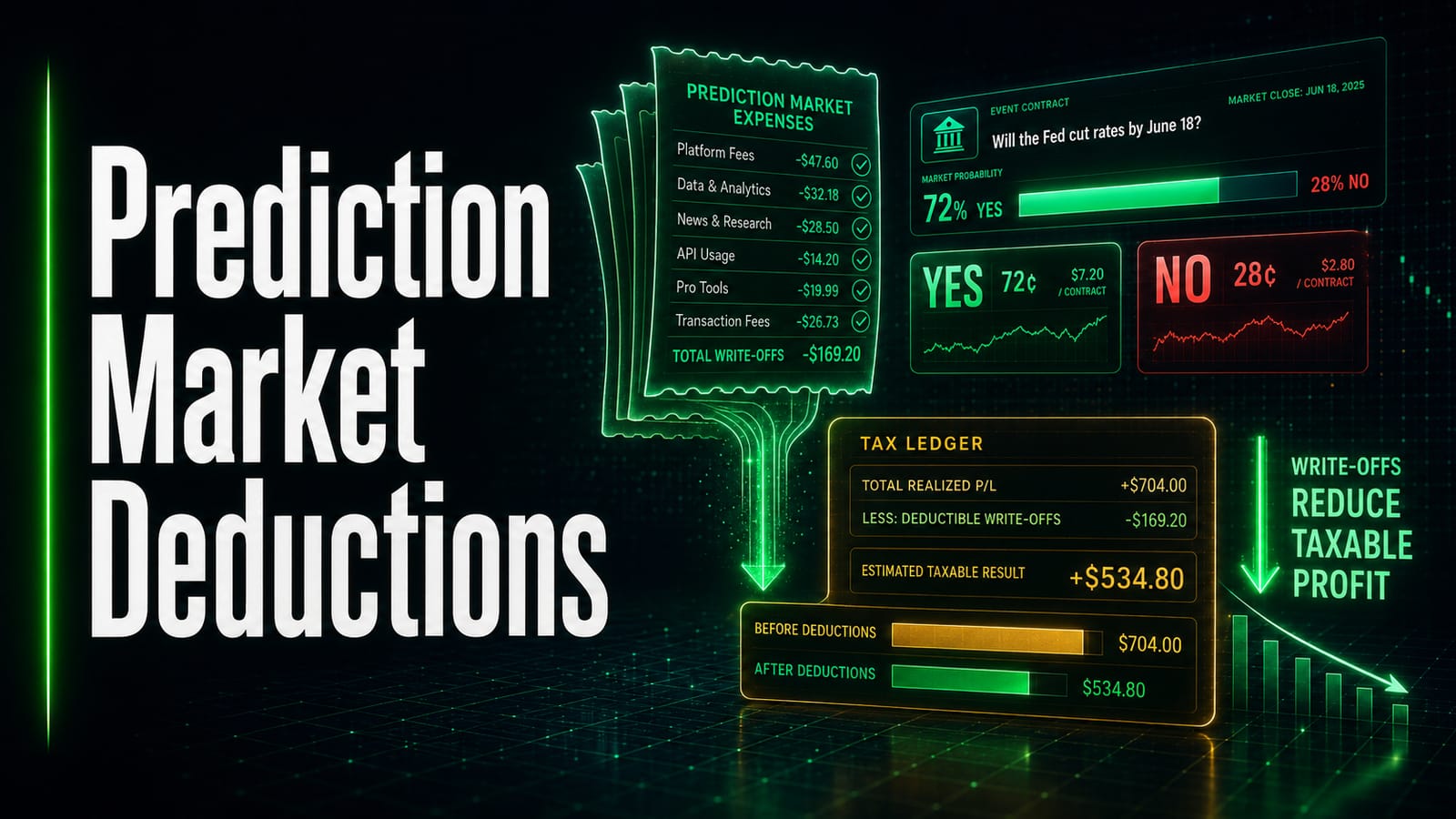
- Deductibility is downstream of the characterization question. The IRS has published no revenue ruling, notice, regulation, or FAQ addressing how event contracts are characterized, and each candidate treatment routes costs somewhere different — so "can I write this off?" typically can't be answered until "how is this taxed?" is settled for that trader.
- Platform and transaction fees usually aren't a separate deduction at all. Under capital or Section 1256 treatment they typically fold into basis and proceeds — quietly reducing gain instead of appearing on a schedule. Platform P&L exports often already include fees, so double-counting is a common error.
- Data, research, API, and home-office costs sit behind a business gate. They typically live inside a trade or business — and whether event-contract trading can constitute one for trader-tax-status or §475 mark-to-market purposes is genuinely unanswered territory practitioners are only beginning to analyze.
- A wagering characterization is the worst case for costs. The One Big Beautiful Bill Act's amended §165(d) folds a wagering business's ordinary expenses in with its losses, and the combined figure faces a 90%-of-losses, capped-at-winnings limit for tax year 2026 — if event contracts are treated as wagering, which the IRS hasn't addressed.
- Every situation varies — most traders document costs contemporaneously, keep trading records separate from expense records, and confirm what's supportable with a CPA who understands trader taxation.
Regulatory and tax status as of July 2026 — this area is evolving; we update this page as guidance lands. As of July 2026 the IRS and Treasury have published no revenue ruling, notice, regulation, or FAQ — and no published private letter ruling we're aware of — addressing how prediction-market event contracts are characterized for tax purposes, and no event-contract project appears on the current Treasury/IRS priority guidance plan.
That silence is specific to the tax side: the CFTC itself has been active, including a June 2026 notice of proposed rulemaking on prediction markets and public-interest determinations, with comments due July 27, 2026. The nearest realistic checkpoint for tax guidance is the 2026–2027 priority guidance plan, generally expected around September or October. Because deductibility follows characterization, everything below is written as a range of approaches rather than a single answer.
Written by the TraderTax Editorial Team. The law is cited by section so it can be checked rather than taken on faith — IRC §61 (gross income), §165(d) (wagering losses), §1221 and §1234A (capital assets and terminations), §1256 including the §1256(b)(2)(B) swap exclusion, §475(f) (mark-to-market election), §461(l) (excess business losses), and the One Big Beautiful Bill Act (P.L. 119-21 §70114 and §70433) with its still-proposed implementing regulations (REG-113229-25). The relevant IRS form and topic pages are linked at the bottom so readers and their CPAs can go to the source.
Platform and practice details rest on multiple independent professional sources per claim — CPA-firm analyses, association guidance, national law and tax-research publishers, and mainstream financial press — rather than on any single blog; some platform help pages could not be read directly during research, which is why platform-form details here are hedged rather than stated flatly. The specialist Tax Notes Federal classification analysis published in June 2026 is referenced through its authors' public summaries; the article itself is paywalled. The Editorial Team are researchers and writers — not CPAs. TraderTax is a referral platform; filings are handled by independent licensed tax professionals in our partner network. Where sources genuinely conflict or a question is unsettled, this page says so instead of picking a side.
Trading prediction markets costs money before it makes any. There are platform and transaction fees on every fill, data and analytics subscriptions, news and research feeds, API access for anyone automating, "pro" charting tools, a computer and monitors, and — for the people doing this seriously — a corner of a room that stopped being a spare bedroom a while ago.
The natural question is which of those costs come off the top at tax time. The honest answer is more interesting than a list: on event contracts, whether a cost is deductible at all depends on a question the IRS hasn't answered. The same $1,200 data subscription can reduce taxable profit dollar-for-dollar, do nothing whatsoever, or get swept into a bucket that a new 2026 rule caps at 90% — depending on which characterization a trader's return uses. That's the part almost no other guide explains, and it's where this page starts.
"Are my Kalshi fees deductible?" is really "how are my event contracts characterized?" — because the answer routes costs to completely different places. Under capital or Section 1256 treatment, fees typically fold into basis and proceeds. Under a wagering characterization, §165(d) governs, and for tax year 2026 the One Big Beautiful Bill Act capped that deduction at 90% of losses, allowed only up to winnings. A trader who qualifies for trader tax status is in a different world again. Nobody can promise which applies, because the IRS hasn't said. What the cap does to a break-even year is worked out in the 90% gambling-loss cap explainer.
Are Prediction Market Trading Fees Tax Deductible?
Usually not as a separate write-off line. Under the capital and Section 1256 approaches, platform and transaction fees typically fold into basis and proceeds, quietly reducing gain. Under a wagering characterization they behave differently. Because the IRS has not answered the characterization question, most traders confirm the treatment with a CPA.
This trips people up because "deductible" gets used loosely. A fee that increases basis or reduces proceeds has already done its work by the time gain is computed — the benefit is real, but it never shows up as a deduction anyone can point to. A fee claimed twice, once inside the platform's P&L figure and again as an expense, is a different thing entirely: that's a double-count, and it's one of the more common errors in prediction-market tax prep.
Fee mechanics vary by venue, and the specifics move, so the reliable move is reading the current fee schedule rather than a blog's snapshot of it:
- Kalshi charges a taker fee reported to follow a curve rather than a flat rate — roughly
ceil(0.07 × contracts × price × (1 − price)), which peaks around $1.75 per 100 contracts near the 50¢ midpoint and shrinks toward the extremes. Third-party descriptions of the maker-side structure conflict, so treat any single writeup with caution. Kalshi's own profit-and-loss statements reportedly compute results FIFO with fees and rebates already included. More in our Kalshi taxes guide. - Polymarket ran essentially fee-free through 2025, with taker fees introduced during 2026 (sports-league fees from February 2026, reported at a maximum near 0.44%, with a structure update at the end of March 2026). On the offshore crypto-settled platform, basis generally starts from the USDC paid. See our Polymarket taxes guide.
- PredictIt has historically taken 10% of gross profits plus 5% on withdrawals — and its historical 1099-MISC reporting was described as computed net of those fees, including the withdrawal fee whether or not funds were withdrawn. A useful illustration that fees sometimes get netted before a form is even issued.
- Deposit-side costs such as roughly 2% card-funding fees on Kalshi don't attach to any single contract, which makes them the awkward category — covered further below.
Why Does Deductibility Depend on the Characterization Question?
Because each candidate treatment routes costs somewhere different. Capital and Section 1256 treatment typically absorbs fees into basis. A wagering characterization pushes losses — and, for a wagering business, ordinary expenses — into the §165(d) bucket that 2026's 90% cap limits. Ordinary other-income treatment leaves the question genuinely open.
Practitioners openly disagree about which characterization is right for event contracts, and two identical traders can legally file differently today. Our prediction market taxes hub walks all four positions in depth; here's how each one handles money spent rather than money won:
| Treatment | Where trading fees typically land | Data / research / equipment costs | How losses behave |
|---|---|---|---|
| A — Section 1256 (60/40) aggressive; Form 6781 | Fold into basis and proceeds; open positions marked to market at year end | Same business gate as capital treatment — deductible only inside a qualifying trade or business | 60/40 capital loss; $3,000/yr against ordinary income; three-year carryback election available |
| B — Short-term capital mainstream default; Form 8949 | Fold into basis and proceeds per position | Deductible inside a qualifying trade or business; a pure investor posture is much narrower | Nets against all capital gains; $3,000/yr against ordinary income; indefinite carryforward |
| C — Gambling (§165(d)) harshest for 2026 | Effectively inside the wagering computation — and for a wagering business, expenses join "losses" | Swept into the same 90%-of-losses, capped-at-winnings limit for TY2026 | Winnings only; itemizers only; 90% cap; no carryforward |
| D — Ordinary other income conservative consumer default; Schedule 1 line 8z | Unresolved — practitioner descriptions implicitly net, but no authority blesses it | Unresolved for the same reason | Whether losses net inside line 8z is an open question |
Two reporting-line details are worth keeping straight, because guides mix them up constantly: under a gambling characterization, gross winnings go on Schedule 1 line 8b with losses on Schedule A line 16; the ordinary other income approach uses Schedule 1 line 8z instead. They are different treatments, not two labels for one thing.
How Do Platform and Transaction Fees Work Under Each Treatment?
Fees typically adjust the numbers rather than appearing as a deduction. Basis is generally what was paid for a contract plus fees; proceeds are the sale price or the $1.00 or $0 settlement, net of fees. Platform P&L exports often already include fees, so double-counting them is a common error.
A quick illustration on a binary contract, using the structure common to CFTC-designated event-contract venues. Buying 100 YES contracts at 40¢ costs about $40 plus fees; if the event resolves YES the contracts settle at $1.00 for $100 of proceeds, so the gain is roughly $60 after fees have already nudged both sides of that subtraction. Nothing about the fee shows up as a separate deduction — and if those same fees also came out of the platform's reported P&L figure, subtracting them again overstates the cost.
Under a Section 1256 approach the same fee logic applies, with the added wrinkle that open positions are marked to market at year end — so the fee treatment travels with positions that haven't settled. Under a wagering characterization the arithmetic is different in kind: gross winnings and gross losses are tracked separately rather than netted per position, which is exactly why the 90% cap has teeth. And under the ordinary other-income approach, whether fees (or losses) can be netted inside Schedule 1 line 8z is one of the genuinely unresolved sub-questions in this area.
One reporting quirk worth naming, because it's the closest thing to a fee-and-basis horror story in prediction markets: for tax year 2024, IBKR reportedly reported ForecastEx forecast-contract proceeds on a 1099-MISC as gross proceeds with no cost basis at all, with notes telling the taxpayer to adjust. Whether that practice carried into later years is unverified, and at least one account describes the activity consolidating into IBKR's 1099-B instead — a direct conflict. Traders in that situation typically pull the actual statement and hand it to a CPA rather than guessing at a workaround.
Platform profit-and-loss statements frequently arrive with fees and rebates already baked in. Adding a separate "trading fees" deduction on top of a fee-inclusive P&L figure double-counts the cost — a small error that scales badly on a high-frequency account. The reliable pattern is to establish, once, whether the starting figure is gross or net of fees, write that down, and treat every downstream number consistently. Every situation varies; a CPA can confirm which convention a given export uses.
Can Prediction-Market Traders Deduct Data, Research, and API Subscriptions?
It depends on whether the activity rises to a trade or business for the trader — and, for event contracts, on a characterization question the IRS has not answered. Traders who qualify for trader tax status typically deduct business expenses; a casual participant generally has a much narrower path. A CPA sizes this.
This is the fork in the road that the receipt-style graphic at the top of this page hides. Platform fees and transaction fees have a home under every treatment, because they attach to specific contracts. Recurring subscription costs don't attach to anything — they're the cost of operating, and operating costs generally need a business to belong to.
The categories traders most often ask about, and where each typically lands:
| Cost | Attaches to a trade? | Where it typically lands |
|---|---|---|
| Platform / transaction fees | Yes | Basis and proceeds under capital or §1256 treatment; inside the wagering computation under §165(d) |
| Data & analytics subscriptions | No | Business-expense territory — needs a qualifying trade or business |
| News & research feeds | No | Same business gate; documentation of business purpose matters |
| API access / market-data feeds | No | Same business gate; often the clearest business-purpose story for automated traders |
| Charting and "pro" tools | No | Same business gate |
| Computer, monitors, peripherals | No | Business gate, plus capitalization-versus-expensing and personal-use questions |
| Home office | No | Business gate, plus exclusive-and-regular-use requirements |
| Card-deposit / withdrawal fees | Partly | Genuinely awkward — account-level, not contract-level; a CPA question |
| Tax software / CPA fees | No | Depends on business status and the year's rules — worth asking directly |
For the general trader-side framework — what a qualifying trading business typically deducts, and how the documentation usually looks — our trader tax deductions guide is the deeper resource, and the deduction checklist is the working version of it. The wrinkle unique to prediction markets is that the underlying activity's status is itself unsettled, so the general framework arrives with an extra caveat attached.
What About a Home Office, Computers, and Monitors?
Same gate, one step further. Home-office and equipment write-offs typically live inside a trade or business, so they hinge on trader tax status — and whether event-contract trading can constitute that business is genuinely unanswered. Many traders in this position document everything now and decide the treatment with a CPA later.
Why the extra caution here rather than a confident checklist? Because the specialist analysis on event contracts hasn't resolved two threshold questions:
- Whether event-contract trading can be a trading business at all for trader-tax-status purposes. The frameworks that exist were built around securities and commodities trading; event contracts fit neither category cleanly, which is precisely the same ambiguity that drives the four-treatment debate on the income side.
- Whether a §475(f) mark-to-market election can reach them. A §475 election applies to securities or commodities. Specialist commentary has flagged that an election probably doesn't solve the event-contract problem, because these contracts aren't clearly either — genuinely open territory rather than a settled no.
Traders who also trade futures, options, or equities are often in a materially better position, because that activity has a well-developed trader-tax-status and §475 analysis of its own. Our trader tax status qualifier walks the general factors, and LLC vs S-Corp for traders covers the entity layer that frequently comes up in the same conversation. Whether either framework extends to a pure event-contract book is exactly the kind of question that belongs with a CPA rather than an article.
The practical move most practitioners describe for unsettled areas is unglamorous: keep records as though the costs will be deductible, then let the characterization decision determine whether they are. Square footage and exclusive-use notes for a home office, receipts and business-purpose lines for subscriptions, and purchase records for equipment cost nothing to keep and can't be reconstructed later. A trader who documents and then learns the deduction isn't supportable has lost nothing; the reverse isn't true.
Where Is the Hobby-Versus-Business Line for Prediction-Market Trading?
Nobody can draw it cleanly yet. The professional-gambler standard from Groetzinger asks whether activity is full-time, regular, and pursued for a livelihood; trader tax status asks a similar frequency-and-intent question on the trading side. Whether event contracts fit either framework is open territory practitioners are only beginning to analyze.
Notice the structure of that problem: there are two entirely different business tests in play, and which one applies depends on the characterization question. A trader treated as running a wagering business lands in the professional-gambler framework — Schedule C, self-employment tax, and the §165(d) limits described in the next section. A trader treated as running a trading business lands in the trader-tax-status framework — the one TraderTax's deductions and mark-to-market pages describe. The costs look identical on the receipt; the tax outcome doesn't.
Practitioner analyses also tend to frame a contract-by-contract spectrum rather than one verdict for a whole account: sports-outcome contracts sit closest to wagering; macro, Fed, and economic-data contracts present the strongest capital-asset case; election contracts fall in between. A trader whose book is CPI and Fed-funds contracts is arguing from a different position than one trading World Cup markets — which means the deduction analysis can differ inside the same household.
How Does the 90% Wagering-Loss Cap Reach Business Expenses?
The One Big Beautiful Bill Act's amended §165(d) folds a wagering business's ordinary expenses in with its losses, and the combined figure faces the 90%-of-losses, capped-at-winnings limit for tax year 2026. That reaches prediction-market traders only if their contracts are characterized as wagering — which the IRS has not addressed.
This is the single most consequential 2026 development for anyone thinking about prediction-market write-offs, so the mechanics are worth stating carefully. P.L. 119-21 §70114 amended §165(d) so that the wagering-loss deduction equals 90% of losses, allowed only to the extent of wagering gains, effective for tax years beginning after December 31, 2025, with no carryforward of the disallowed portion. Under the prevailing reading, the deduction is the lesser of 90% of losses or total winnings — though early commentary differed on the computation and the implementing regulations are still only proposed.
For a professional in that framework, the amendment does something further: ordinary business expenses of a wagering trade or business get folded into "losses," so subscriptions, data, and tooling face the same cap as the losing contracts. The resulting net figure is also self-employment-taxable, at 15.3% up to the 2026 Social Security wage base of $184,500 (plus Medicare above it), and §461(l) excess-business-loss rules can apply on top.
If prediction-market activity were treated as wagering — a question the IRS hasn't answered — the 90% cap would reach both losses and, for a wagering business, ordinary expenses. It is law for tax year 2026, and repeal efforts have gone nowhere so far: the FAIR BET Act was blocked in the House Rules Committee in January 2026, and a Senate unanimous-consent attempt on the FULL HOUSE Act was blocked as well.
The implementing regulations (REG-113229-25) were published April 17, 2026; comments closed June 16, and a public teleconference hearing was held July 17, 2026, where Rep. Dina Titus, the American Gaming Association, CPAs, and professional gamblers all pressed the phantom-income problem. No final rule had landed as of late July 2026, and nothing in the proposal addresses prediction markets specifically. The cap stands for 2026; whether it touches event contracts is a separate, unanswered question.
How Much Can the Same Costs Swing? A Worked Example
In an illustrative 2026 scenario — $30,000 of gross winnings, $20,000 of gross losses, and $1,200 of data and research costs — the same $1,200 either reduces taxable profit fully, does nothing at all, or gets swept into a 90%-capped bucket. Every situation varies.
The setup: a single filer with roughly $100,000 of other ordinary income, a 24% marginal bracket, $10,000 of net trading profit before costs, and $1,200 spent on subscriptions and research during the year. Economic profit after costs is $8,800 in every row below — only the tax treatment moves.
| Posture applied to identical activity | Deduction for the $1,200 | Taxable result | Approx. federal income tax |
|---|---|---|---|
| Section 1256 (60/40), investor posture | None separately | $10,000 of 60/40 gain | ≈ $1,860 |
| Short-term capital, investor posture | None separately | $10,000 short-term gain | ≈ $2,400 |
| Capital gain + qualifying trading business | Full $1,200 | $8,800 net | ≈ $2,112 |
| Wagering, casual itemizer | None separately; losses capped at $18,000 | $12,000 | ≈ $2,880 |
| Wagering trade or business | Folded into the capped bucket: 0.9 × $21,200 = $19,080 allowed | $10,920 net | ≈ $2,621 + self-employment tax |
All figures are rough approximations for illustration only — 2026 bracket math, phase-outs, state tax, and self-employment-tax offsets all move with each trader's full picture, and every situation varies. What the table is really showing:
- The business gate is worth more than the fee mechanics. Moving from investor posture to a qualifying trading business is what makes the $1,200 do anything at all — a roughly $288 difference at a 24% rate in this example, and far larger for traders with heavier cost stacks.
- The wagering rows tax more than the trader earned. The casual itemizer is taxed on $12,000 of a real $8,800; the wagering business on $10,920, because the 90% haircut applies to losses and expenses combined ($21,200 × 10% = $2,120 of disallowed deductions).
- Not itemizing is the worst case of all. A standard-deduction filer under a wagering characterization gets no loss offset whatsoever — tax on all $30,000 of gross winnings, roughly $7,200 at this bracket, on $8,800 of real profit.
- Costs never rescue a wagering loss year. Under capital or §1256 treatment, $3,000 a year of net loss typically reaches ordinary income with the rest carried forward; under a wagering characterization nothing goes past winnings, ever.
Want to run the branches on your own numbers instead of these? Our prediction market tax calculator models the treatments side by side, including the 90% rule and the itemizing toggle.
Are Prediction-Market Losses Themselves Deductible?
Losses and expenses follow different rules. Under capital treatment, net losses typically offset other capital gains, then up to $3,000 a year against ordinary income, with the remainder carried forward. Under a wagering characterization, losses offset winnings only — itemizers only, 90%-capped for 2026, and never carried forward.
The distinction matters because traders tend to use "write-off" for both. A losing contract is a loss; a data subscription is an expense; they travel on different lines and follow different limits. Three points that come up repeatedly:
- Against wages, the capital route is limited but real. Net capital losses typically absorb capital gains first, then up to $3,000 per year against other income including W-2 wages, with the balance carried forward indefinitely. Section 1256 treatment adds a three-year carryback election against prior §1256 gains.
- Under a wagering characterization there's no route to wages at all. Losses stop at winnings, require itemizing, and disappear rather than carrying forward — which is what produces the break-even-year phantom income problem.
- The wash-sale question is unsettled but probably not the main risk. §1091 applies to "stock or securities," and event contracts are almost certainly neither — but no IRS authority confirms it, and rapid close-and-reopen patterns could still invite scrutiny. Practitioners typically frame it as "not clearly applicable" rather than exempt; background in our wash-sale rule guide.
Traders whose activity runs through crypto-settled venues carry an extra layer worth reading up on separately: each stablecoin movement can be its own digital-asset disposal, which changes the record-keeping burden more than the deduction math. Our crypto taxes guide and the Polymarket taxes guide cover that terrain.
What Records Do Prediction-Market Traders Keep for Deductions?
Typically two sets: the trading records that establish basis and proceeds, and a contemporaneous expense log with receipts and a business-purpose note for each cost. One documented gotcha on Kalshi exports: values are reportedly stored in cents, so raw sums often overstate results one hundred-fold.
The sequence most practitioners describe, in order:
- Keep the two buckets separate from the start. Trading records answer "what did each contract cost and return"; expense records answer "what did operating cost." They land in different places under every treatment, so combining them into one spreadsheet creates work later.
- Pull the platform exports that show fees. On Kalshi that's the annual transaction-history CSV and the monthly profit-and-loss statements; on Robinhood, the Event Contracts Annual Statement its own materials label as not a substitute tax reporting form; on the offshore crypto-settled venues, wallet history. Divide Kalshi CSV values by 100 before trusting a total.
- Log each non-trade cost as it happens — date, amount, vendor, receipt, and a one-line note on business purpose. The note is the part that makes the cost reviewable a year later, and it's the part everyone skips.
- Write down which characterization the return uses, and why. Consistency year over year is the single thing practitioners emphasize most in this area; a short memo costs minutes and is exactly what supports the position if anyone ever asks.
- Review the whole picture with a trader-specialist CPA — especially with large gains, a net loss year, sports-heavy activity, multi-platform trading, or a meaningful cost stack. This is the terrain where personalized advice earns its keep.
Worth remembering that no prediction-market platform appears to withhold tax, so profitable traders who expect to owe $1,000 or more typically make quarterly estimated payments, often anchored to the 100%/110% prior-year safe harbor. Deductions reduce the number; they don't remove the timing obligation.
Kalshi's transaction-history CSV values are reportedly stored in cents, not dollars. Summing the raw columns without dividing by 100 overstates results one hundred-fold — documented as the most common error in prediction-market tax prep, and it distorts the fee side just as badly as the P&L side. If a spreadsheet says a hobby account generated $400,000 of activity, checking the units first typically saves an afternoon.
What Could Change This Picture?
Several things, none of them settled. The 2026–2027 Treasury and IRS priority guidance plan, generally expected around September or October, is the nearest checkpoint for any tax guidance. The proposed wagering-loss regulations remain proposed, the CFTC is mid-rulemaking, and two state operator excises begin January 1, 2027.
The watch list that would move this page, in rough order of impact:
- Any IRS tax guidance on event contracts — a revenue ruling, notice, FAQ, or form instruction would resolve the characterization question that every deduction answer above depends on. The 2026–2027 priority guidance plan is the nearest place a project would show up.
- Finalization of REG-113229-25 — the proposed regulations implementing the 90% wagering-loss cap and the new $2,000 information-reporting threshold. Still proposed as of late July 2026, with the hearing held July 17.
- The CFTC's event-contract rulemaking — its June 2026 notice of proposed rulemaking on prediction markets and public-interest determinations took comments through July 27, 2026. Regulatory classification isn't tax law, but it shapes the arguments on both sides.
- Appellate decisions and any Supreme Court review — Ninth and Fourth Circuit merits decisions are pending after the Third Circuit ruled for Kalshi in April 2026. The gambling question being litigated there is about state regulation, not tax, but it keeps the wagering characterization live.
- State activity, correctly framed. North Carolina's SB 257 (signed July 7, 2026) applies a 6% tax to operators' net trading-fee revenue apportioned to NC residents from January 1, 2027, and Kentucky's HB 757 sets a 14.25% operator excise from the same date; roughly fifteen states considered prediction-market bills during 2026. Both enacted measures are operator excises rather than individual income taxes, and no state revenue agency appears to have issued individual income-tax guidance — so for traders these reach the P&L indirectly through fees rather than showing up on a return.
- Platform reporting practices for tax year 2026 — form policies have shifted year to year across these venues, and the OBBBA raised the 1099-MISC threshold from $600 to $2,000 for payments made in 2026 (inflation-indexed from 2027), so more profitable traders will receive no form at all while still owing tax.
Not Sure Which Of Your Trading Costs Actually Count?
Answer 8 quick questions. Get a personalized AI summary of your tax exposure, missed deductions, and what to look at next — reviewed by a real CPA.
Get My Free Tax Snapshot →Frequently Asked Questions
Are Kalshi's trading fees tax deductible?
Typically they reduce taxable profit rather than appearing as a separate deduction. Under capital or Section 1256 treatment, fees generally adjust basis and proceeds. Kalshi's own profit-and-loss statements reportedly already include fees and rebates, so deducting them again on top is a common double-count. A CPA confirms the treatment.
Can prediction-market traders write off data subscriptions and API costs?
Sometimes — it depends on whether the activity is a trade or business for that trader, and on a characterization question the IRS has not answered. Traders who qualify for trader tax status typically deduct business expenses on Schedule C. Casual participants generally have a much narrower path, so every situation varies.
Can I deduct a home office for prediction-market trading?
Only inside a qualifying trade or business, and whether event-contract trading can constitute one is genuinely unanswered as of July 2026. Traders who already run a qualifying trading business typically apply the usual home-office rules to the space. Documenting square footage and exclusive use now keeps the option open.
Does the 90% wagering-loss cap apply to my expenses too?
If — and only if — the activity is characterized as a wagering trade or business, the amended §165(d) folds ordinary expenses in with losses, and the combined amount faces the 90%-of-losses, capped-at-winnings limit for 2026. The IRS has not addressed whether event contracts are wagering transactions.
Can prediction-market losses be written off against W-2 salary?
Only in limited ways. Under capital treatment, net losses typically offset capital gains first, then up to $3,000 a year against other income including wages, with the rest carried forward indefinitely. Under a wagering characterization, losses reach winnings only — never salary — and nothing carries forward.
Does a Section 475 mark-to-market election help with deductions?
Unclear for event contracts. A §475 election applies to securities or commodities, and whether event contracts are either is one of the genuinely open questions specialist practitioners are still working through. Traders who also trade futures, options, or stocks often have a much clearer §475 analysis on that activity.
Do deposit, withdrawal, or platform subscription fees count as write-offs?
They sit in an awkward spot. Fees tied to a specific trade typically flow into basis or proceeds, while account-level costs such as card-deposit fees do not attach to any one contract. Where those land depends on the characterization chosen, so most traders log them and ask a CPA.
What records support prediction-market deductions in an audit?
Typically the trading exports that establish basis and proceeds, plus a dated expense log with receipts, amounts, and a short business-purpose note for each cost. A written memo explaining which characterization was chosen and why is also common practice, since consistency year over year is what practitioners emphasize most.
See what your costs and profits could look like across the possible treatments
Because the IRS hasn't ruled on event contracts, the honest answer is a range, not a number — and the deduction side moves with it. Our calculator models the Section 1256, capital-gain, and gambling branches side by side, including the 90% loss rule and the itemizing toggle. The tools below give a ballpark; a CPA confirms what actually applies.
Or create a free account to get matched with a CPA →Kalshi runs its federally regulated event-contract exchange at kalshi.com and Polymarket operates at polymarket.com. Each venue structures fees and paperwork differently, so the platform-specific guides carry the details:
Disclosure: TraderTax has no affiliate, referral, or commercial relationship with Kalshi, Polymarket, Robinhood, PredictIt, or IBKR, and earns nothing if you sign up with any of them. The outbound links above are provided for reference only. Links to IRS.gov are likewise informational — the IRS has published no guidance addressing prediction-market event contracts, so none of those pages speaks to them.
Deductions are one slice of the prediction-market tax picture, and the general trader-side framework matters just as much. These are the guides that pair with this one:
Important framing: as of July 2026 the IRS has published no revenue ruling, notice, regulation, or FAQ addressing prediction-market event contracts, so none of the pages below speaks to them directly. They are the primary material for the underlying forms and topics each candidate treatment routes through, so a trader (or a CPA) can read the source rather than a summary of it.
- IRS — About Form 8949, Sales and Other Dispositions of Capital Assets, plus Schedule D. The mainstream capital-treatment path, where fees show up as basis and proceeds adjustments rather than deductions.
- IRS — About Form 6781, Gains and Losses From Section 1256 Contracts and Straddles. The form the 60/40 approach runs through, including the three-year loss-carryback election.
- IRS — About Schedule 1 (Form 1040), Additional Income and Adjustments to Income. Line 8b is where gambling winnings go under a wagering characterization; line 8z is the separate ordinary "other income" approach.
- IRS — Topic No. 419, Gambling Income and Losses, with Schedule A for the itemized loss line. Note that the topic page describes the pre-2026 rules in places; the OBBBA 90% limit applies to tax years beginning after December 31, 2025.
- IRS — Publication 550, Investment Income and Expenses. Where capital-asset, holding-period, straddle, and wash-sale mechanics are laid out.
- IRS — About Schedule C (Form 1040), Profit or Loss From Business. Where business expenses live for a trader — or a professional gambler — who qualifies for that treatment.
- IRS — Publication 587, Business Use of Your Home, and Form 8829. The home-office rules that apply only once a qualifying trade or business exists.
- IRS — About Form 8275, Disclosure Statement, and Form 1040-ES, Estimated Tax for Individuals. The disclosure practitioners commonly attach to aggressive positions, and the estimated-tax form that matters because no platform appears to withhold.
Statutory and regulatory citations used on this page: IRC §61 (gross income), §165(d) (wagering losses, as amended), §1221 and §1234A (capital assets and terminations), §1256 including the §1256(b)(2)(B) swap exclusion and the §1256(g)(7)(B) qualified-board-or-exchange definition, §1091 (wash sales), §475(f) (mark-to-market election), §461(l) (excess business losses), P.L. 119-21 §70114 and §70433 (OBBBA), and REG-113229-25 (proposed wagering-loss and information-reporting regulations, published April 17, 2026; hearing held July 17, 2026).