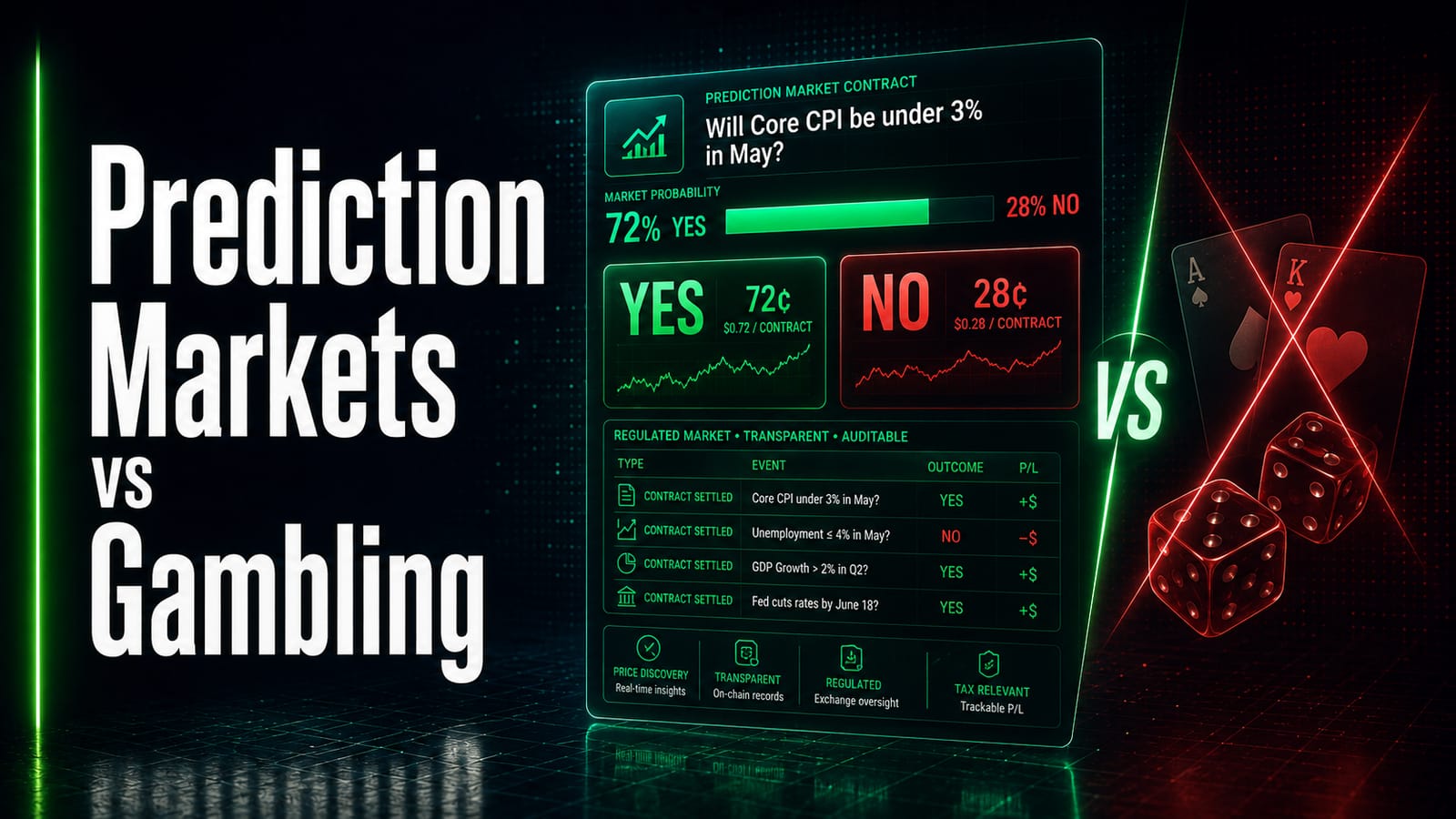
- Two different tax worlds, one set of trades. Trading treatment runs event-contract results through Form 8949 (or Form 6781 under the aggressive Section 1256 approach) with full netting. Wagering treatment puts gross winnings on Schedule 1 line 8b and strands losses on Schedule A line 16.
- Which world applies is genuinely unsettled. As of July 2026 the IRS and Treasury have issued no revenue ruling, notice, regulation, published private letter ruling, or FAQ on event-contract characterization. That silence is about tax guidance — the CFTC itself has been active.
- The money at stake is large. On the same illustrative trades — $30,000 of wins, $20,000 of losses, $10,000 of real profit — the federal bill runs from roughly $1,860 to roughly $7,200, about a 3.9x spread decided by a legal question plus an itemizing checkbox.
- The CFTC "swap" label is the strongest argument against wagering treatment — and, awkwardly, the strongest argument against Section 1256 too. Sports-outcome contracts are the weakest case for keeping wagering treatment off the table.
- Every situation varies. For most traders this comes down to contract mix, itemizing status, and the size of the spread — which is exactly why it typically ends up as a conversation with a CPA who understands trader taxation, not a rule of thumb.
We update this page as guidance lands. As of July 2026 the IRS and Treasury have issued no formal tax guidance on prediction-market event contracts — no revenue ruling, notice, regulation, published private letter ruling, or FAQ that we are aware of — and no event-contract project appears on the current Treasury/IRS priority guidance plan.
That silence is specific to the tax side: the CFTC has been busy, including a June 2026 notice of proposed rulemaking titled "Prediction Markets; Public Interest Determinations," with comments due July 27, 2026. Separately, the wagering-loss regulations proposed under the One Big Beautiful Bill Act (REG-113229-25) remain proposed, and appellate courts are still split on whether these contracts are gambling as a regulatory matter. Any of those could move quickly.
Written by the TraderTax Editorial Team. The tax mechanics described here trace to named statutory provisions — IRC §61, §165(d), §1221, §1234A, §1256 (including the §1256(b)(2)(B) swap exclusion), §1091, §1411, §461(l) — plus P.L. 119-21 §70114 and §70433 (the One Big Beautiful Bill Act), the still-proposed regulations at REG-113229-25, published appellate decisions, and specialist practitioner analysis including the June 2026 Tax Notes Federal classification piece.
Limitations, stated plainly: direct fetches of irs.gov and platform help centers were blocked during research for this page, so nothing here should be read as our own primary-source verification of IRS material — the IRS links at the bottom are provided so a reader or a CPA can check the underlying forms directly.
Each factual claim rests instead on repeated consistent sourcing across five to eight independent professional sources (a national tax association, several CPA firms, two international law firms, and business press). The Tax Notes Federal analysis is paywalled and is known here only through its authors' public summaries. The Editorial Team are researchers and writers — not CPAs. TraderTax is a referral platform; the filings themselves are handled by independent licensed CPAs in our partner network.
This is the question the entire prediction-market tax debate reduces to: is a Kalshi or Polymarket event contract a trade, or a bet? Everything else — which forms get filed, whether losses are usable, whether a break-even year can generate a tax bill — falls out of that one answer.
And nobody has the answer. Not the IRS, which has published nothing on the question. Not the courts, which are split on the related regulatory issue. Not the platforms, which decline to characterize their own products for tax purposes. When a senior economist at the Tax Foundation reportedly netted around $128,000 trading Kalshi, he told Business Insider he wasn't sure how to file it — and that is the honest state of the field in mid-2026.
What can be laid out precisely is the shape of the two worlds: what each one looks like on a return, what each one costs on identical trades, which arguments push toward each, and where the genuinely hard cases sit. That's what this page does. It doesn't pick a side, because the available authority doesn't support picking one.
Are Prediction Markets Taxed as Trading or as Gambling?
Nobody can say definitively. The IRS has issued no revenue ruling, notice, regulation, published private letter ruling, or FAQ addressing event-contract characterization as of July 2026. Practitioners typically choose between trading treatment and wagering treatment, and the two produce very different bills on identical trades. Every situation varies.
Both worlds agree on one thing, and it's worth saying first: the income is taxable either way. Under IRC §61, gross income means all income from whatever source derived. Whether a platform sends a form, whether the activity was legal in the trader's state, and whether the money was ever withdrawn are all beside the point. Section 165(d) has applied to illegal wagers as readily as to legal ones for decades. The characterization debate is about how much tax and which forms — never about whether.
Within "trading treatment" there are actually two sub-positions, and within "gambling" there are two as well. Practitioners generally describe four candidate treatments in total:
- Section 1256 (60/40) on Form 6781 — the most favorable, and generally considered aggressive. The CFTC, and Kalshi's own regulatory filings, classify event contracts as swaps, and §1256(b)(2)(B) excludes swaps from Section 1256.
- Short-term capital gain on Form 8949 and Schedule D — the mainstream practitioner default. Contract as capital asset under §1221, gain or loss on settlement or termination under §1234A.
- Wagering under §165(d) — the harshest outcome for 2026, because of the new 90% loss cap.
- Ordinary "other income" on Schedule 1 line 8z — the conservative approach many consumer guides teach. Note that line 8z is not the gambling line; that distinction trips up a lot of readers and is covered below.
The prediction market taxes hub walks through all four in detail. This page zooms in on the fault line between the two worlds — trading versus wagering — because that's where the dollars actually move.
What Does the Side-by-Side Comparison Actually Look Like?
Trading treatment routes profits through Form 8949 or Form 6781, nets gains against losses, allows up to $3,000 a year against ordinary income, and carries the rest forward. Wagering treatment puts gross winnings on Schedule 1 line 8b and strands losses on Schedule A. The table below compares them line by line.
| Mechanic | Trading treatment (capital or §1256) | Wagering treatment (§165(d)) |
|---|---|---|
| Primary forms | Form 8949 → Schedule D; or Form 6781 → Schedule D under §1256 | Schedule 1 line 8b for winnings; Schedule A line 16 for losses |
| What enters income | Net result, position by position | Gross winnings, before any losses |
| Netting wins against losses | Full netting — including against other capital gains from stocks, options, futures | No netting into income; losses are a separate below-the-line deduction |
| Rate on gains | Ordinary rates on short-term results; a 60% long-term / 40% short-term blend under the §1256 position | Ordinary rates on gross winnings |
| Loss against ordinary income (wages) | Up to $3,000 per year of net capital loss | None, ever — losses reach winnings only |
| Carryforward of unused losses | Indefinite; the §1256 position adds a 3-year carryback election against prior §1256 gains | None — disallowed amounts disappear |
| Itemizing required? | No | Yes — standard-deduction filers get zero loss offset |
| 2026 loss haircut | None | Deduction limited to the lesser of 90% of losses or total winnings (OBBBA §70114, tax years beginning after Dec 31, 2025) |
| Effect on AGI | Net figure only | Gross winnings inflate AGI, which can cascade into phase-outs, IRMAA, and state add-backs |
| Self-employment tax | Typically none for a trader | None for casual activity; a professional gambler files Schedule C and owes SE tax |
| Netting doctrine | Per-position accounting; the arithmetic is settled | The "sessions" doctrine — but no authority defines a session for event-contract trading |
| Wash sales / year-end marking | §1091 is not clearly applicable to event contracts; the §1256 position marks open positions at year-end | Not applicable |
| Illustrative federal tax on $10K of real profit | ≈ $1,860 (§1256) · ≈ $2,400 (short-term capital) | ≈ $2,880 itemizing · ≈ $7,200 taking the standard deduction |
| State overlay | Generally taxed on the net figure | Roughly ten states allow no gambling-loss deduction at all — state tax on gross winnings |
Two structural points to notice before the detail. First, the loss column is where the two worlds diverge most — gains are taxed at ordinary rates in three of the four treatments, so a profitable year with few losses narrows the gap considerably. Second, wagering treatment requires data that trading treatment doesn't. Trading treatment needs the net figure per position; wagering treatment needs gross winnings and gross losses separately, and those typically can't be reconstructed from a net number after the fact. Traders who keep only a net P&L have quietly foreclosed the ability to compute one of the two worlds.
What Does Trading Treatment Look Like on an Actual Return?
Under trading treatment, each position is reported per-contract — Form 8949 into Schedule D under capital treatment, or Form 6781 under the aggressive Section 1256 approach. Gains and losses net freely, up to $3,000 of net loss offsets ordinary income each year, and unused losses carry forward indefinitely.
The mechanics, for the mainstream capital version:
- Basis and proceeds are per contract. Basis is what was paid plus fees; proceeds are the sale price or the $1.00 / $0 settlement. A "YES" bought at 40¢ that resolves in the money produces roughly 60¢ of gain per contract.
- Character follows holding period. Nearly every event-contract position is held under a year, so gains are short-term and taxed at ordinary rates anyway. The netting — not the rate — is the benefit here.
- Form 8949 Box C or F covers transactions not reported on a 1099-B, which is where event-contract activity typically lands, since no comprehensive trade-level 1099 for event-contract profits appears to arrive on a direct platform account.
- Losses net against everything capital. An event-contract loss can offset gains from stock, options, or futures trading in the same year — a genuinely useful feature for traders running several books.
- $3,000 a year, then carryforward. Net capital losses offset up to $3,000 of ordinary income annually, and the remainder carries forward with no expiration.
- No itemizing required, and typically no self-employment tax. The net investment income tax under §1411 can apply above the statutory thresholds.
The Section 1256 version sits on top of the same records but changes the output: a 60/40 rate blend regardless of holding period, year-end mark-to-market of open positions, and a three-year loss carryback election. It's the best outcome available — which is exactly why practitioners treat it cautiously.
The CFTC classifies event contracts as swaps, §1256(b)(2)(B) excludes swaps, and the regulated-futures prong fails as well because these contracts are fully collateralized upfront with no variation-margin system. Specialist commentators generally describe 60/40 on event contracts as aggressive and commonly pair it with a Form 8275 disclosure. Our Kalshi taxes guide works through that argument in depth, including the Nadex precedent that makes it uncomfortable.
Capital treatment and Section 1256 treatment are usually grouped together because they share the same structural advantages — netting, the $3,000 ordinary offset, carryforward, no itemizing requirement. But they rest on different legal arguments and carry different audit profiles. A trader can hold the capital position comfortably as the mainstream practitioner default while treating 60/40 as a separate, more aggressive claim requiring disclosure. Grouping them for comparison purposes doesn't mean they stand or fall together.
What Does Wagering Treatment Look Like on an Actual Return?
Under wagering treatment, gross winnings go on Schedule 1 line 8b as other income, and losses go on Schedule A line 16 — deductible only for itemizers, only up to winnings, and for tax year 2026 only up to 90% of losses, with nothing carried forward.
That sentence contains four separate limitations, and each one costs money:
- Gross, not net. Winnings enter income in full. A trader with $30,000 of winning contracts and $20,000 of losing ones reports $30,000 of income, then tries to deduct the losses separately. AGI rises by the gross figure, which can pull in phase-outs and Medicare premium surcharges that a net figure never would have touched.
- Below the line, itemizers only. Wagering losses are an itemized deduction on Schedule A line 16. A filer taking the standard deduction gets nothing — no partial offset, no proration. This is the single largest swing factor in the entire comparison.
- Capped at winnings. Section 165(d) has always limited wagering losses to the extent of wagering gains. A net losing year produces no deductible loss at all.
- And now the 90% haircut. For tax years beginning after December 31, 2025, the deduction is limited to 90% of losses — under the prevailing reading, the lesser of 90% of losses or total winnings.
Two further mechanics belong in this world, and both are unsettled in ways that matter:
The sessions doctrine. Casual gamblers have long been permitted to net wins and losses within a "session" rather than tracking every individual transaction — a concept developed in IRS memoranda and Tax Court decisions in the casino context. Nothing defines a session for prediction-market trading. Is it a contract? A trading day? A calendar year? A platform's own annual netted P&L statement implicitly assumes full-year netting, which no authority has blessed. Practitioners generally present this as open rather than as a reliable planning tool.
Professional-gambler status. Under the Groetzinger standard — activity pursued full-time, in good faith and with regularity, as a means of livelihood — a gambler can file Schedule C, report gross winnings as receipts, and deduct ordinary business expenses.
The 2026 amendment made that path materially worse: the statute now folds business expenses of a wagering trade or business into "losses," so expenses and losses together face the same 90%-of-losses, capped-at-winnings limit. Any phantom Schedule C profit is also subject to self-employment tax at 15.3% up to the $184,500 Social Security wage base for 2026, and the §461(l) excess business loss rules can apply on top. For anyone weighing it, this is CPA terrain, not article terrain.
The One Big Beautiful Bill Act (P.L. 119-21 §70114, signed July 4, 2025) amended IRC §165(d) so the wagering-loss deduction equals 90% of losses, allowed only to the extent of wagering gains, effective for tax years beginning after December 31, 2025, with no carryforward of the disallowed amount. That is settled statute. The worked math on how that shortfall can create phantom income for a break-even trader is in the 90% gambling-loss cap breakdown.
Whether it reaches prediction-market traders at all is not. The cap bites only if event contracts are characterized as wagering transactions — a question the IRS hasn't answered. The implementing regulations (REG-113229-25) were published as a proposed rule on April 17, 2026; comments closed June 16, and a public teleconference hearing was held July 17, 2026, where Rep. Dina Titus, the American Gaming Association, CPAs, and professional gamblers all pressed the phantom-income problem.
No final rule had landed as of late July 2026, and nothing in the proposal addresses prediction markets specifically. Repeal efforts have gone nowhere so far — the FAIR BET Act was blocked in the House Rules Committee in January 2026, and a Senate unanimous-consent attempt on the FULL HOUSE Act was blocked as well — so for tax year 2026 the cap stands. Early commentary also differed on the exact computation (90% of losses versus 90% of gains); the lesser-of reading matches the statutory text quoted in the proposed regulations, and the final regulations should settle it.
How Much Does the Classification Actually Cost?
In an illustrative 2026 scenario — $30,000 of gross wins, $20,000 of gross losses, $10,000 of real profit, single filer, about $100,000 of other income — the federal bill runs from roughly $1,860 under Section 1256 to roughly $7,200 under wagering treatment without itemizing. Nearly a 3.9x spread.
| Treatment applied to identical trades | Approx. federal tax on $10K of real profit | Approx. effective rate on real profit |
|---|---|---|
| Trading — Section 1256 (60/40) | ≈ $1,860 | ≈ 18.6% |
| Trading — short-term capital | ≈ $2,400 | ≈ 24% |
| Wagering — itemizing | ≈ $2,880 | ≈ 28.8% |
| Wagering — standard deduction | ≈ $7,200 | ≈ 72% |
All figures are approximations for illustration — 2026 bracket math varies with each trader's full picture, and every situation varies. What the table shows structurally:
- The itemizing checkbox dominates. Under wagering treatment, the standard-deduction filer is taxed on all $30,000 of gross winnings with no offset — roughly 72% of the real economic profit. The itemizer's bill is less than half of that.
- The 90% haircut costs real money even for itemizers. Deducting $18,000 of $20,000 in losses leaves $12,000 of taxable income on a $10,000 profit — about $480 of extra federal tax in this example, before any state effect.
- Itemizing isn't free either. Claiming Schedule A losses can mean giving up the standard deduction, and the gross winnings still inflate AGI even when the losses are deducted below the line.
- Section 1256 is the outlier on the favorable side — and the position with the weakest legal footing. The gap between it and short-term capital treatment (about $540 here) is much smaller than the gap between trading and wagering.
- Loss years diverge hardest. A $10,000 net loss under capital treatment typically produces $3,000 against ordinary income now plus carryforward; the §1256 position adds a three-year carryback against prior §1256 gains. Wagering treatment produces nothing beyond winnings, ever.
Our prediction market tax calculator models the branches side by side with an itemizing toggle and state estimates, so the spread can be checked against real numbers rather than this example's.
What Is Phantom Income, and How Does a Break-Even Year Create It?
Phantom income is tax on profit that never existed. Under wagering treatment, a trader with $150,000 of winnings and $150,000 of losses deducts only $135,000 for 2026 — leaving roughly $15,000 of taxable income on zero economic profit. Trading treatment typically nets that same year to zero.
This is the scenario that drew CPAs and professional gamblers to the July 2026 regulatory hearing, and it's the sharpest illustration of why the characterization question matters more than the rates do.
| Break-even year: $150,000 won, $150,000 lost, $0 profit | Taxable amount | Approx. federal tax |
|---|---|---|
| Trading treatment (capital or §1256) | $0 — the year nets flat | $0 |
| Wagering treatment, itemizing | ≈ $15,000 of phantom income | ≈ $3,600 |
| Wagering treatment, standard deduction | $150,000 of gross winnings, no offset | Tax on the full $150,000 |
The arithmetic is worth walking once, because it's counterintuitive. The 90% limit applies to losses first, then the result is capped at winnings: deduction = the lesser of 0.90 × losses or total winnings. At exactly break-even, 90% of $150,000 is $135,000, well under the $150,000 of winnings, so the cap binds at $135,000 and $15,000 of winnings survives as taxable income.
A trader who lost considerably more than they won is, oddly, unaffected by the 90% rule — 90% of a much larger loss figure still exceeds winnings, so the winnings-cap binds first and the offset is complete. The 90% cap creates phantom income specifically in the band where losses are less than about 111% of winnings, which is exactly where a disciplined, roughly break-even trader lives.
A related trap sits at the boundary between platforms. A trader arbitraging a prediction-market contract against a sportsbook position has two legs that may be characterized differently — and under trading treatment, capital losses on the contract leg generally cannot offset sportsbook winnings reported as other income. Under wagering treatment, both legs would sit in the same pool.
Whether losses from one venue can offset winnings from another therefore depends on the characterization of each leg, which is genuinely open. Traders running that strategy typically want a CPA looking at it before year-end, not after. If your year ended in the red, our guide for traders who lost money covers the general loss-handling picture.
Why Is the CFTC "Swap" Classification the Strongest Argument Against Wagering Treatment?
Because a swap is a regulated financial instrument, not a bet. The CFTC treats event contracts as swaps under the Commodity Exchange Act, and the Third Circuit relied on that in April 2026 to hold state gambling law preempted for Kalshi. That same label, though, is the leading argument against Section 1256.
The anti-wagering case, assembled:
- The regulatory classification is financial, not gaming. The CFTC has treated event contracts as binary options that are "swaps" under CEA §1a(47), and Kalshi's own filings with the CFTC state that its contracts are swaps under the Commodity Exchange Act. A swap is a category the federal derivatives regime defines and regulates.
- A federal appellate court has now said so. In Kalshiex LLC v. Flaherty (3d Cir., April 6, 2026), the court held that sports event contracts are CEA swaps and that state gambling law is preempted — in a preliminary-injunction posture, but it is a federal court treating these as financial instruments rather than wagers.
- There is no house. On a designated contract market the order book is peer-to-peer: the exchange collects fees rather than taking the other side and setting a line. A sportsbook is the counterparty to its customers; an exchange is not. That structural difference is the one most often cited as separating the two activities.
- Positions are transferable before resolution. A contract bought at 40¢ can be sold at 65¢ without waiting for the event — the hallmark of a tradable instrument. Wagers generally can't be sold into a market.
- There is a hedging use case. Contracts on CPI prints, Fed decisions, and economic data have plausible risk-management uses for businesses, which is precisely the function the derivatives regime exists to serve.
- North Carolina's legislature just wrote the federal-jurisdiction point into statute. SB 257, signed July 7, 2026, imposes a 6% tax on operators' net trading-fee revenue apportioned to NC residents beginning January 1, 2027 — and in the same bill statutorily recognizes exclusive CFTC jurisdiction over these products.
Now the honest counterweights, because this argument is the best one available rather than a decided one:
- Regulatory labels don't automatically control tax characterization. That principle cuts both ways. Practitioners note that Treasury proposed regulations in 2011 (REG-111283-11) tying the §1256 swap exclusion to the notional-principal-contract definition, and those proposals appear never to have been finalized — a detail we flag as reported rather than verified.
- Section 165(d) doesn't ask whether the venue is regulated. "Wagering transaction" is a tax concept, and §165(d) has long applied to legal and illegal wagers alike. Federal regulation of the venue is evidence, not an exemption.
- The deepest structural objection. A binary event contract conveys no right to buy or sell underlying property; the payout is all-or-nothing on an outcome. That is the feature that makes it resemble a wager — and it's the same feature that undercuts calling it an "option" for Section 1256 purposes.
- A non-precedential Chief Counsel Advice treating daily-fantasy entry fees as wagering exists — but it is authority by analogy only, addresses a different product, and Chief Counsel Advice is non-precedential regardless. It is not authority on event contracts.
Kalshi's strongest regulatory shield is that its contracts are swaps under the Commodity Exchange Act — the classification that beat state gambling regulators in the Third Circuit. That same classification is the single strongest argument that its contracts are excluded from Section 1256 by §1256(b)(2)(B), and therefore cannot get 60/40 rates. The legal theory that keeps the sports contracts alive is in direct tension with the tax theory that would make them cheapest to trade. Any page telling you the answer is obvious has not sat with that tension.
Why Are Sports Contracts the Weakest Case Against Gambling Treatment?
Because a sports-outcome contract looks most like a wager and least like a financial hedge. Practitioner analyses typically frame a spectrum: economic and Fed-data contracts present the strongest capital-asset case, election contracts fall in between, and sports contracts sit closest to wagering. State regulators argue they are gambling outright.
The spectrum framing comes from specialist analysis rather than from any authority — most visibly the June 2026 Tax Notes Federal classification piece co-authored by a specialist CPA and a former head of the IRS Office of Digital Assets, and echoed by a tax economist quoted in CNBC's July 2026 coverage. What makes sports the hard case:
- No hedging story. A contract on a game result has no plausible commercial risk-management function for the typical retail participant. Economic-data contracts do.
- The regulatory fight is loudest here. Roughly eleven states have issued cease-and-desist orders; a 38-state attorneys-general amicus brief argues these products are gambling as a regulatory matter; courts in Nevada, New York, Washington, Michigan, and Massachusetts have leaned or ruled against the exchanges even as the Third Circuit ruled for Kalshi. Ninth and Fourth Circuit merits decisions were pending as of late July 2026, and Supreme Court review is widely expected.
- The CFTC is actively defining "gaming." Its June 2026 notice of proposed rulemaking, "Prediction Markets; Public Interest Determinations," would address that definition, with comments due July 27, 2026. A federal definition of gaming for regulatory purposes wouldn't decide the tax question — but it would give both sides better material.
- The migration narrative cuts against itself. Coverage through late 2025 and 2026 described bettors moving from sportsbooks to prediction markets partly for tax reasons, since trading treatment would beat §165(d). The obvious counter-risk is that recharacterization would erase that advantage retroactively for open years.
None of that makes sports contracts gambling for tax purposes — the IRS hasn't said, and the strongest regulatory precedent to date went the other way. It does mean a trader whose activity is mostly sports contracts is standing on less comfortable ground than one holding CPI and Fed-funds contracts, and practitioners generally hedge sports-heavy situations more heavily. Every situation varies.
What Is a Form W-2G, and Why Doesn't One Usually Show Up Here?
Form W-2G reports certain gambling winnings — slot, bingo, keno, and pari-mutuel payouts above set thresholds. No prediction-market platform appears to issue one, and the generic trigger (a $600 payout at odds of 300 to 1 or better) almost never fires on binary contracts. No W-2G does not mean no tax.
It's worth understanding the form precisely, because its absence gets misread constantly in both directions.
- What it is. W-2G is the information return a payer files for certain gambling winnings, and the copy the winner receives. Different categories carry different thresholds; the slots, bingo, and keno threshold rose to $2,000 effective January 1, 2026 under the same 2025 tax act that created the 90% loss cap.
- Why the generic trigger misses binaries. The catch-all rule reaches winnings of $600 or more when the payout is at least 300 times the amount wagered. On a contract priced between $0.01 and $0.99 that settles at $1.00, the maximum payout ratio is about 100 to 1 at the very cheapest entry — reaching 300 to 1 would require an entry price under about a third of a cent, which the price range doesn't offer.
- Why platforms don't issue one anyway. A CFTC-regulated exchange is not filing as a wagering operator. That's a reporting posture, not an IRS determination — which is the whole point.
- No withholding, either. Gambling withholding doesn't appear to occur on these platforms, and neither does any other kind. That pushes the payment burden onto quarterly estimated taxes for profitable traders who expect to owe $1,000 or more, typically anchored to the 100%/110% prior-year safe harbor.
"No W-2G" ≠ "not taxable" ≠ "not gambling." The absence of a form is a fact about a platform's reporting choices. It says nothing about whether income is reportable — under §61 it is, form or no form — and nothing about how it will ultimately be characterized. Traders who skip reporting because nothing arrived in the mail typically face 20% accuracy-related penalties plus interest if the IRS catches up, and practitioners report prediction-market CP2000 notices already circulating.
The related trap runs the other way too: if a platform does issue a 1099-MISC and the trader reports the same dollars on Schedule D instead, the IRS matching system can generate a notice even when the return is right. Reconciling that mismatch is standard CPA work — and much easier before filing than after.
Does the State Picture Change the Comparison?
Often, yes — and usually in wagering treatment's disfavor. Roughly ten states allow no gambling-loss deduction at all, so gross winnings enter the state base with nothing offsetting them, while trading treatment is taxed on net. New Jersey is the notable exception, permitting same-year netting without itemizing.
Most states piggyback on federal adjusted gross income, so the federal characterization mechanically drives the state result. Under wagering treatment, gross winnings land in AGI and the losses sit below the line — where a fair number of states simply don't follow. Connecticut, Illinois, Indiana, Kansas, Louisiana, North Carolina, Ohio, Rhode Island, Vermont, and Wisconsin are commonly listed as allowing no gambling-loss deduction; a break-even Illinois trader would face 4.95% of gross winnings with nothing to offset it. Under trading treatment the same trader is taxed on net. Nine states levy no individual income tax at all, which flattens the difference entirely. Per-state rules change and deserve individual verification.
Two states have now enacted prediction-market-specific taxes, and the framing matters: both are operator-level excises, not individual income taxes. North Carolina's SB 257 (signed July 7, 2026) applies 6% to operators' net trading-fee revenue apportioned to NC residents from January 1, 2027; Kentucky's HB 757 (April 2026) sets a 14.25% operator excise from the same date. Roughly fifteen states considered prediction-market bills during 2026. No state revenue agency appears to have issued individual income-tax guidance on prediction-market winnings — so for most traders these reach the P&L indirectly through platform fees rather than showing up on a return. Our prediction market taxes hub carries the fuller state picture.
What Would It Take to Settle This?
Formal IRS or Treasury guidance, most plausibly. The nearest checkpoint is the 2026–2027 Treasury/IRS priority guidance plan, generally expected around September or October 2026. Also worth watching: the CFTC's pending event-contracts rulemaking, finalization of REG-113229-25, and the Ninth and Fourth Circuit decisions still pending.
Ranked roughly by how directly each would move the tax answer:
- Any IRS guidance at all — a revenue ruling, notice, FAQ, or even a form instruction naming event contracts would reset every page on this topic, including this one.
- The 2026–2027 priority guidance plan. Nothing on event contracts appeared on the 2025–2026 plan's 105 projects. Its successor is the nearest realistic signal that the question is on Treasury's radar at all.
- Final regulations under REG-113229-25. They would settle the 90% cap's computation mechanics — which matters enormously if wagering treatment applies, and not at all if it doesn't.
- The CFTC's final event-contracts rule from the June 2026 proposal, particularly any definition of "gaming." Regulatory, not tax — but influential.
- The Ninth and Fourth Circuit merits decisions, and any Supreme Court cert grant. A deepened or resolved circuit split on whether these are gambling as a regulatory matter would shape how practitioners weigh the wagering position.
- Platform reporting practices for tax year 2026. If a major venue starts issuing forms coded a particular way, that won't decide the law — but it will change what shows up in IRS matching, which is a practical problem of its own.
How Do Practitioners File While the Question Is Open?
The emerging consensus: pick one reasonable characterization, apply it consistently year over year, document the reasoning, and keep complete per-contract records. Aggressive positions such as Section 1256 are typically paired with a Form 8275 disclosure. Because the dollar spread is so wide, most traders confirm the choice with a CPA.
What that tends to look like in practice:
- Capture gross and net from the start. Trading treatment needs per-position results; wagering treatment needs gross winnings and gross losses separately. Keeping only a net figure quietly removes one of the two worlds from the table.
- Look honestly at the contract mix. A book of CPI and Fed-funds contracts sits differently from a book of World Cup markets. The spectrum isn't authority, but it's how specialists are reasoning.
- Run the numbers both ways before choosing. Sometimes the spread is a few hundred dollars and the question is academic. Sometimes it's the difference between owing nothing and owing tax on a break-even year.
- Write down the reasoning. Consistency plus documentation is the spine of every practitioner recommendation found on this question — and the thing that's hardest to reconstruct three years later under examination.
- Take it to a CPA who knows trader taxation. Especially with large gains, a net-loss year, sports-heavy activity, multi-platform trading, or an entity in the mix. This is exactly the terrain where personalized advice earns its keep, and where a generic preparer is likely to reach for the simplest line on the form rather than the defensible one.
Two frontier questions genuinely have no answers yet, and both belong in that CPA conversation rather than in an article: whether event contracts count as "securities or commodities" for a Section 475 mark-to-market election, and how trader tax status or an entity structure such as an LLC or S-Corp interacts with event-contract activity. Adjacent ground that is reasonably well settled is worth reading alongside this page — what active traders can typically deduct, how the wash-sale rule works where it does apply, and how the digital-asset layer stacks on top for crypto-settled venues.
Not Sure Which World Your Trading Falls Into?
Answer 8 quick questions. Get a personalized AI summary of your tax exposure, missed deductions, and what to look at next — reviewed by a real CPA.
Get My Free Tax Snapshot →Frequently Asked Questions
Are prediction market winnings taxed as gambling or as trading?
Unsettled. As of July 2026 the IRS has published no revenue ruling, notice, regulation, private letter ruling, or FAQ addressing event-contract characterization. Practitioners typically pick between trading treatment (Form 8949 or Form 6781) and wagering treatment (Schedule 1 line 8b with Schedule A losses), then apply it consistently and document why.
What is the difference between Schedule 1 line 8b and line 8z?
Line 8b is where gambling income goes under wagering treatment, with losses claimed separately on Schedule A line 16. Line 8z is the ordinary other-income line some consumer guides use for net prediction-market profit — a different treatment entirely, and whether losses may be netted inside it is unresolved.
Does the new 90% wagering-loss cap apply to prediction markets?
Only if event contracts are characterized as wagering — a question the IRS hasn't answered. The cap itself is law for tax year 2026 under the One Big Beautiful Bill Act, and its implementing regulations (REG-113229-25) remain proposed. Repeal attempts have failed so far, so the cap stands.
Can prediction-market losses offset my salary?
Under trading treatment, typically up to $3,000 of net capital loss per year offsets ordinary income including wages, with the remainder carried forward indefinitely. Under wagering treatment, losses offset winnings only — never salary — and nothing carries forward. That single difference often dominates the whole comparison in a losing year.
Can I owe tax in a year I broke even?
Under wagering treatment, yes. The 2026 cap allows a deduction equal to the lesser of 90% of losses or total winnings, so a trader with $100,000 of each deducts $90,000 and reports $10,000 of phantom income. Trading treatment typically nets the same year to zero.
What is the sessions doctrine, and does it help prediction-market traders?
The sessions doctrine lets casual gamblers net wins and losses within a single gambling session rather than transaction by transaction. No authority defines a session for prediction-market trading — per contract, per day, or per year — so practitioners treat it as genuinely open territory rather than a reliable shelter.
Should I file as a professional gambler on Schedule C?
That's a CPA question, and a consequential one. Professional status is judged under the Groetzinger standard — full-time, regular activity pursued for a livelihood. It moves activity to Schedule C with self-employment tax, and for 2026 losses and business expenses share the same 90%-of-losses, capped-at-winnings limit.
Does a platform's tax form settle which treatment applies?
No. A platform's reporting choice reflects the platform's own compliance posture, not an IRS determination about a trader's characterization. No comprehensive trade-level 1099 for event-contract profits appears to arrive on a direct platform account anyway, though orders routed through a broker may surface in that broker's year-end reporting.
See the spread on your own numbers — trading treatment vs wagering treatment
Because the IRS hasn't ruled on event contracts, the honest answer is a range rather than a number. Our calculator models the Section 1256, capital-gain, and wagering branches side by side — including the 90% loss cap and the itemizing toggle. The tools below give a ballpark; a CPA confirms what actually applies to your situation.
Or create a free account to get matched with a CPA →The platforms named on this page have each built something genuinely impressive, and the characterization debate applies to all of them — it isn't a knock on any venue. What differs is the paperwork each one produces and the extra layers that come with it, so each gets its own guide. Kalshi runs a federally regulated event-contract exchange; Polymarket operates both a crypto-settled exchange and a CFTC-designated US venue; Robinhood routes event-contract orders to regulated exchanges from inside its brokerage app. Platform features and rules change often — their own sites are the current source for that.
Disclosure: TraderTax has no affiliate, referral, or commercial relationship with Kalshi, Polymarket, or Robinhood, and earns nothing if you sign up with any of them. Those links are provided for reference only. Links to IRS.gov are likewise informational — no IRS page cited here addresses prediction-market event contracts.
This page covers the characterization fault line. These cover the platforms, the mechanics, and the adjacent instruments where the tax rules are far more settled:
Important framing: none of the IRS pages below mentions prediction markets or event contracts. They are the primary material for the underlying forms and topics that each candidate treatment routes through, linked so a trader — or a CPA — can read the source rather than a summary of it.
- IRS — About Form 8949, Sales and Other Dispositions of Capital Assets, plus About Schedule D (Form 1040). The mainstream capital-treatment path; Box C/F covers transactions not reported on a 1099-B.
- IRS — About Form 6781, Gains and Losses From Section 1256 Contracts and Straddles. The form the 60/40 approach runs through, and the one carrying the three-year loss-carryback election.
- IRS — About Schedule 1 (Form 1040), Additional Income and Adjustments to Income. Line 8b is the gambling-income line; line 8z is the general other-income line — two different treatments on the same schedule.
- IRS — About Schedule A (Form 1040), Itemized Deductions. Line 16 is where wagering losses would be claimed, which is why itemizing status is decisive under that treatment.
- IRS — Topic No. 419, Gambling Income and Losses. The baseline framework if event contracts were ever characterized as wagering. Note that it describes the pre-2026 rules in places; the 90% limitation applies to tax years beginning after December 31, 2025.
- IRS — About Form W-2G, Certain Gambling Winnings. The categories and thresholds that trigger the form — none of which appears to reach event-contract trading.
- IRS — About Publication 550, Investment Income and Expenses. Where capital-asset, holding-period, straddle, and wash-sale mechanics are laid out.
- IRS — About Schedule C (Form 1040), Profit or Loss From Business. The professional-gambler path, and the reason self-employment tax enters that branch.
- IRS — About Form 8275, Disclosure Statement. The disclosure practitioners commonly attach when taking an aggressive position such as Section 1256 on event contracts.
- IRS — About Form 1040-ES, Estimated Tax for Individuals. Relevant because no prediction-market platform appears to withhold.
Statutory, regulatory, and case citations used on this page: IRC §61 (gross income), §165(d) (wagering losses), §1221 and §1234A (capital assets and terminations), §1256 including the §1256(b)(2)(B) swap exclusion and the §1256(g)(7)(B) qualified-board-or-exchange definition, §1091 (wash sales), §1411 (net investment income tax), §461(l) (excess business loss), P.L. 119-21 §70114 and §70433 (the One Big Beautiful Bill Act), REG-113229-25 (proposed wagering-loss and information-reporting regulations), CEA §1a(47) (the swap definition), Commissioner v. Groetzinger (professional-gambler standard), and Kalshiex LLC v. Flaherty (3d Cir., April 6, 2026). State measures referenced: North Carolina SB 257 and Kentucky HB 757, both operator-level excises effective January 1, 2027.