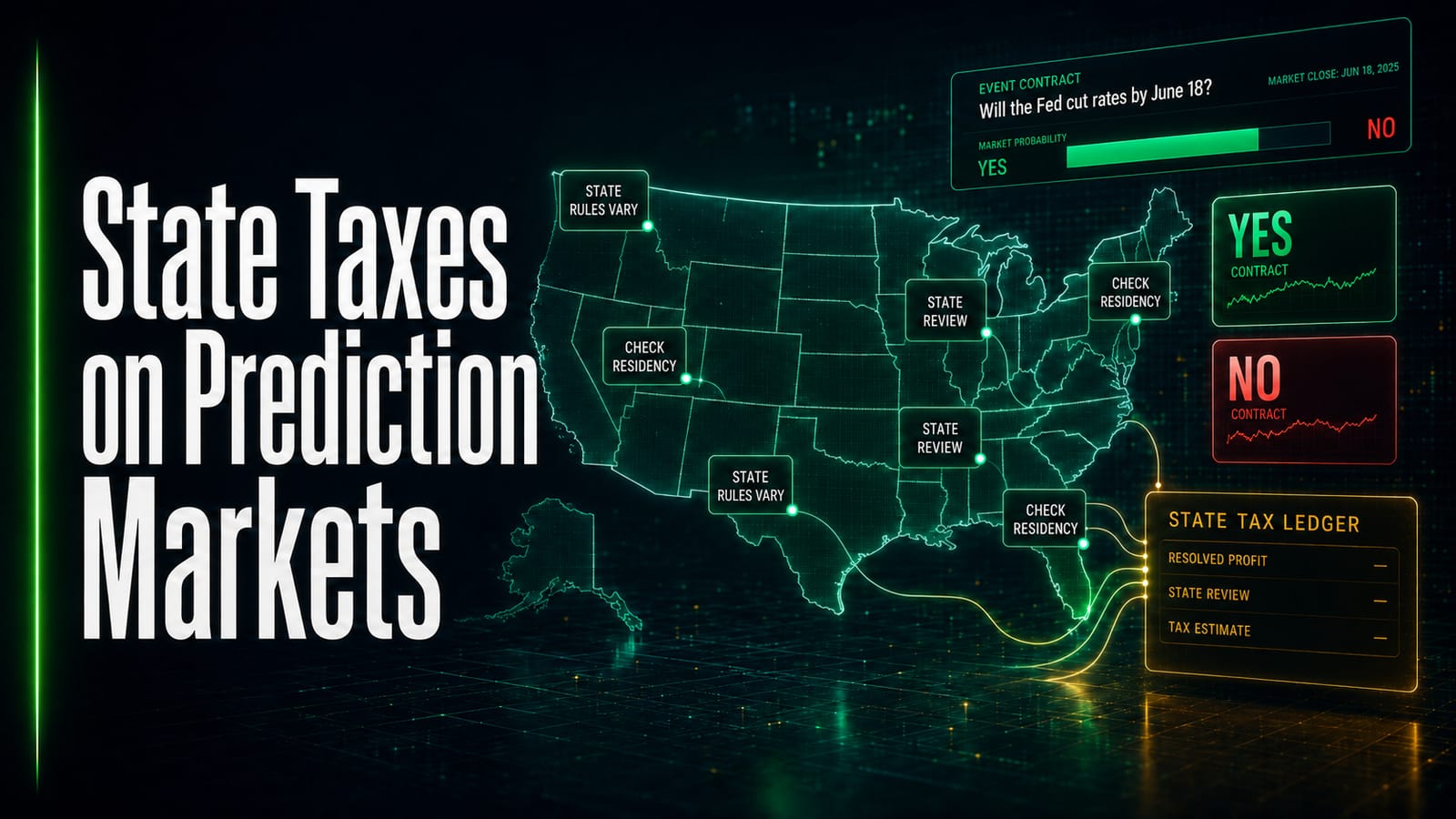
- The two state prediction-market taxes enacted so far are operator excises, not taxes on your winnings. North Carolina's SB 257 (6%, signed July 7, 2026) and Kentucky's HB 757 (14.25%, April 2026) both take effect January 1, 2027 and both land on the platform, not the trader.
- No state revenue agency has issued individual income-tax guidance on prediction-market winnings as of July 2026 — but "states have done nothing" is also wrong. They have acted at the operator level, and roughly fifteen states weighed bills during 2026.
- Most states inherit the federal answer. Because state returns typically start from federal adjusted gross income, the unsettled federal characterization — Section 1256, capital, gambling, or ordinary income — mechanically drives the state result.
- The harshest combination is conditional. Roughly ten states allow no gambling-loss deduction at all — so if event contracts were characterized as wagering, a trader there could owe state tax on gross winnings. Nine states levy no broad individual income tax at all.
- State rules vary widely, change annually, and are documented inconsistently for prediction markets specifically. Every situation varies — most traders confirm their state picture with a CPA who follows trader taxation.
We update this page as guidance lands. Two facts anchor everything below. First, as of July 2026 the IRS and Treasury have issued no formal tax guidance on prediction-market event contracts — no revenue ruling, notice, regulation, published private letter ruling, or FAQ that we're aware of — and no event-contract project appears on the current Treasury/IRS priority guidance plan.
That silence is specific to the tax side: the CFTC has been active, including a June 2026 notice of proposed rulemaking on prediction markets and public-interest determinations, with comments due July 27, 2026. Second, at the state level the only enacted prediction-market taxes are operator excises effective January 1, 2027, and no state revenue agency has issued individual income-tax guidance. Bills, court rulings, and state rates all move quickly; the "last updated" date above is the tell for how current this page is.
Written by the TraderTax Editorial Team. The state-level findings here are assembled from multiple independent professional sources per claim — law-firm state-tax alerts, a July 2026 Holland & Knight legislative survey, state budget and legislative coverage, and specialist practitioner analysis of the wagering rules — cross-checked so that each load-bearing statement appears in several places rather than one.
We were not able to fetch irs.gov or several platform help pages directly during this research pass, so nothing on this page should be read as a primary-document review; the statutory references below name the provisions each conclusion runs through so a reader or a CPA can pull the source themselves. Where a state's treatment is documented inconsistently — California is the clearest example — this page flags the conflict instead of picking a side. The Editorial Team are researchers and writers — not CPAs. TraderTax is a referral platform; the filings themselves are handled by independent licensed CPAs in our partner network. Primary IRS material is linked at the bottom of the page.
The state-tax story on prediction markets changed in July 2026 — and almost every summary of it circulating right now gets the most important part backwards. North Carolina's Senate Bill 257 was signed on July 7, 2026, becoming the first state tax written specifically for prediction markets. Kentucky's House Bill 757 landed a few months earlier. Both are real, both are new, and both take effect January 1, 2027.
Neither one taxes your winnings.
That distinction is the whole page. These are operator-level excises — taxes on what the platform earns in trading fees, not on what a trader takes home. They may eventually reach traders indirectly, through fee schedules, but they do not add a line to an individual return. Meanwhile the question traders actually ask — what does my state do with my Kalshi or Polymarket profit? — still has no state-specific answer anywhere in the country. What it has instead is a mechanical one: most states start from federal adjusted gross income, so the unsettled federal characterization drives the state result. This guide covers both halves honestly.
"States are starting to tax prediction-market winnings" is not an accurate description of what happened in 2026. North Carolina's SB 257 and Kentucky's HB 757 are excises on operators, effective January 1, 2027, and no state revenue agency has issued individual income-tax guidance for prediction-market traders. If you read a headline saying your state now taxes your event-contract profits, check whether the bill taxes the platform's fee revenue or your return — so far, it has been the platform's.
Are States Starting to Tax Prediction-Market Winnings?
Not at the individual level. Two states have enacted prediction-market taxes, but both land on operators rather than traders: North Carolina's SB 257 and Kentucky's HB 757, each effective January 1, 2027. No state revenue agency has issued individual income-tax guidance on prediction-market winnings as of July 2026.
Both halves of that sentence matter. It would be wrong to tell a trader their state just started taxing prediction-market profits — nothing enacted so far does that. It would be equally wrong to say the states have done nothing, because they have legislated, litigated, and in two cases taxed. Here is what is actually on the books:
| State | Bill | What it taxes | Rate | Effective |
|---|---|---|---|---|
| North Carolina | SB 257 (signed July 7, 2026) | Operators' net trading-fee revenue apportioned to NC residents. First state prediction-market-specific tax; the same law statutorily recognizes exclusive CFTC jurisdiction. | 6% | Jan 1, 2027 |
| Kentucky | HB 757 (April 2026) | Operator excise | 14.25% | Jan 1, 2027 |
| Individual traders | — | No state prediction-market income tax enacted; no state revenue-agency individual guidance as of July 2026 | — | — |
What Does North Carolina's SB 257 Actually Tax?
Operators, not traders. Signed July 7, 2026, SB 257 applies a 6% tax to prediction-market operators' net trading-fee revenue apportioned to North Carolina residents, effective January 1, 2027. It is the first state prediction-market-specific tax, and the same law statutorily recognizes exclusive CFTC jurisdiction over these markets.
Three details make SB 257 more interesting than its rate:
- The base is fee revenue, not volume or winnings. A 6% tax on net trading-fee revenue apportioned to North Carolina residents is a tax on the exchange's take — the fee an operator collects on matched trades — rather than on notional volume or on any trader's profit. That is a much smaller base than a sports-betting tax on gross gaming revenue, which is part of why states are unhappy about the migration.
- The CFTC-jurisdiction language is the headline for the industry. The same bill statutorily recognizes exclusive federal CFTC jurisdiction over these markets — a notable position given how many state attorneys general have spent 2026 arguing the opposite in court. North Carolina effectively chose to tax the activity rather than fight it.
- It arrived inside a broader gambling-tax package. The same budget legislation raised North Carolina's sports-betting tax rate to 23%, which frames the policy logic: if wagering dollars are moving to federally regulated exchanges, states want a revenue path that follows them.
North Carolina also sits on the list of states commonly described as allowing no gambling-loss deduction on the individual side — a separate issue from SB 257 entirely, and one that would only matter for a trader if event contracts were ever characterized as wagering. Reported individual rates for 2026 hover near 4% (North Carolina's flat rate has been stepping down annually, so the current figure is worth confirming rather than assuming).
What Does Kentucky's HB 757 Do?
Kentucky enacted a 14.25% excise on prediction-market operators in April 2026, effective January 1, 2027 — the same start date as North Carolina's. Like SB 257, it taxes the operator rather than the individual trader, so it does not create a new state tax line on a trader's winnings.
The 14.25% rate is more than double North Carolina's, and it is not an accident: 14.25% is the rate Kentucky already applies to sports wagering, so the state chose rate parity with sportsbooks rather than a fee-revenue-scaled number. That design choice is the live policy debate in miniature — whether a prediction-market exchange should be taxed like a betting operator or like a financial venue.
The Kentucky excise has drawn litigation. Sources conflict on who filed the challenge, so we are not naming a plaintiff here; what is clear is that the measure is contested and that the outcome could affect whether the January 2027 start date holds. Kentucky's attorney general has separately been active against offshore prediction-market operators on the regulatory side.
Beyond the two enacted excises, several states have measures at various stages. Illinois has advanced a tiered transaction tax (reported at 1.75% and 3.5% brackets plus licensing fees), which has itself drawn a legal challenge from a major operator. New Jersey has a bill advancing that would apply a 9% gross-revenue tax to these markets — advancing is not the same as enacted, and we have not confirmed a signature. Roughly fifteen states considered prediction-market bills during 2026 per a July 2026 Holland & Knight survey. All of these are operator-side measures. None of them, as drafted, creates an individual income tax on prediction-market winnings.
Do Operator Excises Change What Traders Actually Pay?
Possibly, but indirectly. An excise on an operator's fee revenue is a platform cost, and platform costs typically show up in fee schedules rather than on a tax return. Whether either state's 2027 rate moves what traders pay is not yet knowable, and neither law taxes winnings directly.
For a trader, the practical translation is a watch item rather than a filing change:
- Fees adjust basis and proceeds, not a separate deduction line. On the capital-treatment path, trading fees typically fold into what a position cost and what it returned. So if operator excises did push fee schedules up, the tax effect would arrive quietly as slightly worse per-contract math — not as a new tax to report. Our trader deductions guide covers what is and isn't separately deductible for active traders.
- Nothing has changed yet. Both excises begin January 1, 2027, and neither state's revenue department has published implementation detail that we could review. Platforms have not announced fee changes tied to either law.
- Apportionment means the cost isn't uniform. North Carolina's base is fee revenue apportioned to North Carolina residents, so any pass-through pressure would be concentrated rather than national — though whether an exchange would price state-by-state at all is unknown.
The honest summary: operator excises are the biggest genuinely new fact in state prediction-market taxation, and for individual traders they are still a footnote. The bigger state variable remains the one nobody legislated — how a state treats the income once it hits a federal return.
How Do States Tax Prediction-Market Winnings at the Individual Level?
Mostly by inheriting the federal answer. Most states start from federal adjusted gross income, so the unsettled federal characterization mechanically drives the state result. Under a gambling characterization gross winnings enter state AGI with losses handled below the line, if at all; under capital treatment only the net typically flows through.
This is why the federal debate covered in our prediction market taxes guide is not an academic exercise: the characterization a trader adopts federally is usually the characterization their state applies, whether or not the state has ever thought about event contracts. Four federal treatments are in play — Section 1256 60/40 (aggressive), short-term capital gain (the mainstream practitioner default), gambling under §165(d), and ordinary "other income" — and each pushes a different number into the state base.
| Federal treatment | Federal forms | What typically enters federal AGI | Usual state consequence |
|---|---|---|---|
| Section 1256 (60/40) | Form 6781 → Schedule D | Net gain or loss, split 60% long-term / 40% short-term | Net flows through; the 60/40 rate benefit usually does not repeat, since almost no state prefers long-term gains |
| Short-term capital | Form 8949 → Schedule D | Net gain or loss after capital netting | Net flows through; state taxes it at ordinary state rates |
| Gambling (§165(d)) | Schedule 1 line 8b for winnings; Schedule A line 16 for losses | GROSS winnings — losses sit below the line as an itemized deduction | Gross enters state AGI; whether the state allows any loss offset varies enormously |
| Ordinary "other income" | Schedule 1 line 8z | Whatever figure is reported on that line (whether losses may be netted inside it is unresolved) | Flows through at ordinary state rates |
The row that does the damage is the gambling row. Everything else pushes a net number into AGI; the wagering branch pushes gross winnings in and parks the losses in a place many states simply don't follow. That single structural difference is why the state answer can swing harder than the federal one.
Two related mechanics are worth naming because they don't behave the way traders expect. Wash-sale rules under §1091 apply to "stock or securities," which event contracts are almost certainly not — but no authority confirms that, so practitioners typically call it "not clearly applicable" rather than exempt (background in our wash-sale rule guide). And a Section 475 mark-to-market election is genuinely open territory here, because whether event contracts count as "securities or commodities" for §475 has not been analyzed to a conclusion by anyone.
Which States Allow No Gambling-Loss Deduction?
Roughly ten, by most practitioner counts: Connecticut, Illinois, Indiana, Kansas, Louisiana, North Carolina, Ohio, Rhode Island, Vermont and Wisconsin. If — and only if — prediction-market activity were characterized as wagering, a trader in one of those states could face state tax on gross winnings with no loss offset.
This is the single harshest scenario in prediction-market taxation, and it is entirely conditional. It requires the wagering characterization the IRS has never confirmed. Where it does apply, the arithmetic is unforgiving: a trader who won $150,000 and lost $150,000 — economically flat — could owe state tax on the full $150,000 of gross winnings.
| State bucket | States | If a wagering characterization applied | Under capital or Section 1256 treatment |
|---|---|---|---|
| No gambling-loss deduction | CT, IL, IN, KS, LA, NC, OH, RI, VT, WI | State tax on gross winnings, no loss offset — Illinois's flat 4.95% applies to federal AGI with no itemized deductions at all; Connecticut's top rate reaches roughly 6.99% | Tax on the net figure only |
| No broad individual income tax | AK, FL, NV, NH, SD, TN, TX, WA, WY | $0 at the state level | $0 at the state level |
| Partial or unusual | MA, MI, MN | Massachusetts has been described as allowing gambling losses only against state-licensed casinos, which would exclude a CFTC exchange (an inference worth verifying); Michigan's deduction has been described as tracking the federal itemized amount, which would inherit the 90% cap (unverified); Minnesota disallows the losses under its state alternative minimum tax | Massachusetts applies a higher short-term capital-gains rate than its ordinary rate — a genuine tension that can cut both ways |
| Most favorable documented | NJ | Historically allows same-year netting without itemizing, floored at zero, no carryforward; did not adopt the federal 90% cap; rates roughly 1.4%–10.75% | May not recognize the federal 60/40 split for state purposes — worth confirming |
| Documented inconsistently | CA | Better-sourced view: allows gambling losses as an itemized deduction under fixed-date conformity, without the federal 90% cap. One account says the opposite. Treat as unresolved. | No capital-gains preference — ordinary rates from roughly 1% to 13.3% apply to everything |
Two cautions on that table. First, state gambling-loss rules are documented at varying levels of reliability and several states change them; the buckets above reflect how practitioners commonly describe them, not a state-by-state statutory audit, and per-state verification is genuinely worth doing before relying on a row. Second, none of these rules was written with event contracts in mind — they were written for casinos and sportsbooks, which is exactly why applying them to a CFTC-regulated exchange is an open question rather than a lookup.
Which States Have No Individual Income Tax on Prediction-Market Gains?
Nine states levy no broad individual income tax: Alaska, Florida, Nevada, New Hampshire, South Dakota, Tennessee, Texas, Washington and Wyoming. A trader living in one of them typically owes nothing at the state level under any of the four federal characterizations, though local and entity-level taxes can still apply.
Two asterisks on that list are worth knowing:
- New Hampshire is fully income-tax-free as of January 1, 2025, following the repeal of its interest-and-dividends tax. Older guides that describe a New Hampshire investment-income tax are out of date.
- Washington has a capital-gains excise, but it probably misses event contracts. The 7% excise reaches only long-term capital gains above a high threshold (reported around $270,000), and Washington's revenue department has indicated in interim guidance that Section 1256 gains enter the base only where the position was held more than a year. Prediction-market positions are nearly always short-term, so they typically fall outside the excise under any characterization — a quirk almost nobody covers.
There is an irony in the list, too: Nevada levies no individual income tax and has been the most aggressive state litigant against prediction-market exchanges. A Nevada trader has no state income-tax exposure on the winnings and the most contested market access in the country.
One structural caution: no-income-tax status follows residency, not the platform. Moving mid-year, maintaining a second home, or trading through an entity organized elsewhere can all complicate the answer — and entity choices bring their own state-level costs. Our LLC vs S-Corp guide covers the structural trade-offs, but a residency or apportionment question is a CPA conversation rather than a checklist item.
Which States Look Best Under a Gambling Characterization?
New Jersey is the most favorable case documented. It has historically allowed same-year netting of gambling losses without itemizing, floors the result at zero, and did not adopt the federal 90% cap. California's treatment is genuinely disputed across sources, so it is worth confirming with a CPA rather than assuming.
New Jersey's combination is unusual enough to spell out: netting without itemizing means a trader who won $150,000 and lost $150,000 could reach a $0 state result even while the federal wagering branch produced phantom income — because New Jersey did not adopt the 90% haircut and does not require the trader to itemize to use the losses. The result floors at zero (there is no net-loss benefit and no carryforward), but the phantom-income problem largely doesn't travel to the New Jersey return. It is also, fittingly, the state where the Third Circuit ruled for Kalshi in April 2026.
California is the opposite kind of case — not harsh, just unclear. The better-sourced view is that California allows 100% of gambling losses as an itemized deduction because its conformity to the federal code is fixed-date and it had not conformed to the OBBBA change as of early 2026. A conflicting account says California disallows the losses. We are not resolving that here; a California trader should treat it as an open item for their CPA. What is not disputed: California gives no preferential rate to capital gains, so the federal 60/40 benefit does nothing at the state level, and top ordinary rates reach 13.3%.
Does My State Follow the Federal 60/40 Section 1256 Split?
Usually it makes no difference. The 60/40 split changes the federal character of gain, but almost no state gives long-term capital gains a preferential rate, so the federal benefit generally does not repeat at the state level. Whether a given state respects the split for its own purposes varies.
This is one of the most common misunderstandings among traders who move from equities into event contracts hoping for futures-style 60/40 treatment. Even where the aggressive Section 1256 position were available — and specialist practitioners generally consider it aggressive for event contracts, because the CFTC and Kalshi's own regulatory filings classify these instruments as swaps, which §1256(b)(2)(B) excludes — the state savings are typically zero. States overwhelmingly tax all income at the same rate schedule. New Jersey has been described as possibly not recognizing the federal 60/40 characterization for its own purposes at all, which is worth confirming for anyone taking that position.
The practical takeaway: 60/40 is a federal-rate argument, not a state-tax strategy. Comparing how listed options and futures are actually treated is useful context, since those are far more settled areas than binary event contracts.
If Prediction Markets Are Contested or Blocked in My State, Do I Still Owe Tax?
Yes. Taxability and legality are separate questions — income is taxable under IRC §61 regardless of whether an activity is permitted where the taxpayer lives, and §165(d) has long applied to lawful and unlawful wagers alike. A state fight over market access does not create a tax exemption.
This matters because 2026 was a chaotic year for state access, and traders reasonably wonder whether a blocked market means untaxed profits. It does not. The regulatory scoreboard as of July 2026, in brief:
- The Third Circuit ruled for Kalshi in April 2026 in a preliminary-injunction posture, holding sports event contracts are Commodity Exchange Act swaps with state gambling law preempted.
- Several states have gone the other way. Nevada, New York, Washington, Michigan, and Massachusetts courts have leaned or ruled against the exchanges at various stages; Ninth Circuit and Fourth Circuit merits decisions were pending, and roughly eleven states have issued cease-and-desist orders. A 38-state attorney-general amicus brief supported the Massachusetts side.
- Arizona brought the first criminal charges in March 2026, after which the CFTC sued the state and obtained a temporary restraining order in April 2026 — a federal agency litigating against a state on the exchanges' side.
- Supreme Court review is widely expected within the next year or two given the circuit split.
None of that is a tax fight. It is a fight about who regulates these markets — and whichever way it resolves, gains already realized remain taxable. Sports contracts sit at the center of it, which is why they carry the highest wagering-recharacterization risk; our sports prediction market taxes guide handles that branch in depth.
How Much Can the State Layer Actually Add? An Illustrative Example
Take the standard scenario from our federal analysis: a single filer with about $100,000 of other income who won $30,000 and lost $20,000 on event contracts in 2026 — $10,000 of real economic profit. The federal bill ranges from roughly $1,860 to roughly $7,200 depending on characterization. Here is what three states add on top.
| Federal branch | Approx. federal tax | TX / FL | Illinois (4.95% flat on AGI) | California (approx.) |
|---|---|---|---|---|
| Section 1256 (60/40) | ≈ $1,860 | $0 | ≈ +$495 | ≈ +$930 |
| Short-term capital | ≈ $2,400 | $0 | ≈ +$495 | ≈ +$930 |
| Gambling, itemizer | ≈ $2,880 | $0 | ≈ +$1,485 | ≈ +$930 |
| Gambling, standard deduction | ≈ $7,200 | $0 | ≈ +$1,485 | ≈ +$930 |
All figures are rough illustrations, not projections — 2026 bracket math varies with each trader's full picture, and every situation varies. What the table shows structurally:
- Illinois triples its own bill under the wagering branch — from about $495 to about $1,485 — because the flat 4.95% applies to federal AGI, which under that branch contains the full $30,000 of gross winnings rather than the $10,000 of profit. Illinois allows no itemized offset, so the itemizer/non-itemizer distinction that matters federally makes no difference at all in Illinois.
- California's state number barely moves across branches in this scenario, because California has no capital-gains preference and — on the better-sourced reading — allows the loss deduction. The 60/40 argument buys nothing there.
- Texas and Florida are flat zero regardless. The entire characterization debate is federal-only for a resident of a no-income-tax state.
- The state layer can exceed the federal spread in percentage terms. A 3x swing in state tax from one characterization decision is larger, proportionally, than the federal 60/40-vs-capital gap.
Want to run your own numbers across the branches? Our prediction market tax calculator models the three main treatments side by side, including the itemizing toggle and a state overlay.
The One Big Beautiful Bill Act (signed July 2025) capped the federal wagering-loss deduction at 90% of losses starting tax year 2026, allowed only up to winnings, itemizers only, with no carryforward. If prediction-market activity were treated as wagering — a question the IRS hasn't answered — a break-even trader with $100,000 of wins and $100,000 of losses could deduct only $90,000 and owe federal tax on $10,000 of phantom income.
Under the prevailing reading the deduction equals the lesser of 90% of losses or total winnings, though early commentary differed on the computation and the regulations remain proposed only (REG-113229-25, published April 17, 2026; comments closed June 16; a public hearing was held July 17, 2026 where Rep. Dina Titus, the American Gaming Association, CPAs, and professional gamblers all pressed the phantom-income problem).
Repeal efforts have failed so far: the FAIR BET Act was blocked in the House Rules Committee in January 2026, and a Senate unanimous-consent attempt on the FULL HOUSE Act was blocked as well. The cap stands for tax year 2026. The state angle: New Jersey did not adopt it. Michigan's deduction has been described as tracking the federal itemized figure, which would inherit it — unverified. And in the ten states with no gambling-loss deduction, the 90% cap is beside the point, because there was never a state deduction to haircut.
How Many States Moved on Prediction Markets in 2026?
Roughly fifteen states considered prediction-market bills during 2026, according to a July 2026 Holland & Knight survey. Two enacted operator taxes; others weighed transaction taxes, licensing regimes, or outright restrictions on sports event contracts, and about eleven states have issued cease-and-desist orders on the regulatory side.
The motive behind the legislative wave is revenue, and the numbers explain the urgency. Industry and policy estimates of state sports-betting tax revenue lost to the migration toward prediction markets have ranged from roughly $600 million (a MultiState estimate) to more than $1 billion (an American Gaming Association figure). The per-dollar gap is the sharpest illustration: on $100 of net revenue, a New York sportsbook has been described as paying about $51 in state tax, while a prediction market pays roughly $7.25. States are not primarily trying to tax traders — they are trying to tax the venues that captured the wagering dollars.
For a trader, the practical read is that the state legislative pipeline is about operators for now. The individual-side question remains untouched in every state, which means the federal characterization keeps doing the work.
Do Traders Owe State Estimated Tax Payments Too?
Often, yes. No prediction-market platform appears to withhold federal or state tax, and most states that levy an income tax run their own estimated-payment rules and safe harbors. Profitable traders typically set aside a percentage for both layers rather than waiting for an April surprise.
The zero-withholding reality is what makes this bite. A profitable World Cup run or election cycle can generate a meaningful liability with nothing withheld behind it, and no year-end form arriving as a reminder — Kalshi's documentation describes no comprehensive trade-level 1099 for event-contract profits on a direct account, and offshore Polymarket issues no forms at all. State thresholds, due dates, and safe-harbor percentages differ from the federal ones, and a few states have no estimated-payment regime at all. Sizing both layers together is standard CPA work; the same discipline applies to active day traders and prop-firm traders with untaxed payouts.
What Could Change at the State Level Next?
Several things, none decided. The North Carolina and Kentucky excises take effect January 1, 2027; more states may legislate; appellate rulings and possible Supreme Court review could reshape where these markets operate; and any federal characterization guidance would flow straight into the states that conform to federal adjusted gross income.
The specific watch list we monitor for this page:
- January 1, 2027 — both operator excises take effect. Watch for platform fee-schedule changes and for implementation guidance from either revenue department.
- The 2026–2027 Treasury/IRS Priority Guidance Plan, expected around September or October 2026. It is the nearest single event that could move the federal no-guidance baseline — and because most states conform to federal AGI, federal guidance would be state guidance by inheritance.
- The CFTC's event-contract final rule, following the June 2026 proposal on prediction markets and public-interest determinations (comments due July 27, 2026). A federal definition of "gaming" would reshape the state preemption fights even though it is not a tax rule.
- Ninth and Fourth Circuit merits decisions and any Supreme Court cert grant on state gambling-law preemption.
- Final §165(d) regulations (REG-113229-25), still proposed as of late July 2026 — the details will matter in states that track the federal itemized deduction.
- More state bills in 2027 sessions, and the first individual-side state guidance from any revenue department — which would be genuinely new ground.
- Litigation over the Illinois, Kentucky, and New Jersey operator measures, any of which could delay or reshape an effective date.
How Do Traders Typically Handle the State Side?
Most start from the federal characterization, then check three things for their own state: whether it conforms to federal AGI, whether it allows any gambling-loss deduction, and whether estimated payments are required. Because state rules vary widely and change often, the last step is typically a CPA conversation.
What that sequence looks like in practice:
- Settle the federal treatment first. The state answer usually follows it mechanically, so choosing and documenting a federal characterization is the load-bearing decision. Practitioners generally recommend picking one reasonable approach and applying it consistently year over year.
- Confirm how your state starts. Most begin from federal AGI. That single fact determines whether gross winnings or a net figure lands in the state base.
- Check the gambling-loss position — but only if that branch is in play. For a trader holding economic and Fed-data contracts, the wagering branch may never be relevant. For someone trading sports-outcome contracts in a no-deduction state, it's the most important number on the return.
- Keep operator excises out of your own math. North Carolina's and Kentucky's taxes are the platform's, not yours. Track them as a potential fee change for 2027, not as a liability.
- Bring it to a trader-specialist CPA. Residency, part-year moves, multi-state work income, entity structure, and contract mix each move the answer, and the underlying law is actively changing. This is exactly the terrain where personalized advice earns its keep — every situation varies.
Not Sure How Your State Fits Your Prediction-Market Tax Picture?
Answer 8 quick questions. Get a personalized AI summary of your tax exposure, missed deductions, and what to look at next — reviewed by a real CPA.
Get My Free Tax Snapshot →Frequently Asked Questions
Do I owe state taxes on Kalshi or Polymarket winnings?
Typically yes, if your state has an income tax. Most states begin with federal adjusted gross income, so prediction-market gains flow through automatically once they land on the federal return. Nine states levy no broad individual income tax at all. No state revenue agency has issued prediction-market-specific individual guidance.
Did North Carolina just start taxing prediction-market winnings?
No — SB 257, signed July 7, 2026, taxes operators, not traders. It applies 6% to prediction-market operators' net trading-fee revenue apportioned to North Carolina residents beginning January 1, 2027, and statutorily recognizes exclusive CFTC jurisdiction. It creates no new individual tax line on a trader's winnings.
What is Kentucky's 14.25% prediction-market tax?
HB 757, enacted in April 2026, imposes a 14.25% excise on prediction-market operators effective January 1, 2027. Like North Carolina's measure it sits at the operator level, not on individual winnings. The excise has drawn litigation; sources conflict on who brought the challenge, so we are not naming a plaintiff.
Which states would be worst if prediction markets were treated as gambling?
Practitioner lists generally name Connecticut, Illinois, Indiana, Kansas, Louisiana, North Carolina, Ohio, Rhode Island, Vermont and Wisconsin as allowing no gambling-loss deduction. In those states a wagering characterization could mean state tax on gross winnings even in a break-even year. Per-state rules change, so verification matters.
Does Washington's capital-gains excise hit prediction-market gains?
Probably not, for most traders. Washington's 7% excise reaches only long-term capital gains above a high threshold, and the state's interim guidance indicates Section 1256 gains enter the base only when the position was held over a year. Event contracts are nearly always short-term, so they typically fall outside.
How does New Jersey treat prediction-market winnings?
New Jersey is the most favorable documented case under a gambling characterization: it has historically allowed same-year netting of gambling losses without itemizing, with the result floored at zero and no carryforward, and it did not adopt the federal 90% cap. Rates run roughly 1.4% to 10.75%.
Does California allow prediction-market losses if they are treated as gambling?
Sources genuinely conflict. The better-sourced view is that California allows gambling losses as an itemized deduction under its fixed-date conformity, without the federal 90% cap; another account says the state disallows them. California also gives no capital-gains preference. This one is worth confirming with a CPA.
If Kalshi is blocked or contested in my state, do I still owe tax?
Yes. Taxability does not depend on whether an activity is permitted locally — IRC §61 reaches income either way, and §165(d) has long applied to lawful and unlawful wagers alike. State access fights are regulatory, not tax, and they do not create an exemption for gains already realized.
Do I need to make state estimated tax payments on prediction-market profits?
Often, if your state taxes income. No prediction-market platform appears to withhold, so both federal and state liabilities typically accumulate unpaid until a quarterly deadline. Most income-tax states run their own estimated-payment thresholds and safe harbors, and the amounts differ from the federal ones. A CPA can size both.
See what your prediction-market taxes could look like — federal and state
Because the IRS hasn't ruled on event contracts, the honest answer is a range, not a number. Our calculator models the Section 1256, capital-gain, and gambling branches side by side — including the new 90% loss rule, the itemizing toggle, and a state overlay. The tools below give a ballpark; a CPA confirms what actually applies.
Or create a free account to get matched with a CPA →Each venue is well regarded in its own lane and structures contracts and paperwork differently, which changes the state picture at the margins. Kalshi runs its federally regulated exchange at kalshi.com, Polymarket at polymarket.com, and Robinhood offers event contracts through its derivatives arm at robinhood.com. TraderTax-matched CPAs work with active traders across futures, options, crypto, prop firms — and now prediction markets, including the multi-state questions that come with them. Here are the dedicated tax guides:
Disclosure: TraderTax has no affiliate, referral, or commercial relationship with Kalshi, Polymarket, or Robinhood, and earns nothing if you sign up with any of them. The outbound links above are provided for reference only. Links to IRS.gov are likewise informational — no IRS page cited here addresses prediction-market event contracts.
The state answer sits downstream of the federal one, so the federal guides do most of the work. These are the rest of the hub:
Important framing: none of the IRS pages below mentions prediction markets, event contracts, or any state's treatment of them. They are the primary material for the underlying federal forms and topics that each candidate treatment routes through — and because most states start from federal adjusted gross income, they are also where the state answer begins.
- IRS — About Schedule 1 (Form 1040), Additional Income and Adjustments to Income. Line 8b is where gambling winnings would be reported under a wagering characterization; line 8z is the ordinary "other income" path. Both feed federal AGI, which most states adopt as their starting point.
- IRS — Topic No. 419, Gambling Income and Losses. The baseline federal framework if event contracts were ever characterized as wagering, including the itemized-deduction requirement for losses on Schedule A. Note it describes pre-2026 rules in places; the OBBBA 90% limit applies to tax years beginning after December 31, 2025.
- IRS — About Form 8949, Sales and Other Dispositions of Capital Assets, plus Schedule D. The mainstream capital-treatment path, which pushes a net figure into AGI rather than gross winnings.
- IRS — About Form 6781, Gains and Losses From Section 1256 Contracts and Straddles. The form the aggressive 60/40 approach runs through — a federal character split that most states do not mirror with a preferential rate.
- IRS — About Publication 550, Investment Income and Expenses. Where capital-asset, holding-period, straddle, and wash-sale mechanics are laid out.
- IRS — About Form 1040-ES, Estimated Tax for Individuals. Relevant because no prediction-market platform appears to withhold — and most income-tax states run a parallel estimated-payment regime with their own thresholds.
- IRS — About Form 8275, Disclosure Statement. The disclosure practitioners commonly attach when taking an aggressive federal position such as Section 1256 on event contracts.
Statutory, regulatory, and legislative citations used on this page: IRC §61 (gross income), §165(d) (wagering losses), §1221/§1234A (capital assets and terminations), §1256 including the §1256(b)(2)(B) swap exclusion and the §1256(g)(7)(B) qualified-board-or-exchange definition, §1091 (wash sales), §475(f) (mark-to-market election), P.L. 119-21 §70114 and §70433 (OBBBA), REG-113229-25 (proposed wagering-loss and reporting regulations, published April 17, 2026), North Carolina SB 257 (signed July 7, 2026), Kentucky HB 757 (April 2026), New Jersey TB-20-R (state gambling-loss netting), and Kalshiex LLC v. Flaherty (3d Cir., April 6, 2026).